

With Wild Fish Stocks Dwindling, Congress Considers Backing Aquaculture
After years of fish farmers criticizing the state of Hawaiʻi for overlooking aquaculture, the federal government is offering some hope in new legislation.
Advocates for increasing Hawaiʻi’s aquaculture production are buoyed by the introduction of federal legislation that could supercharge the almost $2 billion national fish farming industry, a sector many believe has been neglected by state authorities for too long.
The bipartisan bill, co-sponsored by Sen. Brian Schatz of Hawaiʻi, intends to streamline permitting, build the aquaculture workforce, facilitate research and development, and eventually pave the way for offshore, commercial-level demonstration facilities across federal waters.
The draft Marine Aquaculture Research for America Act, or MARA Act, aims to boost production throughout the country to lessen the nation’s reliance on imported products, which account for 75% to 90% of its seafood — and 63% in Hawaiʻi. The legislation is a streamlined revival of a previously failed bill, although aquaculture industry leaders say it may now be primed for success.
The bill was introduced soon after President Donald Trump officially began imposing global tariffs on U.S. trading partners, including China and Vietnam, that are among the country’s biggest seafood providers. More recently, Trump’s attempt to open protected waters to commercial fishing stalled after his administration failed to follow due process.
Trump’s focus on seafood production, a holdover from his previous term as president, may ultimately work in the fish farming legislation’s favor.
Both Republicans and Democrats have already shown support for the bill, introduced by Schatz and Sen. Roger Wicker, a Republican from Mississippi. The bill also includes provisions for various environmental and cultural concerns, which is being seen as an olive branch between environmental and fish farming groups that previously were at odds.
But there has been growing recognition of the role aquaculture can play in relieving pressure on wild fish stocks, which have suffered from overfishing and been in decline for decades. Global demand has been rising in the meantime, which means more fish is needed.
“You can’t do that on the back of wild stocks,” Neil Sims of Kona-based Ocean Era says. “At best, your wild stock fisheries are going to be stable … So then where is that seafood going to come from?”
That, Sims says, is where commercial-scale, offshore aquaculture comes in.
Investing In Fish Farming, For The Climate?
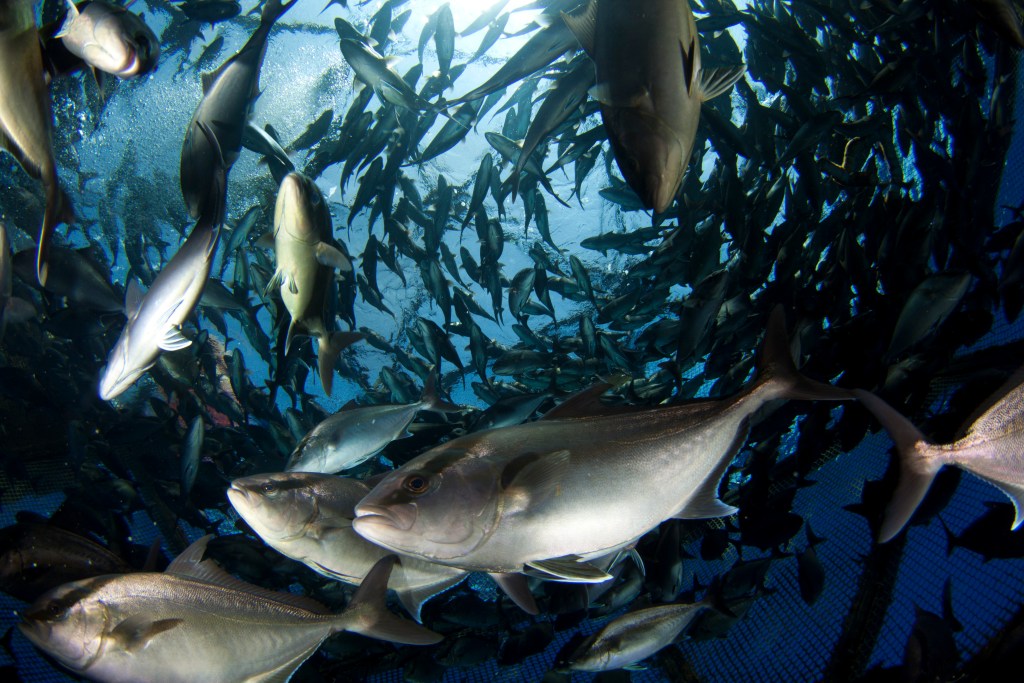
Hawaiʻi is home to the country’s only commercial offshore aquaculture facility, Blue Ocean Mariculture, which Sims started as a demonstration project in 2001. The farm raises sashimi-grade Hawaiian Kanpachi, longfin yellowtail, in up to 240-feet deep waters less than a mile off Kona’s coastline.
If the MARA Act passes, several more facilities could join it. Integral to the act is establishing demonstration aquaculture operations and regional offices, which will report their research, findings and progress to a central office under the National Oceanic and Atmospheric Administration.

That office would then streamline permitting for aquaculture activities in federal waters. It also would be in charge of ensuring compliance with several environmental protection laws and the use of minimal antibiotics and pharmaceuticals, as well as requiring partnerships with sea- and land-grant universities, among other obligations.
The bill would establish a $125 million workforce development grant program, from 2026 until 2030, which includes grants related to education and curriculum development. A further $100 million in cost-sharing grants would be allocated to the aquaculture and commercial fishing industries.
Sims said the industry wants people to see jobs being created, aquaculture products on the market — and to see it done on a commercial scale. That would also better illustrate any environmental impacts.
“If you’re trying to measure the environmental impact of a dairy farm, you don’t run around behind one cow. That doesn’t help,” he said. “You need to have an actual farm. So these farms will be permitted for commercial scale but they will be very rigorously monitored.”
Environmental groups support the bill, particularly as wild fish stocks continue to suffer from overfishing. Technological advances and more environmentally friendly practices have softened perceptions, too.
The Environmental Defense Fund is among the supportive groups, seeking well-researched and scientifically robust evidence for growing seafood offshore to support ocean health and address food security issues.
“Addressing the climate crisis requires bold, science-driven solutions — including how we produce food,” Maddie Voorhees, the fund’s U.S. aquaculture campaign director, said in a press statement. “Seafood is a climate-smart protein with a lower carbon footprint than many land-based alternatives, but we know wild fisheries alone can’t meet rising global demand.”
So, she said, the bill’s focus on researching the best methods of fish production is particularly important, especially to minimize any environmental impacts.
‘Spinning Wheels’ To Boost Fish Production
Hawaiʻi’s history of aquaculture production traces back to Native Hawaiian fishponds, called loko i’a, which produced approximately 2 million pounds of fish annually from 400 ponds in the late 1700s.
In more recent decades, Hawaiʻi has been host to some of the biggest innovations in national aquaculture production. But the $65 million industry’s growth has been stifled, according to both Hawaiʻi and national fish farmers, by burdensome regulations on both the state and federal level.
And while experts often criticize the state for its cumbersome regulations and lack of investment in the industry, the industry is hopeful this legislation – if successful – will prompt change on the state level.
Sen. Glenn Wakai of Oʻahu been among the state’s critics, calling the state agriculture department “more of a foe than a friend” to the aquaculture industry, which he believes could easily outperform the rest of the state’s agricultural economy.

Wakai’s advocacy this year helped the Department of Agriculture and Biosecurity secure more four positions for aquaculture specialists, who are currently being hired. Still, it’s been a “lonely effort, spinning wheels,” to get the state to recognize the industry’s potential, Wakai said.
The state is already home to leading education and research institutions for marine sciences, which continue to develop curricula to focus on sustainable fisheries management. The University of Hawaiʻi on Wednesday announced a new Pacific Islands-focused center for graduate students to learn and meld Indigenous and Western fisheries management.
Now, Wakai hopes, the federal government could lead the way for Hawaiʻi on aquaculture, so those students will have a place to work after graduation.
Hawaiʻi’s $65 million aquaculture industry is the seventh most valuable in the country, according to the U.S. Department of Agriculture’s 2023 aquaculture census. Algae is the most lucrative aquaculture product in the state.
Mississippi, the leading state, was more than four times as large, worth just shy of $267 million, predominantly from catfish. Mississippi produces about 65% of the national catfish supply, though Magnolia State senator Wicker — who co-sponsored the bill — says there is still too much red tape.
The ultimate goal may not be to reach the production levels of nations like China, Vietnam, Norway or Ecuador, former Blue Ocean Mariculture CEO Dick Jones said. Jones, now CEO of the Tidepoint Group consulting firm, said the country will have to decide.
“I think what we want to do is do it right, and do it strategically, and at least start to build systems people can feel really good about,” Jones said. “It’s not going to reach a level that is China, and I don’t think we want to be there, but we ought to be doing it in the best way possible here, for the environment that we have.”
Wicker and Schatz sponsored a similar bill in 2018, known as the Advancing the Quality and Understanding of American Aquaculture Act — AQUAA.
Trump has shown support of offshore fish farming in the past, signing an executive order during his first term that called on NOAA to identify “Aquaculture Opportunity Areas” in federal waters. The first two areas were in Southern California and The Gulf of Mexico.
“Hawai‘i Grown” is funded in part by grants from the Stupski Foundation, Ulupono Fund at the Hawai‘i Community Foundation and the Frost Family Foundation and “Hawaiʻi’s Changing Economy” is supported by a grant from the Hawaiʻi Community Foundation as part of its work to build equity for all through the CHANGE Framework.

