Honolulu Overtime Pumps Up Pensions, Costs Taxpayers Hundreds Of Millions
The police department, where access to overtime is also leading to an increase in early retirements, accounted for 60% of pension spiking costs in the last seven years.
Public pension spiking fueled by Honolulu employee overtime has cost taxpayers a quarter of a billion dollars over the last seven years, based on department-by-department data the county provided to Civil Beat.
Spiking hit an all-time high of $46 million after the pandemic began, in fiscal year 2022, but continued to burden taxpayers last year with $35 million in costs. That’s more than double pre-pandemic spiking costs and larger than the entire annual budgets of some county departments.
“It’s unfortunate, and it’s improper,” Thomas Williams, executive director of the Hawaiʻi Employee Retirement System, told Civil Beat. “The stability of the fund is everyone’s responsibility, and so if anyone takes advantage of it, it’s to the harm of those who remain.”
While most county departments experienced some pension spiking, it was most pronounced at the Honolulu Police Department, which accounted for 60% of the county’s costs in the last seven years, according to the data.
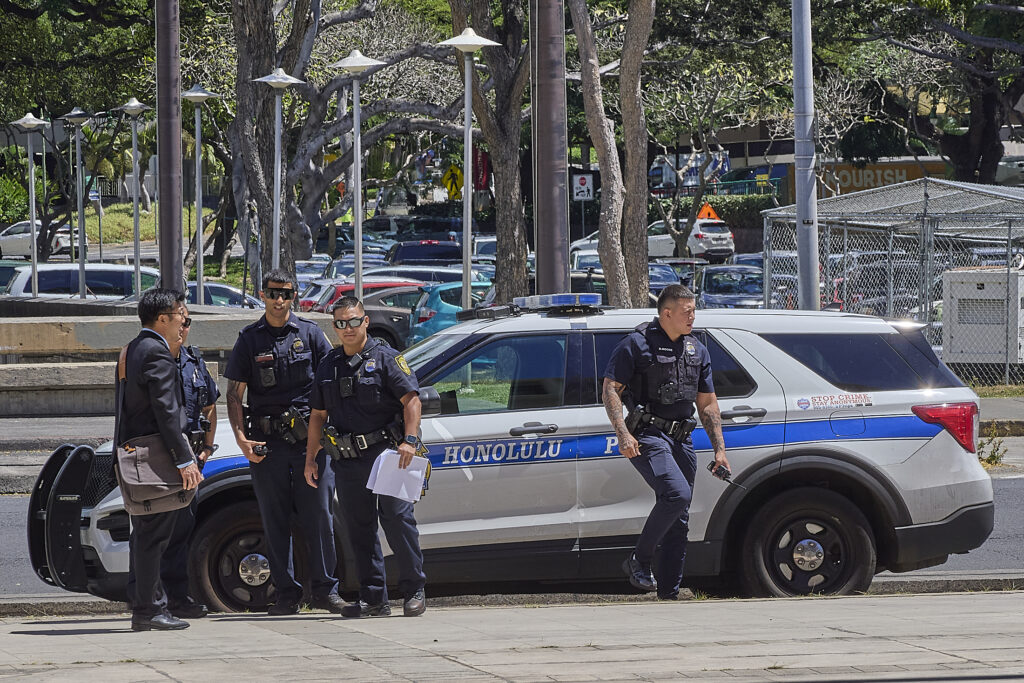
HPD’s use of overtime has attracted criticism recently and was a topic of discussion at Wednesday’s Police Commission meeting. Dozens of officers logged an extraordinary 1,000 or even 2,000 extra hours last year, setting some of them up for generous retirement payments they’ll enjoy the rest of their lives.
At the commission meeting, interim Chief Rade Vanic faced more praise than pushback about the department’s heavy reliance on overtime, even though the added pension costs come directly out of HPD’s own budget.
The police union told Civil Beat that officers are just doing their jobs and consider overtime usage ultimately a management decision for which they shouldn’t be blamed.
“They’re wondering: ‘Why are we getting heat for doing this?'” said Nick Schlapak, president of the State of Hawaii Organization of Police Officers.
Overtime is being used because of a severe officer shortage, said Dustin DeRollo, a SHOPO spokesman. There are 460 open positions.
“If it wasn’t, we’d have no officers in the field,” he said in an interview. “Response times would be through the roof. It would be a dangerous situation.”
Pension Spiking Surged During Pandemic
For more than a decade, government employers have been required to pay the pension system when employees experience a sudden and significant jump in non-base pay ahead of their retirements. Pension payments are based on an employee’s average compensation in their last few years of work. When non-base pay exceeds 10% or 20% of an employee’s average compensation, employers have to pay up.
Covid-era hazard pay is considered non-base pay that is factored into the spiking calculations, according to Williams. But overtime is the main factor, he said. The two are linked, however, since the pandemic triggered the need for more overtime in part due to mass retirements and growing vacancies, according to Honolulu budget director Andy Kawano.
The county already contributes a percentage of employees’ paychecks to their pensions. Payments for spiking are an added cost. For excess pension costs to go beyond $40 million again would not be sustainable, Kawano said.
“It is a significant chunk of money,” he said.
Going forward, Kawano said pension spiking should decrease. In 2012, state legislators changed the law so that overtime would not be considered in government employee pension calculations, but the law only applied to new employees. For those hired pre-2012, it’s up to department management to control overtime.
Even a small number of “spikers” can have a big financial impact, however.
HPD Officer Darren Cachola, who has a history of alleged misconduct, made $371,105 this past year before retiring and will make a reported $10,000 a month in retirement, according to Hawaiʻi News Now.
Chief: Overtime Is Fueling Early Retirements
The police department has increasingly relied on overtime in recent years as it has struggled to hire and retain enough officers. Kathleen Lee, an HPD spokesperson, also noted the department committed in 2018 to putting more officers on the street, and meeting that goal has required more overtime.
HPD spent more than $58 million on overtime in fiscal year 2025, nearly three times as much as the agency spent a decade ago. A city audit in 2022 flagged HPD’s overtime system as expensive and vulnerable to fraud, but overtime since then has only continued to trend upward.
Ironically, the use of overtime itself may be contributing to the department’s staffing issue, Vanic said on Wednesday.

The longer officers stay on the force, the higher their base pay. In the past, when overtime usage was lower, Vanic said, officers were incentivized to continue working to maximize their post-retirement pay.
Overtime changes that calculation: More overtime drives up their pension, incentivizing them to retire earlier.
“It’s just very lucrative to not stay anymore,” Vanic said.
And it’s not that hard to build a significant amount of overtime hours, Vanic said. Two extra 13-hour shifts every week throughout the year would easily put the officer up to over 1,000 hours in overtime. More than 100 officers racked up that amount between July 2024 and June 2025, according to data reviewed by Civil Beat. With those 26 hours, Vanic said a Honolulu police officer close to retirement can bump up their annual salary to more than $200,000 a year.
The department is trying to find ways to use technology to reduce reliance on overtime. Vanic said that in a meeting with prosecutors this week, officers talked about the potential of using artificial intelligence to write police reports. The department is also working on a system to make it easier for supervisors to see who is working lots of overtime and distribute hours more equally.
And HPD leadership wants to find ways to keep officers around. Officers who retire at 50 years old instead of 57 can move on to lucrative second careers, Vanic said, making hypothetically $100,000 as the director of security at a hotel. To prevent that and keep officers in critical roles at HPD, Vanic said the department needs to look at how to retain officers after they retire.
One option, he said, is through the city’s 89-day hire, which would allow retired officers to rejoin the force on a contract basis while still retaining their pensions.
“Let’s pay them that $90,000 paycheck, because we can,” Vanic said. “Why not?”
When asked by commissioners, Vanic said the department leadership could impose a cap on overtime hours for an individual officer. Commissioners didn’t push him to explain whether he would.
Vanic said it depends on whether officers are working so many hours that they’re running into problems doing their job, like getting in accidents, coming to work tired or receiving complaints.
“If the answer is yes to all of those, absolutely,” he said. “If the answer is no, then maybe we don’t.”
‘They’re Working’
Williams, who has worked at the Employee Retirement System for a decade, said some agencies favor retirement-age workers for overtime assignments.
“There has been this historic practice, culturally, in some organizations that overtime is allocated to the more senior individuals, and those are typically the people with higher pay and who are closer to retirement,” Williams said.
Schlapak pushed back on the idea that officers are trying to take advantage of the system.
“I don’t think it’s as malicious as it may be made out to be,” he said.
For one, only patrol officers are eligible to work overtime on patrol shifts, limiting the pool of potential takers. And not everyone wants to sign up, Schlapak said. The younger generation especially values work-life balance, he said. More senior officers closer to retirement may be more likely to volunteer.
“Overtime is given out fairly and equitably,” he said. “You cannot discourage someone from working overtime simply because they happen to be senior in rank or in time in the service.”
He noted that some of the officers raking in the most overtime were hired after the state law was changed in 2012, meaning their overtime isn’t a factor in their pension. One example is Eric Reis, who tops the list of sworn officers who collected the most overtime last fiscal year, but is newer to the force, according to Vanic.

Ultimately, it’s on department leadership to manage overtime, DeRollo said.
“They’re being offered an opportunity to work,” he said. “They’re saying yes.”
The bottom line, Schlapak said, is officers are working hard and providing a public service.
“I don’t see spikers making this money and not earning it,” he said. “They’re working. It’s as simple as that.”