Nonprofits Help Maui Fire Survivors Overcome Obstacles And Return Home
Private aid groups are stepping up to help rebuild homes lost in the 2023 wildfires at no cost to the property owner.
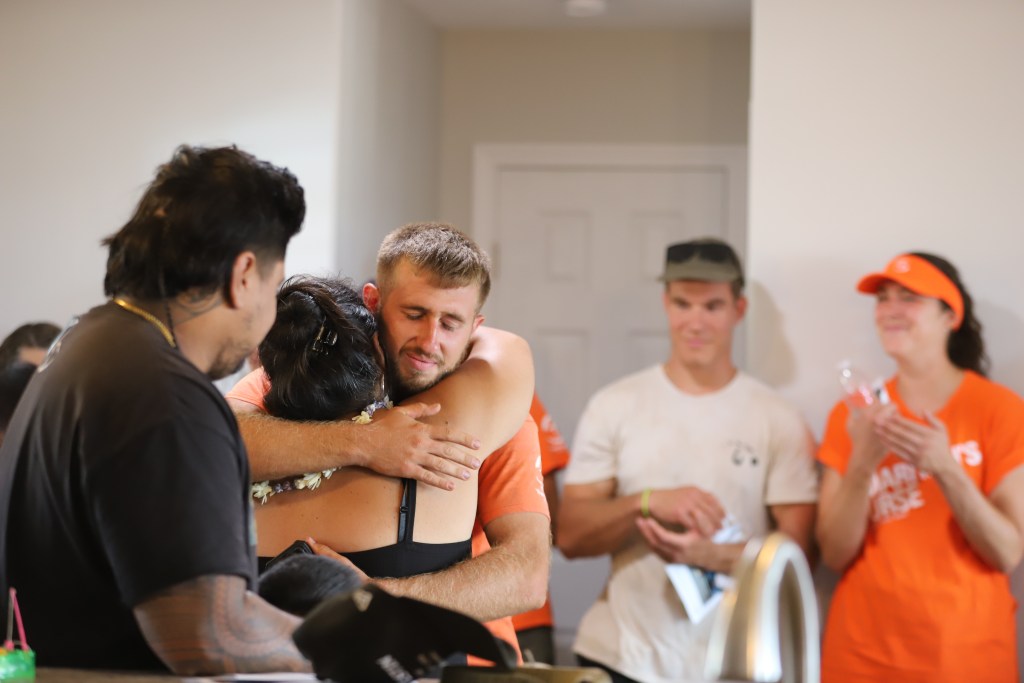
Holding the keys to her brand new house in Lahaina’s Wahikuli neighborhood, Rose Padua blinked back tears and looked around the kitchen at roughly two dozen volunteers.
“These are happy tears,” she said, smiling and brushing aside a few strands of dark hair that had escaped from the bun on top of her head.
Padua, who works at a store inside one of the local hotels, repeatedly thanked the volunteers, a combination of locals and visitors affiliated with the nonprofit Samaritan’s Purse, for building the house and giving her family the opportunity to return to their property for the first time since their longtime home burned down in the Aug. 8, 2023 wildfire. As she spoke, her family embraced and nodded in agreement.
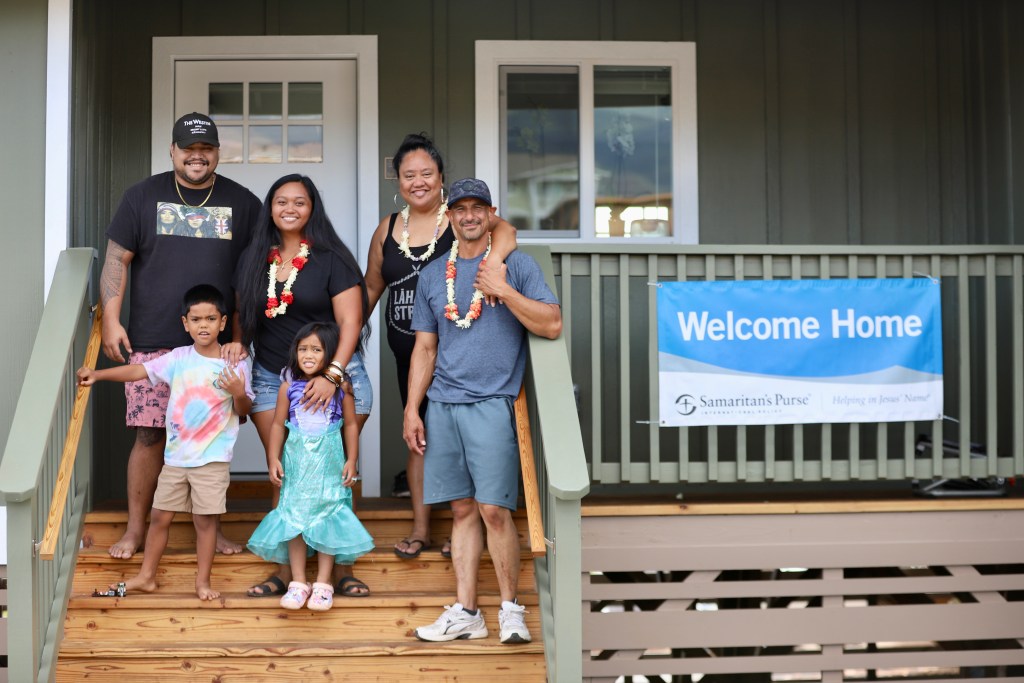
The Padua family’s new house is one of roughly 50 residential structures that have been rebuilt in Lahaina since the deadliest blaze in modern American history leveled much of the West Maui town. Nonprofit groups have built or are in the process of rebuilding several dozen more at no cost to the property owners, according to nonprofit leaders.
Rhonda Alexander-Monkres, executive director of Ho‘ōla iā Mauiakama Disaster Long-Term Recovery Group, said nonprofits have played and continue to play a significant role in the recovery process to help people achieve housing stability.
“They’re like the silent warriors and helpers in the background that help the families to move forward in their recovery time,” she said.
Only a small percent of more than 2,200 structures destroyed by the 2023 wildfires have been rebuilt, and several hundred Lahaina homeowners are still working through the permitting and construction process. Others have yet to submit building plans for review.
But nonprofits — working independently or in collaboration with government agencies and each other — have built a significant portion of the completed homes and have given longtime local families the opportunity to be among the first to return to their properties in Lahaina. For some, the biggest challenge has been connecting with the people who need help.
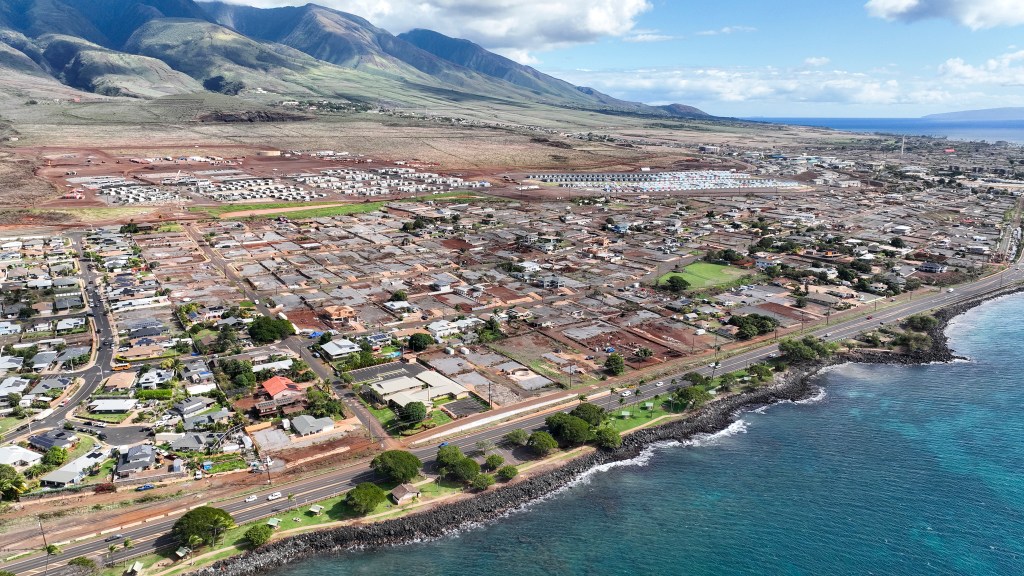
It’s often wealthy property owners who are the first to rebuild after a disaster, said Matt Bachman, executive director of the nonprofit Habitat for Humanity’s Maui chapter. So it’s notable that less privileged residents have also been able to start moving back thanks to the help of nonprofits, he said.
“Especially because our housing costs are so much higher even than the other islands, it’s the nonprofits that had to really step up to help,” Bachman said.
Habitat for Humanity, which has been operating on Maui for more than 25 years, had built 10 of the homes on Komo Mai Street in Lahaina that were destroyed by the fire, Bachman said. The group — through a partnership with Hawai‘i Community Lending, Ho‘ōla iā Mauiakama Disaster Long-Term Recovery Group, Mennonite Disaster Service and Lahaina Community Land Trust — is in the process of rebuilding six of those homes for the families who lived in them, and it’s rebuilding a seventh to use as accommodations for volunteers who travel to Lahaina from the mainland or other parts of the state.
The organization typically works with households that make 80% of the area median income or less, but because the damage caused by the 2023 fire was so devastating, they are including households with incomes up to 100% of the area median income, he said.
“We are there to really show them that there’s still a path home,” Bachman said.
The group primarily relies on insurance payouts to fund the rebuilding of the houses, but if the cost comes out higher the nonprofits absorb it so it remains free to the homeowners, Bachman said. The cost is expected to be kept down to between $300 or $400 per square foot — much cheaper than the average rebuild cost of $550 per square foot.
Through collaborations with other local nonprofits, government agencies and businesses, the groups are also able to pool resources, negotiate material prices and more easily maneuver through the permitting process, he said.
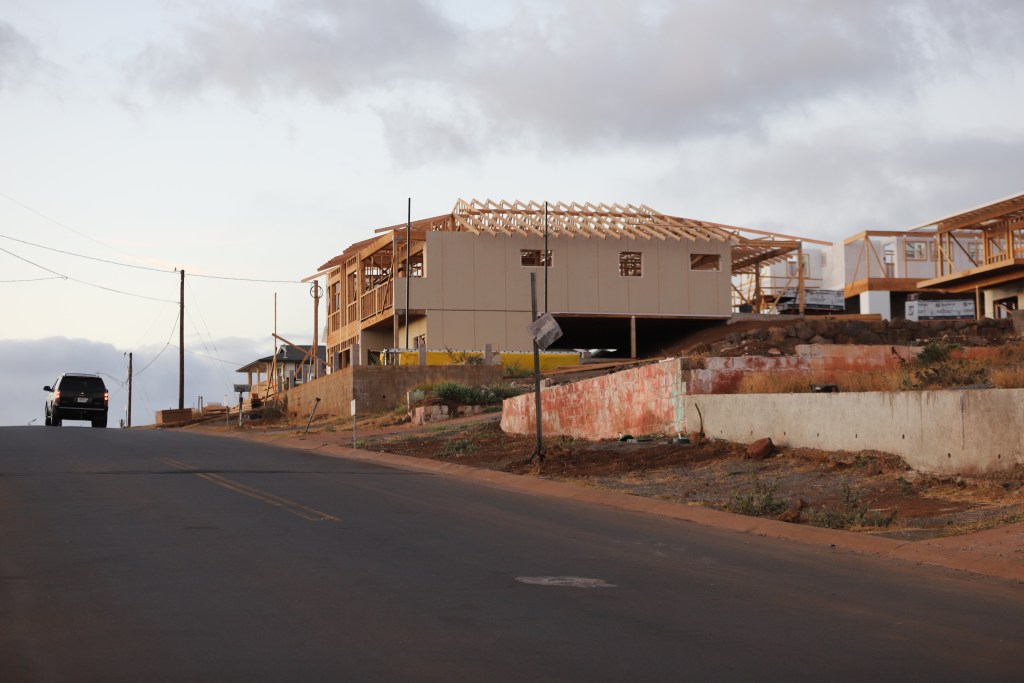
Alexander-Monkres said those partnerships are crucial, and have shown survivors that the road may still be long to return home but there is a path to do so.
“What we have found is that magic happens when you bring people together in these coalitions to help solve some of the most complex and biggest problems, and it’s really rewarding for everyone involved when we can come out on the other side of the mountain and and see possibility and see hope,” she said.
Volunteers from Samaritan’s Purse, an evangelical Christian organization that responds to crises across the globe, have completely rebuilt at least six houses on Maui. As of June, the North Carolina-based group was actively constructing more than a dozen more homes in the burn zone, with an additional 24 approved for rebuilding, according to a statement from the organization.
Padua — whose household includes her longtime partner, her 29-year-old son, her son’s girlfriend and her two young grandchildren — said even though the family had paid off their mortgage years ago, she didn’t know how they would have been able to afford rebuilding without the help of Samaritan’s Purse.
“We knew we were going to come back. We just didn’t know how or when,” she said.
Chris and Gina Palacio were in a similar situation. They had been determined to rebuild after their property on Aulike Street was destroyed during the fire, and Chris Palacio said Samaritan’s Purse gave them the resources that they needed to do it.
Returning Home
At the time of the wildfire, Padua was living with her family in the same 800-square-foot ranch-style house on ʻĀinakea Road where she grew up. It was far from perfect — the roof leaked, hot water ran out frequently, there were a host of electrical problems to address and seven people spanning four generations were crammed into its three bedrooms, she said.
Still, it was home.
“It was rundown and old,” Padua said. “But everyone was welcome at that house.”
The new house on the same property was totally different. Everything from the appliances to the cabinets to the sage green paint covering the outside of the house looked modern and new, and sunlight poured in from large windows in almost every room. Even the front door was facing the opposite direction, which Padua had requested so that she could watch the sunset over the Pacific Ocean.
Kimo Stone, Padua’s boyfriend, said everything was “amazing, amazing, amazing.”
Last week, the neighborhood was brown and dusty, with only a few completed homes dotting the landscape. But Padua fondly recalled how lush foliage and fruit trees once lined the streets, and how many of the local families had been there for decades.
“Everyone knew everyone,” she said.
Padua and her family said that they hope to one day have that sense of community again.
“We’re just hoping to see many of our friends and family return,” Stone said, adding that many of their neighbors were left with nothing after the fire. “We can’t imagine how long it’s going to take, but we just hope to see within the next five to 10 years that they get their properties restored.”
In the meantime, Padua and Stone said they were excited to finally move out of the Honokowai apartment complex where they had been renting a unit, and they were grateful to officially have a place to call home for the first time in more than two years.
“It still feels unreal because we were gone for so long. It’s a shock,” said Stone. “The reality of it — that we’re home — hasn’t set in.”
One week after moving in, Padua said they were eager to unpack and just enjoy each other’s company but that it would take time to resettle into their old neighborhood.
“It’s been kind of strange to have it so quiet, because our street is normally a very busy street and there’s a lot of people who like walk to work and everything like that,” she said. “That’s one thing that has been very different.”
For Padua’s grandchildren — a 5-year-old boy who was holding toy cars in both hands and a 3-year-old girl who ran around the house wearing a mermaid costume — it would be the first time in their lives that they would remember having a permanent place to live.
As Padua said: “My grandbabies finally have a place to just be kids.”
Civil Beat’s coverage of Maui County is supported in part by a grant from the Nuestro Futuro Foundation.