2 Years After Deadly Fire, Lahaina Struggles To Rebuild
Homeowners are running into big gaps between their insurance payouts and the cost to rebuild.

Bit by bit, Jeremy DelosReyes is rebuilding his house in the Lahaina neighborhood he’s called home his whole life. Or at least he’s trying to.
The ʻĀinakea Street house the carpenter shared with his wife and three dogs was completely leveled in the 2023 blaze — the country’s deadliest fire in over a century. They also lost a rental unit on the property that used to provide extra income.
Insurance paid out part of the value of what was lost, around $430,000. But now DelosReyes is on his own. Rebuilding would cost an estimated $1.2 million. And that doesn’t count the roughly $30,000 he’s already spent through the permitting process.
Meanwhile he has to pay his mortgage for the charred property and rent for the couple’s temporary accommodation. He wants to stay in the community where he said his family’s roots go back at least six generations, but he’s struggling.
“Right now, I’m financially … drowned,” he said, and so are others in his community. “We need help.”

On the fire’s second anniversary, Lahaina is in the thick of recovery. Shock has given way to uncertainty about the future as financial constraints hold back the effort to rebuild.
While much of the foundational work of the disaster response is complete — debris has been removed, the water system declared safe — many property owners simply don’t have enough money to restore what was destroyed.
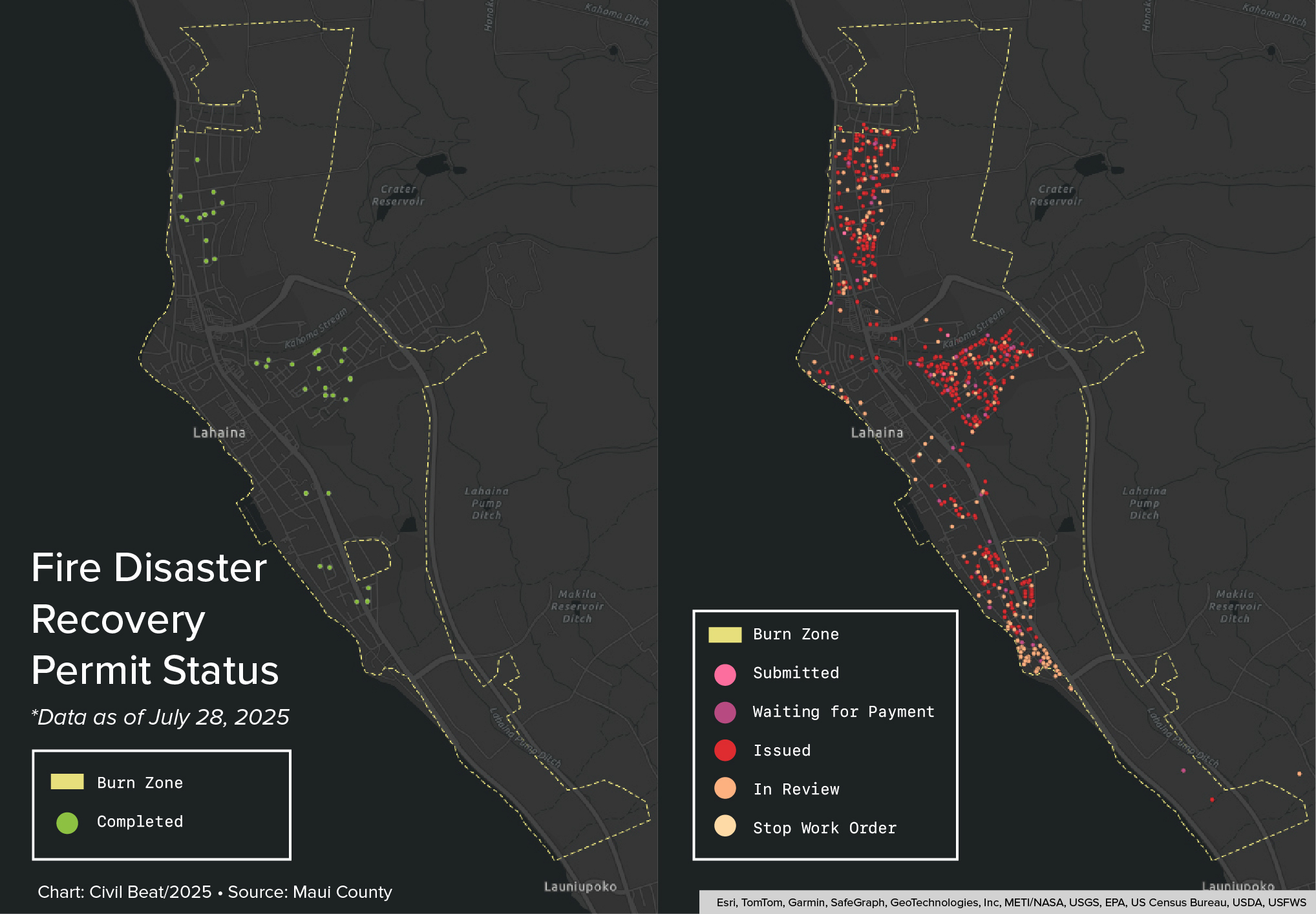
None of the former tourist district’s businesses have been rebuilt. Only 45 residential structures had been rebuilt as of Wednesday, representing only 2% of the homes lost in the fire.
More than 330 applications are in the permitting process and over 400 other projects have been permitted — a rate of permitting faster than that of some other megafires.
But hundreds of other Lahaina homeowners have not yet submitted building plans for review. Some are trying to find ways to work with what they have, said Brandy Cajudoy, a general contractor and member of Maui’s long-term recovery group.
“Many people have tried to build smaller because that’s all they can afford,” Cajudoy said. “But is smaller better? Because if you had 10 people, you still need to be able to have a house for 10 people.”
That’s a major challenge in a county whose goal is not just to rebuild structures but bring back the community that was there before.
“The number one ask of the community,” Mayor Richard Bissen told Civil Beat, “when you ask them what they wanted, they just wanted to be with their neighbors.”
Two financial relief opportunities are in the pipeline. The county is kicking off a new federally funded recovery program this month. And individuals could start receiving lawsuit settlement money as soon as the end of this year, although it’s not clear exactly how much each person will get. Those kinds of cash infusions could make a difference.
After the devastating 2018 fire in Paradise, California, the landscape was dotted with trailers, temporary homes for residents who didn’t yet have the means to rebuild, said Jennifer Gray Thompson, CEO of After The Fire, an organization that helps communities navigate their recoveries after megafires.
After the utility PG&E started paying out a multibillion-dollar lawsuit settlement, Thompson said those trailers started to disappear.
“That’s all they were waiting for, to see if they had enough,” she said. “A hundred thousand dollars for many people is the difference between getting home, or rebuilding your business, or not.”

For now, some families are living in limbo.
Theodore King lost three houses — one he lived in and two rentals. And equipment from his personal watercraft business was “vaporized.” Insurance paid off his mortgage, he said, but not much money was left, certainly not enough to rebuild.
He’s now living in a tiny home on his property with his son until he figures out his next steps.
“I’m just going to wait,” he said, “and see what happens.”
‘Lahaina Still Needs Help’
In Cajudoy’s experience, the average insurance claimant is getting around $300,000 to $500,000, but building a home can cost around $600,000 to $700,000.
Insurance policyholders sometimes forget to update their policy periodically to reflect the current value of their property, she said. And as the cost of rebuilding gets ever pricier in today’s economy, that would need to be factored in.
“In the past 10 years, if they never looked at it,” she said, “it was only covering the value from years ago.”
Some didn’t have homeowners insurance at all. People without mortgages – who perhaps paid off their homes or inherited family property – aren’t required to. Aside from up to $41,000 from the Federal Emergency Management Agency and charitable donations, Cajudoy said: “They have absolutely nothing.”
Meanwhile, the bills don’t stop.
“People still have to pay mortgages for places they can’t even live in,” West Maui’s state Sen. Angus McKelvey said.
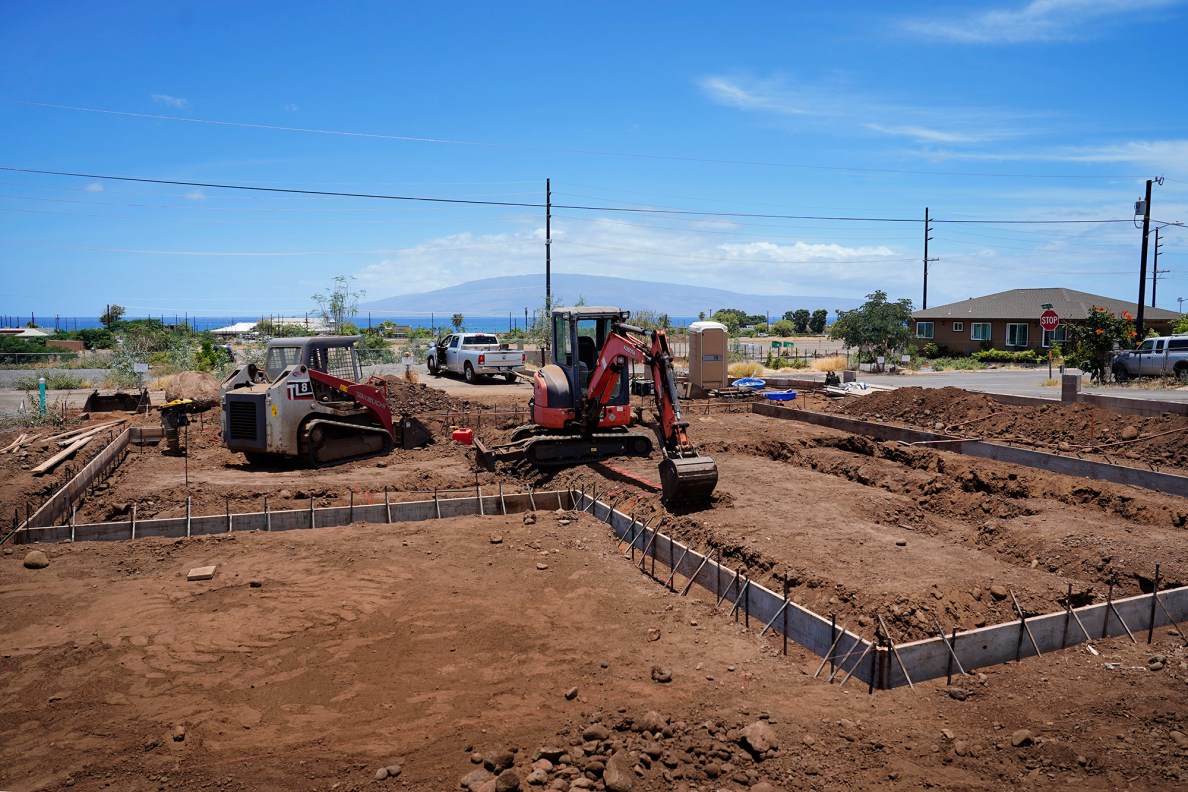
Those kinds of financial gaps are often the biggest barriers for megafire survivors who want to rebuild, according to Thompson.
The other obstacle, of course, is trauma.
“There’s a lot of people who will not pick their heads up until maybe year three, and it’ll be like, OK, maybe I can deal with this now,” she said. “Your fire was particularly traumatizing.”
Longtime Lahaina resident Joe Pluta survived the fire by jumping out of his window. His home burned down as he escaped. Wanting to rebuild, and with the insurance coverage to do it, he started consulting with architects about building plans. But the process was too daunting, especially watching a neighbor hit roadblocks of their own.
“I’m 76 years old. Do I want to spend the next year of my life, with the way that things are all so hard to do, stressful and stuff like that? No, I don’t,” he said.
“Not only that. But when I drive through my neighborhood, I become so sad, and several times, without any notice or warning to me, I just started crying. Uncontrollably. It’s unbelievable. It’s like a wave of misery. And it’s so sad up there because some of my neighbors are dead.”
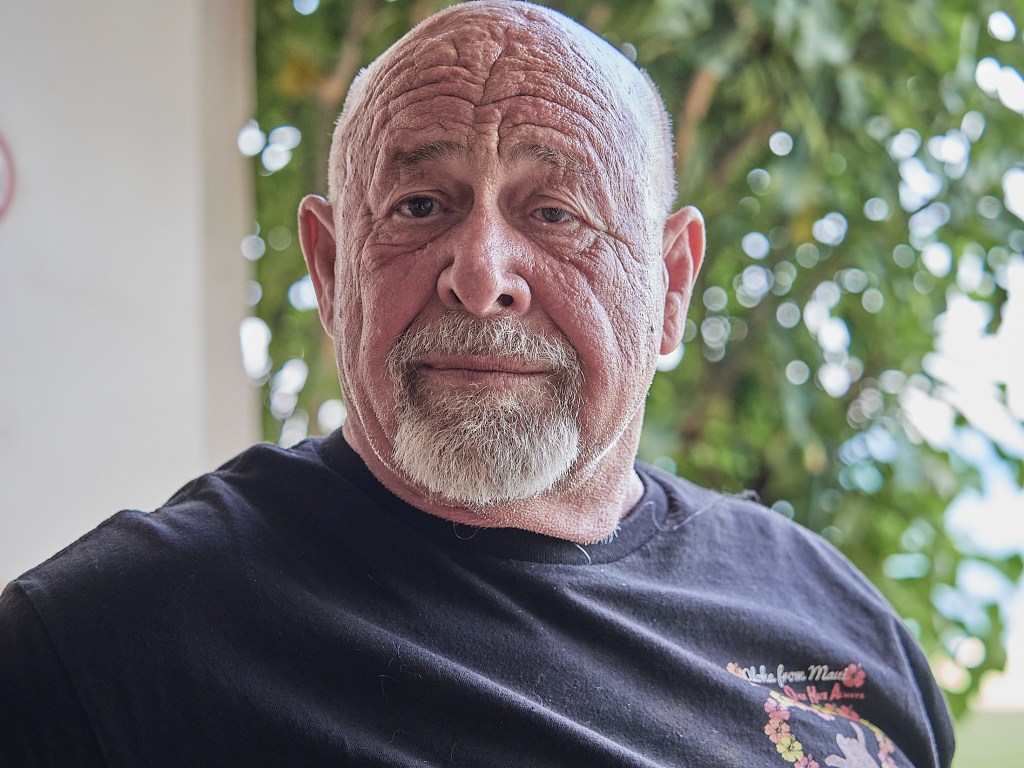
Pluta decided to sell his property to a neighbor and is renting a place nearby.
Those with the financial and emotional wherewithal to rebuild have to contend with additional challenges in the mundane yet vital aspects of home construction. That’s made tougher in a historic district vulnerable to sea level rise in one of the more remote places on Earth.
Early on, there were problems sourcing cement, Cajudoy said. Now, there’s a shortage of trusses. Orders for windows are backed up. It’s hard to find a carpenter. Owners may need to hire archaeologists or environmental consultants that cost thousands or even tens of thousands of dollars.
“I think there needs to be a recognition that the money needs to go not to consultants, but to the rebuild,” said McKelvey, a renter whose own home burned down in the fire.
Meanwhile, the costs of labor and materials, like drywall, continue to rise amid tariffs.
“Now all of a sudden you’re seeing material costs skyrocketing,” McKelvey said. “Imagine trying to rebuild your life on top of that.”
Maui’s construction labor force already had a worker shortage that Rick Nava, a Lahaina community advocate who lost his home in the fire, believes has been exacerbated by recent Immigration and Customs Enforcement activity.

“They’re hiding,” he said.
Oceanfront property owners have to contend with modern rules around building where sea levels are set to rise — that’s if they can overcome community opposition at required public meetings.
There are also concerns about unscrupulous contractors taking owners’ money and not finishing the job.
McKelvey said he’s tried to relieve some of the burden on fire victims at the Legislature. He proposed concessionary lending programs and mortgage forbearance for impacted property owners. That legislation didn’t pass.
“People need the ability to have immediate access to capital so they can absorb this and rebuild,” he said. “We’re so not out of the woods yet. Don’t forget about Lahaina. Lahaina still needs help.”
Hope On The Horizon
Lahaina is at one of the hardest stages of recovery right now, Maui Recovery Director John Smith said.
“But as we get through this next year, you’re going to see more and more hope as we move forward because we have a plan and we have funding,” he said. “It adds a level of surety to how we move forward.”
A lot of foundational work has been done in the two years after the fire to allow for development to get going.
As of February, all debris was removed from the town’s residential and commercial properties. It is now almost halfway through the process of a monthslong journey inland, truck by truck, to central Maui.

The water system was deemed clear of contamination a year after the fire, and the county water department now can hook properties back up to the county system upon request within a week or two, the water department’s deputy director James ‘Kimo’ Landgraf said, although he acknowledged some take longer. As of April, the sewer system was 100% restored.
The county has also purchased some properties that will enable officials to create wider evacuation routes in the event of a future disaster. Many of the dead in Lahaina were found in the area of Kuhua Camp. A federal government study found that nearly three dozen people who perished because they could not get out might have survived if there had been a better route.

The county hired a third party, 4Leaf, to handle building permits, which has sped up average processing times for disaster recovery projects from about a year pre-fire to three to four weeks, according to the county.
Notably, payouts from a $4 billion lawsuit settlement are expected to come through around the end of the year. The details are still being ironed out, but the state of Hawaiʻi, Hawaiian Electric, Maui County, Kamehameha Schools, West Maui Land Company, Charter/Spectrum and Hawaiian Telcom are expected to contribute to the payouts. Recipients will include people who were present during the fire, lost a family member or suffered losses to property or businesses.
This month, the county also will begin rolling out a set of federally funded programs to provide up to $600,000 to people who lost their homes in the fires, including money for first-time homebuyers.
For those who want to sell, organizations like the Lahaina Community Land Trust are on hand to ensure Lahaina lands stay in Lahaina hands.
Philanthropic resources also are available to help people. Charities including Habitat for Humanity and Mennonite Disaster Service are rebuilding homes free of charge. And the Ho’ōla iā Mauiakama Disaster Long Term Recovery Group can help provide gap funding up to $400,000 for the uninsured and underinsured.

“We’re here to help,” Cajudoy said. “I feel like people who have no insurance feel like there’s no way to rebuild and I want them to know there is hope. There are donor dollars to get them home.”
A Family’s Journey Home
Chris and Gina Palacio were the recipients of charitable help from Samaritan’s Purse, an evangelical Christian disaster relief organization. The family home was precious to Chris Palacio, who worked to buy it by holding down two jobs, at the Ritz-Carlton in Kapalua and the Times Supermarket in Lahaina.
Palacio struggled to find words to describe the pain he felt when returned to his property the day after the fire and realized it was gone. But he was determined to rebuild and give his children the opportunity to stay in Lahaina.
“They want to stay here,” he said. “So I told them, ‘OK, even though I don’t know how I’m going to do it, I’m going to find a way. No matter what.'”
In the months after the fire, he applied for a Small Business Administration loan, Palacio said, and he used an insurance payout to pay off his mortgage. The Palacios used what little remained of the insurance money for roughly $30,000 in planning and permitting-related expenses, but almost nothing remained to put toward the cost of rebuilding.

The family was told they did not qualify for aid programs from FEMA, according to Palacio. The only financial assistance they received came in the form of a $700 check from the federal government shortly after the fire.
The generosity of others allowed the family to move into a new house on their property in July, something Palacio said he will be eternally grateful for.
“We had been in the dark,” Palacio said, “and that time is like lights came back on.”
The new house is very different from the one that the Palacios lived in before the fire, and the surrounding neighborhood remains unrecognizable because so little has been rebuilt. Palacio still gets goosebumps every time he drives through the area on his way to and from work.
Someday, he said, he hopes the neighborhood will begin to resemble the one that existed before the fire.
“I love my neighborhood. I hope that nobody moves. I hope that everybody can stay,” he said, explaining that most of his family and friends are still searching for a way to rebuild.
“This is a lovely community — not only my neighborhood, but the whole Lahaina. We need more help.”
This article was funded in part by the Maui Strong Fund of the Hawai’i Community Foundation and Civil Beat’s coverage of Maui County is supported in part by a grant from the Nuestro Futuro Foundation.