

Hawaiʻi Charter Schools Need Facilities. Could The DOE Be A Solution?
Charter schools are the only growing sector of Hawaiʻi education, but limited funding and campus space has prevented schools from expanding and meeting families’ demands.
Three years ago, a group of educators went before the state charter school commission with a bold proposal. With the commission’s approval and state funds, they would build the first charter school in Hawaiʻi to specialize in artificial intelligence and data science, operating out of a small campus in Kalihi.
The commission was ready to give the school permission to move forward, but Department of Education leaders were skeptical. Kalihi schools were already struggling with low student enrollment, they said, and nearby DOE campuses offered lessons in technology and engineering similar to the coursework Kūlia planned to offer.
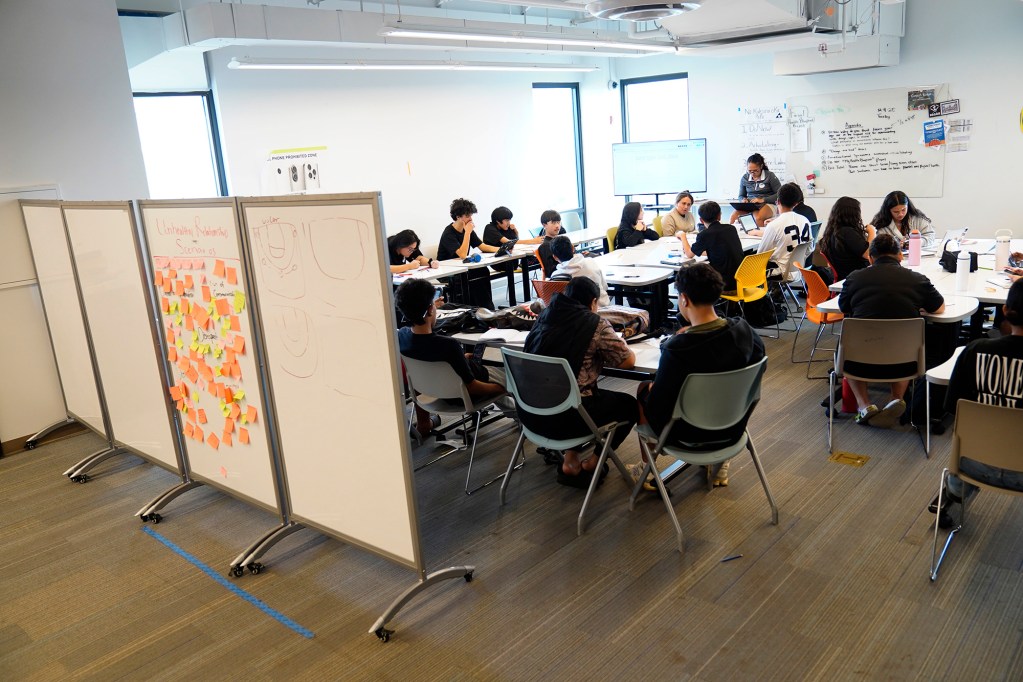
Kūlia Academy, which opened last fall despite opposition from the DOE, already has a lengthy waitlist. The school draws students from across the island and largely appeals to families because of its central location and unique focus on artificial intelligence, school director Andy Gokce said.

“We are on a good trajectory,” Gokce said.
While Hawaiʻi faces shrinking public school enrollment overall, demand for charter schools has continued to grow. Charters have seen nearly a 10% jump in enrollment since 2020 — the only sector of Hawaiʻi education to report continued growth since the pandemic. Even as the state considers closing some small public schools, charter schools are building campuses everywhere from urban Honolulu to the north shore of Kauaʻi.
Three decades after educators and families launched Hawaiʻi’s charter school movement, 40 schools have emerged across the state. But charters and the DOE have often operated in silos, with some principals believing the two systems need to compete for students and resources.
Some charter school leaders say now is the time to collaborate with the DOE. Public schools are facing increasing turmoil and uncertainty around their resources as the federal government moves to dismantle the Department of Education, and Hawaiʻi’s shrinking student population means less funding for schools, whose budgets are closely tied to enrollment.
Charters aren’t guaranteed their own campuses, meaning schools need to find affordable, safe facilities that can accommodate hundreds of students at a time. Schools have operated out of tents, old offices and former restaurants when space is scarce, sometimes searching for years for permanent facilities that can keep up with their growth.
While the state education department received more than $320 million for the maintenance and construction of its schools this year, funding for charter facilities primarily comes out of principals’ annual budgets, which also cover teacher salaries, classroom resources and other expenses.
Allowing charters to share campus space with shrinking DOE schools would create more educational options for families, educational advocates say, while maximizing the use of state facilities. They say closer proximity to DOE campuses could encourage more partnerships between the two school systems, allowing charters to share their innovative approaches to learning and family engagement.
But even directives from lawmakers for state agencies to share their facilities with charters has failed to produce more partnerships between charters and the DOE. The education department has even argued in some cases that open campus space should be converted to state offices or leased for profit instead. Lawmakers and DOE leaders have also said charter school growth can come at the expense of traditional schools that are already struggling with shrinking student populations and tight budgets.
Ongoing concerns about enrollment shouldn’t prevent charters from growing in areas where there’s high demand or need, said David Sun-Miyashiro, executive director of HawaiʻiKidsCAN. Since charter schools enroll students across the island and attract a variety of families, their growth doesn’t necessarily directly hurt local DOE schools, he said, especially when they have unique programs that aren’t offered elsewhere.
“When I think about the new schools that have opened over the last five to 10 years,” he said, “they all bring something that’s really unique and complementary to the local education ecosystem.”
A Win-Win Solution?
At Hawaiʻi Technology Academy’s Kauaʻi campus, students pass a dentist office and a Taco Bell on their commute to their classes, which are taught out of converted offices in a Līhuʻe strip mall.
The unconventional space allowed the middle and high school campus to start small and add classrooms over time as more offices became available, Campus Director Nathaniel Evslin said. But teaching in a strip mall presents challenges: students need to keep quiet as they’re passing businesses between classes, and there’s limited outdoor space for recess.
“We have the insurance agent, we have the orthodontist here,” he said. “So it is a challenge in that respect.”
In some cases, a lack of facilities has prevented charters’ expansion. Enrollment varies widely by school, with roughly half of charters reporting an increase in their student populations since the pandemic and high-demand schools like Hawaiʻi Technology Academy driving the system’s overall growth.

Charter schools spend roughly 15% to 30% of their budgets on school facilities, according to the charter commission, although expenses have escalated much higher for some campuses. Hālau Lokahi, which closed in 2015, spent roughly $33,000 a month on facilities. Before it closed in June, Kamalani Academy used more than half its budget — roughly $39,000 — to rent an old Catholic school campus in Wahiawā.
The DOE, meanwhile, is looking at redistricting some of its schools to avoid closing ones too small to be financially sustainable. Past efforts to shutter small schools have drawn strong opposition from families and teachers, who say the campuses serve as important gathering spots for communities and are a source of local pride.
Some charter school advocates say there’s another alternative to closure that would also help charters: allowing them to share campus space with shrinking DOE schools.
It’s ideal for charters to move into existing schools, rather than build their own campuses from scratch or renovate buildings not created for teaching, said Gokce, who opened Kūlia Academy in another former Catholic school building in Kalihi. Kūlia is looking for additional campus sites as it serves more grade levels, he said, and would be open to renting unused space from the DOE.
Gokce isn’t the only charter school principal to see potential in DOE facilities. In 2017, the School for Examining Essential Questions of Sustainability developed one of the first facility-sharing agreements between a charter school and the DOE, moving onto Kaimukī High School’s campus and teaching middle school classes in unused classrooms and tents.
SEEQS was hopeful it would be able to permanently share a campus with Kaimukī High School, founder Buffy Cushman-Patz said. SEEQS didn’t have to pay rent while operating on Kaimukī’s campus, she said, although the charter school pitched in for small facility projects like installing water fountains.
“We thought it was our forever solution,” Cushman-Patz said.
But within a few years, leadership at Kaimukī and the DOE had changed, and the department said SEEQS would need to leave the high school campus by summer 2021. At the time, DOE was developing long-term plans for Kaimukī’s campus, Cushman-Patz said, although she wasn’t sure what happened to the extra space.
Kaimukī High School’s enrollment has continued to fall since SEEQS left its campus, with enrollment dropping by 20% since 2019, from 668 to 537. The school was built to serve roughly 1,400 students, the Star-Advertiser reported in 2017. DOE is working to maximize its use of campuses and reduce facility costs, said spokesperson Nanea Ching, and Kaimukī High School uses its extra space to house state offices and programs.
No charter schools currently have campus-sharing agreements with the DOE, with the exception of conversion schools that started as department schools and later transitioned to the charter model.
Lawmakers introduced a resolution in 2024 asking for a list of unused DOE facilities and calling for the Board of Education to propose policies to ensure charters could access those spaces. The proposal passed in the House with strong support from charter schools but failed to advance in the Senate.
Shared facility agreements are a win for both DOE and charter schools, said Todd Ziebarth, a senior vice president at the National Alliance for Public Charter Schools. Districts don’t want to close shrinking neighborhood schools, he said, and it’s efficient for taxpayer dollars to go toward maintaining existing campuses that serve both charter and DOE students.
“More often than not, those communities want to keep those schools open,” Ziebarth said. “So I think it prevents them from having to make a really difficult decision that’s going to be unpopular.”
Competing Demands
Hawaiʻi lawmakers have previously tried to expand charter schools’ access to unused state facilities.
According to state law, charters should receive priority to use DOE campuses that are shutting down, unless the department wants to use the space for other educational programs. The Department of Accounting and General Services is also required to survey state departments on a biennial basis to identify vacant facilities suitable for charter schools.
But in practice, opportunities for charters to use DOE facilities are few and far between. DOE hasn’t closed a school since 2011, when it shuttered Queen Liliʻuokalani Elementary in Kaimukī and used the campus to house state offices.
More recently, Rep. Lisa Marten said she inquired about the possibility of Mālama Honua charter moving into unused classrooms at Keolu Elementary, a small DOE school in her district. The principals of both schools supported the idea, she said, but DOE leaders shut down the proposal and turned the empty classrooms into administrative offices.
DAGS’ 2025 survey also found that no state agencies — including the DOE — had facilities that could accommodate charter schools, even though the education department has previously reported excess space in its schools. A 2019 report on DOE facilities had found that campuses had a net surplus of nearly 10,000 classroom seats.
DOE’s resistance to sharing its space may stem from the political difficulties of closing or downsizing a school, only to have a charter school to open in its place, said Tom Hutton, former director of the charter school commission and the executive director of the California Charter Authorizing Professionals. A charter school may enroll students outside of the immediate neighborhood, increasing its enrollment and chances for survival, Hutton said, but it’s still a frustrating process for families to go through.

“You just got through explaining to your angry community why you had to close the school, and the next year, there’s a new school opening in that same site,” Hutton said. “That gives parents whiplash.”
Daniel Larkin, a DOE principal at Kalihi Waena Elementary, said sharing facilities also comes with logistical challenges. Since charters and DOE schools handle facilities differently, principals would need to figure out how to split utility bills or the costs of repairs for shared spaces like bathrooms, he said.
“There’s lots of these little snowball effects that are much more difficult to address given the situation,” he said.
The department has also faced pressure from lawmakers in recent years to make the most of its facilities — not by sharing classrooms with charter schools, but by leasing unused campus space to generate revenue. In early 2020, the department proposed leasing Kaimukī High School’s campus, pointing out that the campus had extra space that SEEQS and state offices were occupying at the time.
While the proposal never came to fruition, it received support from the state education board.
In a legislative hearing last year, DOE administrator Ken Kakesako said the department was open to working with charter schools, but facility agreements would need more details on how schools would share the responsibility of paying for campus expenses.
“I don’t think we’re necessarily opposed to it,” he said, “but we need to look at it in the broader picture of whatever other needs we have to try and save money for the department.”
Limited Space And Students
When it comes to finding charter school facilities, some state leaders have argued the better solution is not to open a new school at all.
Marten supports the possibility of existing charter schools sharing space with DOE campuses or converting traditional public schools into charters. But she said building new charter schools in communities with shrinking enrollment forces more campuses to share limited resources and students.
“Creating a new school for our declining numbers of students doesn’t make any sense to me,” Marten said.
She plans on introducing legislation in January that would allow DOE to convert closed schools into workforce housing, rather than automatically turning vacated campuses over to charter schools.
DOE has raised similar concerns about how the opening of new charter schools could impact public school enrollment. In a few cases, the department has outright opposed the creation of new charters, arguing the campuses would take away students and funding from existing schools or duplicate programs already offered in the DOE.
“The proposed charter school will be in direct competition with our public schools in Wahiawā,” said former complex area superintendent John Brummel in an email to the commission opposing the opening of Kamalani Academy in 2016. The commission went on to approve the opening of the school, which closed earlier this year.
State Public Charter School Commission Director Ed Noh said his team heavily weighs community needs and family interest when deciding whether to approve a new charter school. Since charter schools enroll students from across the island, rather than a single geographic area, Noh said they’re not necessarily competing for the same families enrolled at a nearby DOE school.
At Kalihi Waena Elementary, Larkin said he’s more concerned about losing students to demographic changes, than to charter schools. The Kalihi school, whose enrollment has fallen by 19% since 2020, already lost 15 kids to the mainland this year, Larkin said, and others are moving to West Oʻahu, where more homes are available for their families.
As both DOE and charter schools work with limited resources, some charter school leaders say they want more collaboration between the two systems. For example, DOE offers early college classes and mental health platforms that could benefit charter school students, whose schools might not have the funding to individually contract those services on their own, said Katrina Abes, interim head of school for DreamHouse ʻEwa Beach.

At Kaʻōhao School, a conversion charter in Kailua, director Keoki Fraser said charters can be part of the state’s solution to strengthen public education and increase family engagement. Kaʻōhao, which was once at risk of closure because of its shrinking student population and growing number of families choosing private schools, has successfully enrolled more students from the community since becoming a conversion charter school and focusing on family engagement nearly 30 years ago.
Roughly 70% of the school’s population lives in the surrounding neighborhood, Fraser said, compared to just half of kids when he started as director three years ago.
“Hopefully we’ve done a good enough job where parents have confidence in what we’re doing,” Fraser said. “So instead of sending their kids to different schools or to even private school, they say, ‘Hey, we choose to be home with Kaʻōhao.’”
Civil Beat’s education reporting is supported by a grant from Chamberlin Family Philanthropy.

