Aloha By Zippy’s Stadium? Oʻahu Venue Naming Rights Could Be At Play
To raise revenue for its redevelopment, officials of the Hālawa arena want to join the legions of mainland sports venues named for corporate sponsors.
Foodland Field, ABC Stores Arena, or even 7-Eleven Center — those kinds of options could be on the table if legislators allow Aloha Stadium to sell its naming rights to a corporate sponsor.
Opposition comes from a group that pulled together more than a century ago to successfully ban billboards from places such as Diamond Head and Punchbowl, and anywhere else in Hawaiʻi. Members of The Outdoor Circle today say selling the Hālawa stadium’s name to the highest bidder could send the state down that same old slippery slope.
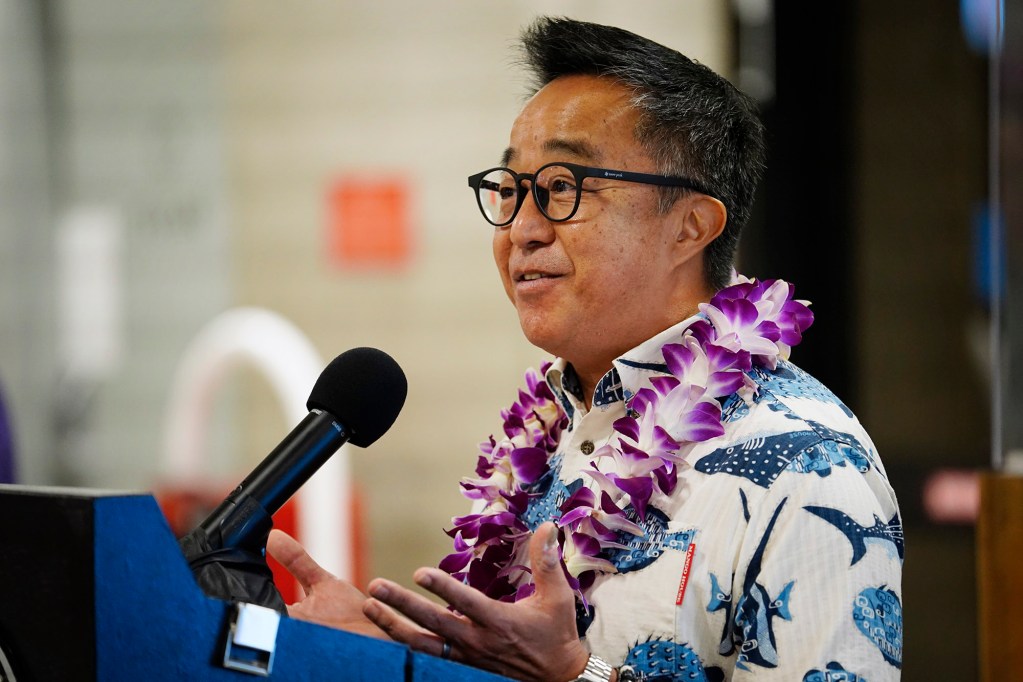
Sen. Glenn Wakai is pushing to get the extra revenue for his district’s biggest project for the third year in a row, and this time Stadium Authority Executive Director Mike Yadao hopes to find a compromise. He said stadium officials need to do a better job of communicating their vision to environmental nonprofit groups.
“The fear,” Yadao told Civil Beat, “is that we were going to turn the Hālawa area into Vegas lite.”

That’s not the goal, he said. Rather than display a big corporate sponsor sign on the outside of the new Aloha Stadium, advertisements could be restricted to indoor spaces, as happened when Hawaiian Airlines paid $2.5 million to sponsor the old stadium’s field for four years starting in 2011.
The Outdoor Circle’s current executive director, Winston Welch, actually likes that idea. But he’s wary the bill as written would still allow billboard-like advertising on the outside, threatening his organization’s mission of keeping Hawaiʻi largely free from blaring outdoor advertisements found in most other states.
Joining The Mainland Ranks
Structural problems led to Aloha Stadium’s closure in 2020. Lawmakers have set aside $400 million for a new stadium and accompanying entertainment district, and they’re reluctant to set aside more. But the cost is now estimated at closer to $650 million.
So how to fill that gap? Enter naming rights. One estimate projected that could bring in about $7 million of revenue each year, although Yadao is skeptical.
“If this were a stadium smack-dab in the middle of Texas where you could show it to everyone and their mother, yeah, $7 million makes sense,” he said, adding that Hawaiʻi’s position in the middle of the Pacific Ocean means mainland viewers might be asleep by kickoff here, reducing stadium brand awareness and, with it, ad revenue.
Yadao suggested naming rights revenue would likely come in at closer to $1 million annually, a tiny contribution to the $250 million needed. But “at the end of the day,” he said, “a million dollars is a million dollars.”
But Welch said that small amount of money may not be worth the risk of opening the floodgates for outdoor advertising.
“We’re not against raising money for the state or having entities support various functions,” he said. “And good corporate citizens do that without needing to emblazon their name on a project.”
As the stadium’s legislative champion, Wakai noted that almost every other major stadium makes revenue by selling naming rights. There’s the American Airlines Center in Dallas, Lumen Field in Seattle and Intuit Dome in Los Angeles. The San Francisco Bay area has a trio: Oracle Park, Chase Center and Levi’s Stadium. And so on.
At a meeting in mid-February, Wakai suggested that if The Outdoor Circle objects, it should step up and lease Aloha Stadium’s naming rights itself for 20 years, then leave the name blank.
“That’s a way for them to be helpful in this conversation,” he said.
That move may sound preposterous but it actually has precedent. When The Outdoor Circle first fought to outlaw billboards in the early 1900s, saying they marred Hawaiʻi’s scenic landscape, the group bought out the last local billboard company only to shut it down.
That wouldn’t be feasible this time, Welch said.
“Like, we’re going to get in a bidding war against, you know, Smirnoff Vodka or whatever, or Marlboro Light cigarettes, so we can make a point?” he said. Welch understands the desire for revenue, “but there’s other ways we can get … this revenue without changing the law.”
Legislative Pushback
Some of the obstacles to the previous bills’ passage have been technical.
A House version of the bill died this year under Rep. Jackson Sayama’s House Labor Committee, which killed it after the state Department of Budget and Finance testified they were worried it could violate federal tax laws.
That’s because the original version included the Convention Center, which has used tax-exempt bonds to partially fund its repairs. Selling naming rights for the center could violate the terms of those bonds. The Senate version that’s still alive removed the Convention Center from its language to avoid that issue.
Last year, the bill passed the Legislature only to be vetoed by Gov. Josh Green. He said that by law the bill’s title — “Relating to Naming Rights” — didn’t encompass the content of the bill, since it also exempted stadium concessions from the standard bidding process.
That wording issue shouldn’t be an issue this year, Yadao said, since the new title of the bill is broader: “Relating to State Facilities.”
But the hospitality, health care and food services union Unite Here Local 5 isn’t a fan of exempting stadium concessions from the standard bidding process.
“There is no reason for these concessions to be added to the long and ever-growing list of things exempt from competitive bidding,” the group said in written testimony. “Without competitive bidding, the process of awarding concessions contracts is opaque. It will be unclear which companies are aware of which opportunities.”
In Yadao’s view, keeping concessions out of the competitive bidding process makes it easier for the private development company Aloha Hālawa District Partners to eventually operate the stadium.
“We don’t want to put constraints on them about who they can bring in to serve food or to do whatever,” he said.
Aloha Hālawa District Partners is responsible for designing, building and then operating and maintaining the stadium area for 30 years. The vision is for the neighborhood to become a vibrant mixed-use entertainment district along the city’s Skyline rail system, with over 4,000 new units of housing.
The new stadium would have 31,000 seats, up from the 25,000 seats projected last year. Demolition on the old 50,000-seat stadium, which opened in 1975, started last year after officials authorized contracts relating to the ground lease and the stadium redevelopment.
Remaining contracts to be worked out include the master development agreement for the entire neighborhood and a shared infrastructure agreement, both of which Yadao hopes to finalize by April.
The new stadium was supposed to be complete in time for the University of Hawaiʻi’s 2028 football season, but that has been pushed to March 2029, in time for that year’s procession of graduation ceremonies.