Eight regions covering 596.7 square miles. Hundreds of volunteers. One day to measure the scope of Oʻahu’s homeless crisis.
For more than two decades, the Point-In-Time Count has served as Hawaiʻi’s main benchmark for whether the state is making any progress on the issue.
But the census — which attempts to capture how many people were experiencing homelessness on a single day — is merely a snapshot. The bigger picture of what this crisis is costing our community is rarely seen.
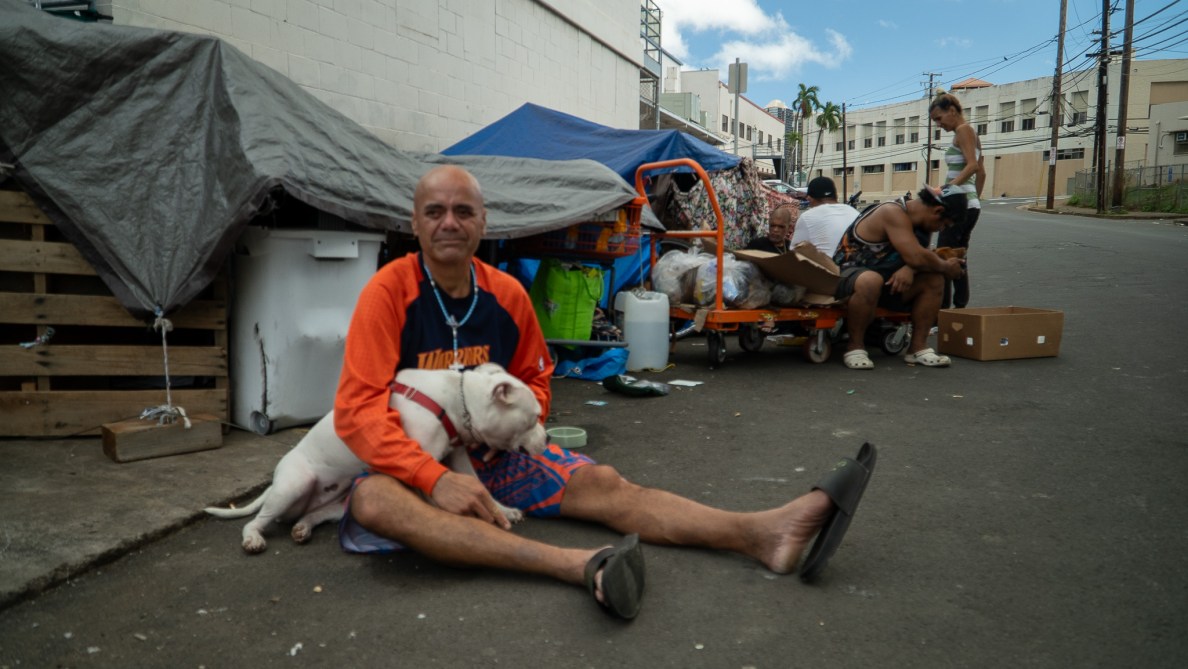
This year, more than a dozen Civil Beat reporters and photographers fanned out across Oʻahu to chronicle the reality of homelessness on Jan. 26, the day of the census. They set out before dawn to follow security teams and business owners, sat in on court hearings, learned the intricacies of making camp under an overpass, talked story with working families searching for stable housing and meth users not ready to make a change.
They spent time with Anderina Petero and her 21-year-old daughter, Marianeina Joseph, who were evicted from their Sheridan Street apartment in October 2024 along with four other family members. The rent for their 2-bedroom unit had been raised from $1,700 to $1,750 — the final straw that left them scattered.
Petero’s youngest son, who is developmentally disabled and requires regular treatment for fluid in his brain, was temporarily placed at a care home in ʻEwa Beach. Another son and his girlfriend moved into a Catholic Charities transitional housing shelter in Waikīkī. Anderina and Marianeina, the second-youngest child, ended up at Pai’olu Kaiāulu, the Waiʻanae shelter run by U.S. Vets, a nonprofit social services provider.
Jan. 26 started out as an ordinary day for the two women, who are in a better situation than many of the homeless Civil Beat encountered that day. They not only have a roof over their heads, they have jobs — they work the overnight shift at a fast-food restaurant in urban Honolulu — and by mid-afternoon, it would become clear that this day could mark a turning point in their story.
6:52 a.m.
Chinatown
The owner of Fancy Orchid & Leis Flower Shop on Pauahi Street arrives in the pre-dawn darkness to find a man sleeping in her doorway, his body twisted — knees going one way, shoulders the other.
“Excuse me,” she says, “can you wake up, please? I need to get in my shop. Sorry.”
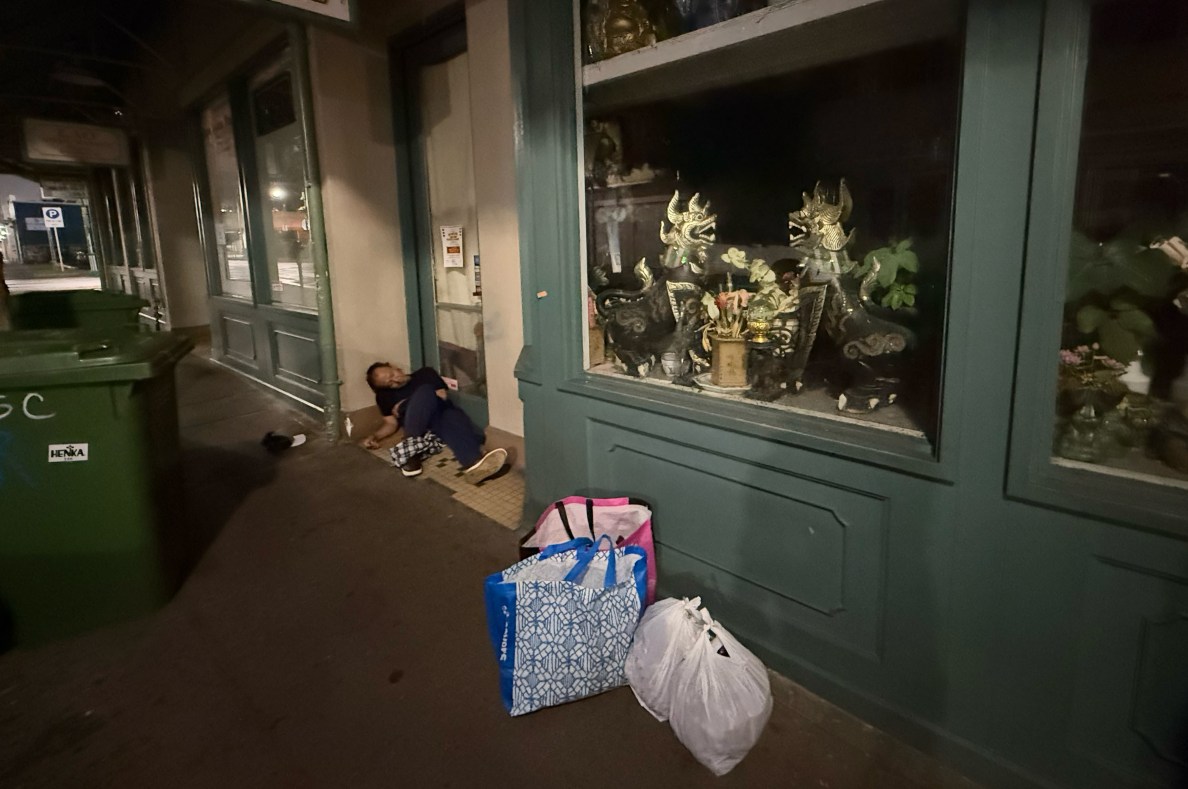
On the ground next to the man is a black messenger bag, its strap over his shoulder. He stares at the woman above him with blank eyes and stays silent when a reporter asks his name.
The lei shop owner also declines to give her name, saying she simply wants to get along with everyone in a neighborhood where outspoken business owners have faced retaliation from houseless residents.
After a moment, the lei shop owner reaches over the sleeping man, unlocks the door and steps gingerly over his outstretched legs with glittery, high-heeled slippers, her flower print dress flowing behind her.
7:05 a.m.
Anderina and Marianeina Part 1
As dawn eases darkness aside, it softens the glow the Jack in the Box at the corner of South King and McCully streets gave off all night.
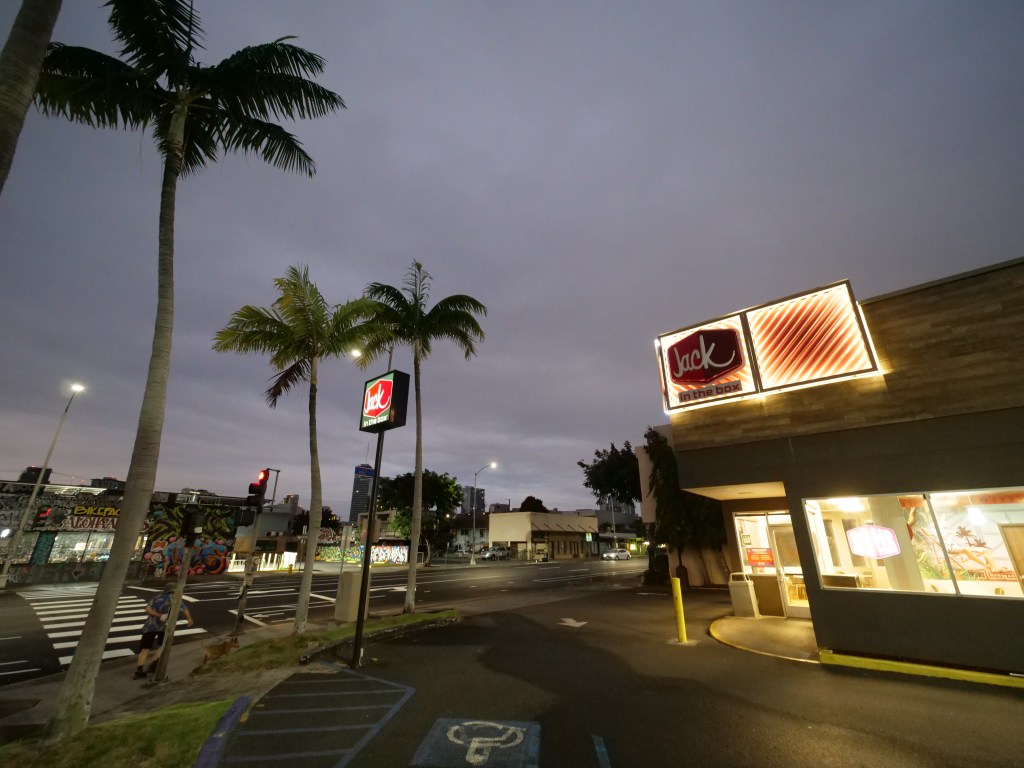

Inside the fast food restaurant, the overnight shift has ended for Anderina Petero and her daughter, Marianeina Joseph, but the two women are still cleaning the kitchen as the morning staff arrives. They’re in no great hurry. TheHandi-Van – Honolulu’s transit service for people with disabilities – isn’t due to pick them up for nearly another hour for the long ride back to the homeless shelter in Waiʻanae, where they have been living for more than a year.
7:33 a.m.
Chinatown
Like old-fashioned beat cops, Ave Kwok and Lincoln Smith — the owner of Maunakea Marketplace and his head of security — know many of Chinatown’s unsheltered residents by name. They know who is harmless, who has a history of violence, who has been banned from certain businesses.
Francis Aiga, crouched in a semi-fetal position on the sidewalk outside the marketplace with his knees up and his head bowed, is a familiar figure to the two men. Aiga’s gray hoodie and black and gray pinstriped pants smell of urine; a fly buzzes around crusty feet clad in Locals slippers.
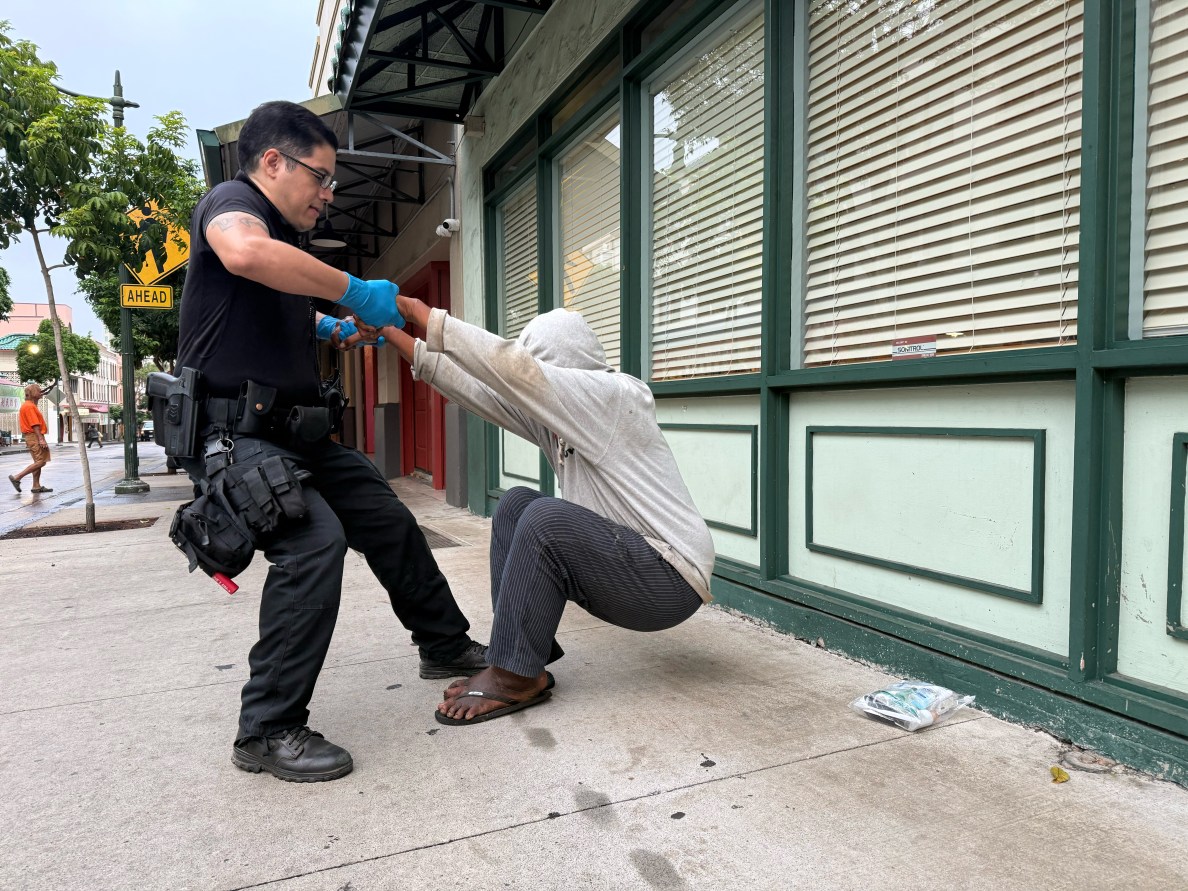
Dressed in a black T-shirt and slacks with wingtip oxford shoes, Kwok looks like a typical businessman except for one thing: a non-lethal Byrna pistol that can fire pepper spray or plastic pellets, holstered at his hip. He says he’s had to use it twice in self-defense. While verbal abuse is common, physical violence is relatively rare. Smith also carries a Byrna gun, along with a radio, pepper spray and a medical kit including Narcan to treat opioid overdoses.
Smith tells Aiga that he can’t sit there. Aiga is willing to move but says he can’t stand up. It takes both Smith and Kwok to help him to his feet.
Things have improved for businesses in the area since Kwok and six other proprietors teamed up to form the security team. Much of the work, Smith said, involves steering people to resources that can help them.
But Kwok says some business owners have found “a new weapon” to discourage unsheltered people from camping out in front of their properties: leaf blowers.
7:40 a.m.
Anderina and Marianeina Part 2
Anderina and Marianeina emerge from the kitchen; their sixth graveyard shift in a week is over. Anderina’s red Jack in the Box T-shirt displays the slogan, “In a world of fries, be the curly one.” She sips her boba iced coffee and slumps into a chair at a table for two, Marianeina across from her.
Anderina, 52, wears a baby blue rubber bracelet on her left wrist that says “John 3:16” and “Loved by God.” A red clip holds back her black hair. She’s worked at this Jack in the Box for 14 years, she says, the last 12 overnight. These days, she’s a cook. Her daughter is a cashier.

Marianeina, 21, checks TheHandi-Van website on the phone the women share. They are hoping the van is on time or at least close to it. It’s a big day ahead, with several Handi-Van trips planned of an hour each – at least.
After living in a homeless shelter for 14 months, they’re hoping to qualify for a housing subsidy that will help them rent their own apartment. They will have to take a Handi-Van back from Waiʻanae to Honolulu this afternoon for a critical meeting to find out where their application stands.
7:52 a.m.
Downtown
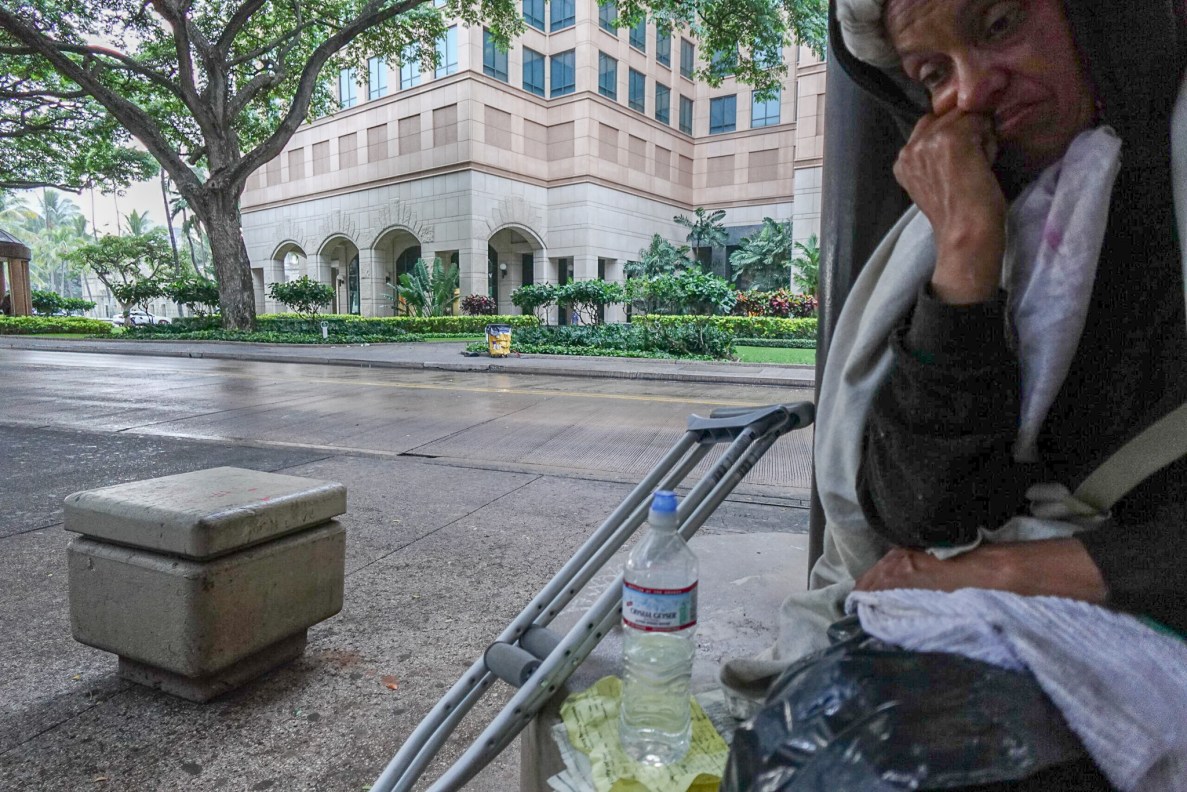
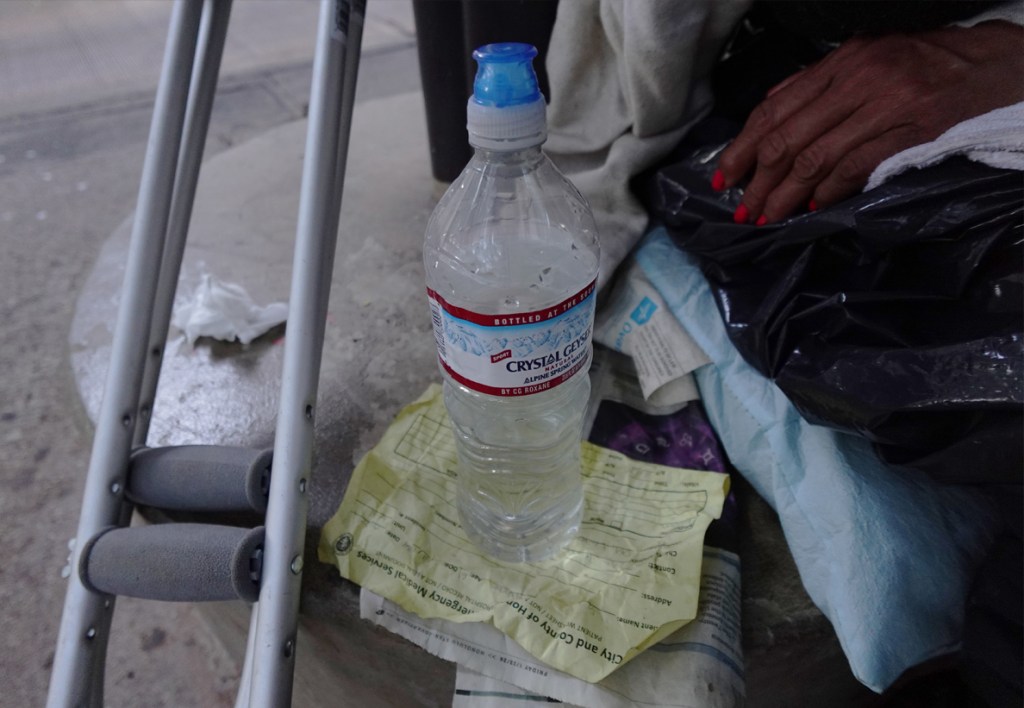
Mona Lisa Hickman perches on a concrete seat at the bus stop on South Hotel Street outside the Honolulu District Court. It is misting softly and she has pulled a stained tan blanket around her shoulders. She is 61.
Hickman’s newspaper is open to the horoscope page. She sits on a hospital pillow with a blue paper cover. She has a water bottle, crutches, an Army backpack and a yellow form that says City and County of Honolulu Emergency Medical Services; it’s filled out in pencil. Her nails are painted pink.
Buses stop and people shuffle on and off them, dispersing. She’s alone for a while until more commuters arrive.
8:14 a.m.
Anderina and Marianeina Part 3
Handi-Van #1440 pulls up outside the restaurant at last. The women hurry to board – Anderina limping behind, hampered by the severe gout that plagues her knees and qualifies her for the transport service. The driver gives her a hand up the stairs and she pays the $2.25 fare. They take the seat all the way at the back. As the van heads down McCully Street to drop off the only other passenger, Anderina leans her head against a rain-smeared window.

“It’s not hard, it’s just tiring,” Marianeina says of homelessness. She dropped out of McKinley High School after ninth grade. She had been living with a relative in Denver in 2024, until homesickness drove her back to Honolulu just in time for her family to be evicted. Now she’s holding down her first-ever job. She pulls her sweatshirt over her face and leans her head back, shutting out the world. It’s a month after Christmas but on her lap is a black shoulder bag printed with the words “Mele Kalikimaka.”
Anderina promises herself she will talk to her employer. Six shifts a week is too much. She hasn’t been to her church in Kailua in two Sundays. As TheHandi-Van pulls onto H-1 just before Ward Avenue, her eyes close, she crosses her arms against the air conditioning, sleep takes over.


9:37 a.m.
Downtown
“Who are you?” Colin Keliʻi blurts out, his weathered face appearing on the bottom of a TV screen in Courtroom 7D at the Honolulu District Court. Behind him, the cream colored walls of his room at the state’s only public psychiatric facility are marked with what appear to be fingernail scratches.
“I’m Judge Shimozono. Or are you talking about who your attorney is?” the judge asks. “Is that what your question is, Mr. Keliʻi?”
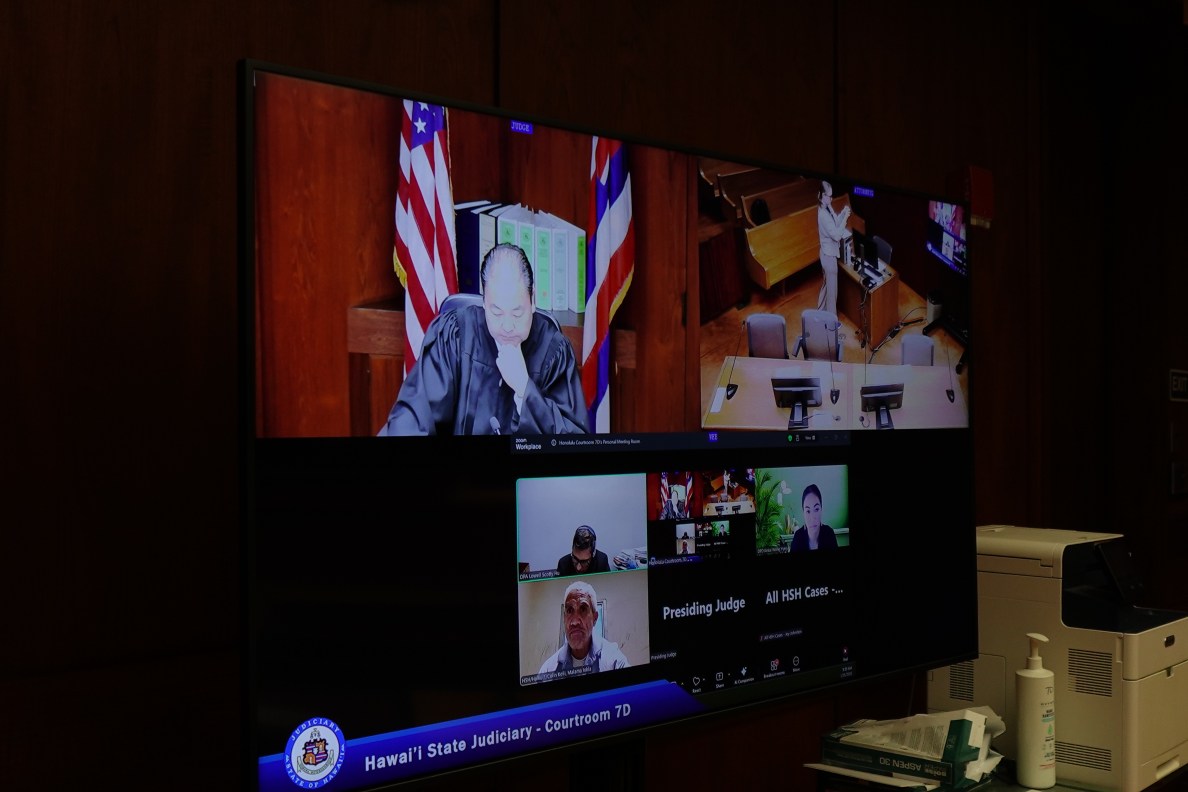
Keliʻi is homeless and living with significant mental health and addiction issues. He’s been in and out of the state hospital a half-dozen times in the last year, repeatedly arrested for low-level offenses ranging from theft to harassment. Each time, he’s held only a few days before he’s released under the state’s Act 26, which requires the release of people arrested for petty misdemeanors if they aren’t mentally fit to stand trial.
Keli‘i knows enough to reference Act 26 by name, but struggles to listen to his attorney and make sense of who and where he is.
“I made it known,” he said, “that I’m the owner of the Hawaiian Islands, and that I want a jury trial and no judge is supposed to deny me a fair trial.”
Shimozono’s voice is soft and respectful as he acknowledges Keliʻi’s comments and moves on. He finds Keliʻi unfit to proceed with the case and grants the public defender’s request that he be admitted to the state hospital.
But Keliʻi will be released in less than a week, only to be arrested again a few days after that.
9:44 a.m.
Anderina and Marianeina Part 4
TheHandi-Van turns up a side street and arrives at the Pai’olu Kaiāulu shelter, which fronts on the highway: two long Quonset hut-style structures behind a chain link fence. The ride took an hour and a half.
Anderina hurries off the van as best she can and she and her daughter head through the facility’s gate. Another Handi-Van — ordered the day before — is due to come for them in just a little over an hour. They need to get back to town for their early afternoon appointment at WorkHawai‘i, a city and county jobs program that also provides federally funded housing assistance.
Their rooms at the shelter are small — 10-by-8-foot partitions that open on top into the larger shelter space — but they offer relative privacy and each woman has her own. Three extra Jack in the Box employee T-shirts hang in Anderina’s room. Her bed is piled with blankets.
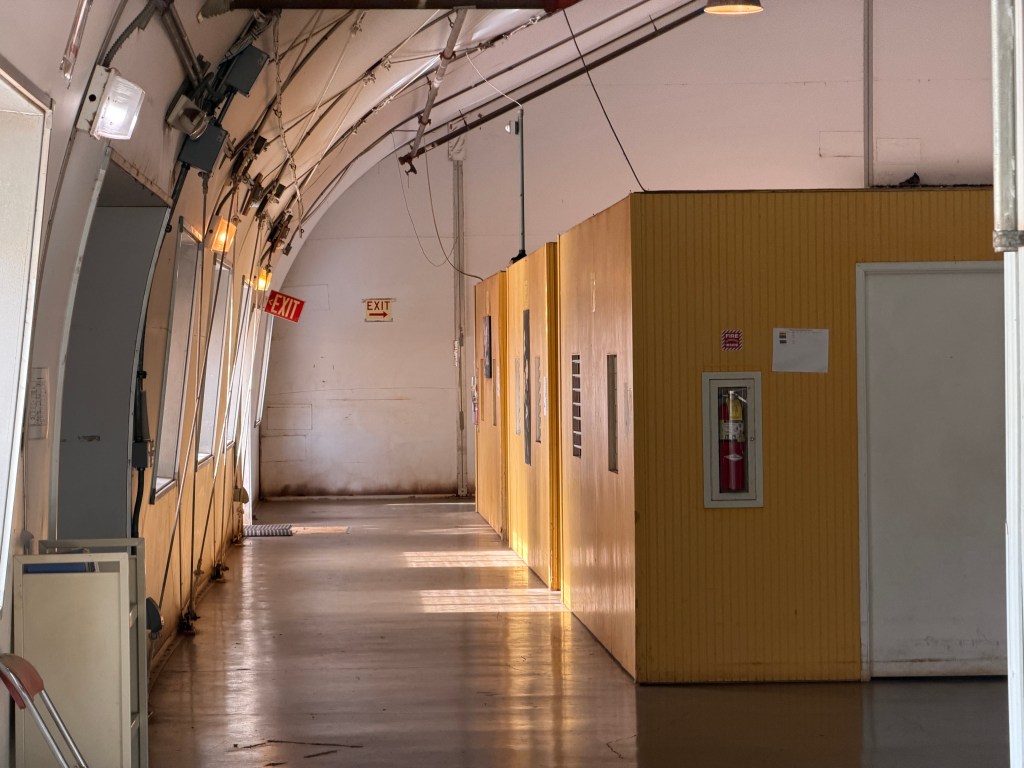

The shelter is made of a double wall of tan fabric stretched tight over an arched steel frame. Jalousie windows. Fans stirring overhead. Concrete floors. Their rooms are in Wing A, for singles and couples. Wing B is for families with children. Anderina and Marianeina are among 207 current residents.
Because they have income, the women each pay $250 a month in program fees, an amount determined by a sliding scale.
They go to their rooms to lie down. Neither really sleeps. They are too tired and have to get up too soon anyway.
10:35 a.m.
Kamaile Academy, Wai‘anae
Cozy Mendoza, outreach specialist at Kamaile Academy, spends every Friday driving a white van up and down the mile stretch of Farrington Highway outside the charter school campus. Armed with supplies like blankets, shampoo and tarps, Mendoza connects with homeless families and encourages parents to send their kids to school.

The first stop on her list is a homeless shelter a few minutes away from campus, where the greatest number of homeless kids from the school – 46 – reside. To avoid singling these kids out, the school bus picks up kids in the cul-de-sac between the homeless shelter and an affordable housing complex on the same road, so students don’t know where their peers are coming from.
About a decade ago, Kamaile had around 30 to 40 homeless kids. The number tripled to 90 after the Covid-19 pandemic, when parents lost their jobs as waitresses or cashiers at local grocery stores.
Now, the number has fallen to 70, but Mendoza worries that more families will become homeless amid federal cuts to Medicaid and SNAP, the food assistance program.
Her next stop will be Waiʻanae District Park, where a few families live in the thick grass in the back of the park. When families see the large camping van, they rush to the parking lot to talk story.
Building those relationships took time — and a little internal pep talk. When she started her Friday routes a decade ago, a few residents at the boat harbor surrounded her car and swore at her until she backed out of the parking lot. Even still, Mendoza remained undeterred.
“I was like, girl, you’re born and raised here,” Mendoza said. “Put on your big girl boots.”
5,237
5,237 homeless students were enrolled in public schools in the 2024-25 school year.
10:50 a.m.
Anderina and Marianeina Part 5
Anderina and Marianeina sit at a picnic table near the shelter’s gate. There’s been no time for sleep, but they need to make their way back into town.
TheHandi-Van is late again.
“Sometimes they piss me off,” Anderina says. She has changed out of her black work pants and is wearing a traditional Chuukese outfit with pinks, reds and blues embroidered on a black background. Marianeina has put on a sparkly cross necklace that she isn’t allowed to wear at work.
The women review a sheaf of papers, including photocopies of their pay stubs. They need to establish their household income and savings for WorkHawaiʻi’s Rent to Work program, which offers subsidies to people at risk of or experiencing homelessness who earn below 60% of the area’s median income. Currently, that’s $64,000 a year for a single person. Anderina earns $16.50 an hour, she says. It is her third job in 26 years. After arriving from Chuuk in 2000, she worked at the Sheraton Waikīkī as a house cleaner, then at a McDonald’s.
“In my country we don’t pay,” she says, referring to rent. “We sleep free, we eat free. We had our own land, we build our own house, we have our own ocean — we fish, we get food, we eat breadfruit.”
The sun bears down. Marianeina goes off to stand in the shade. In the near distance, the Waiʻanae mountain range holds down the horizon.
11:01 a.m.
Downtown
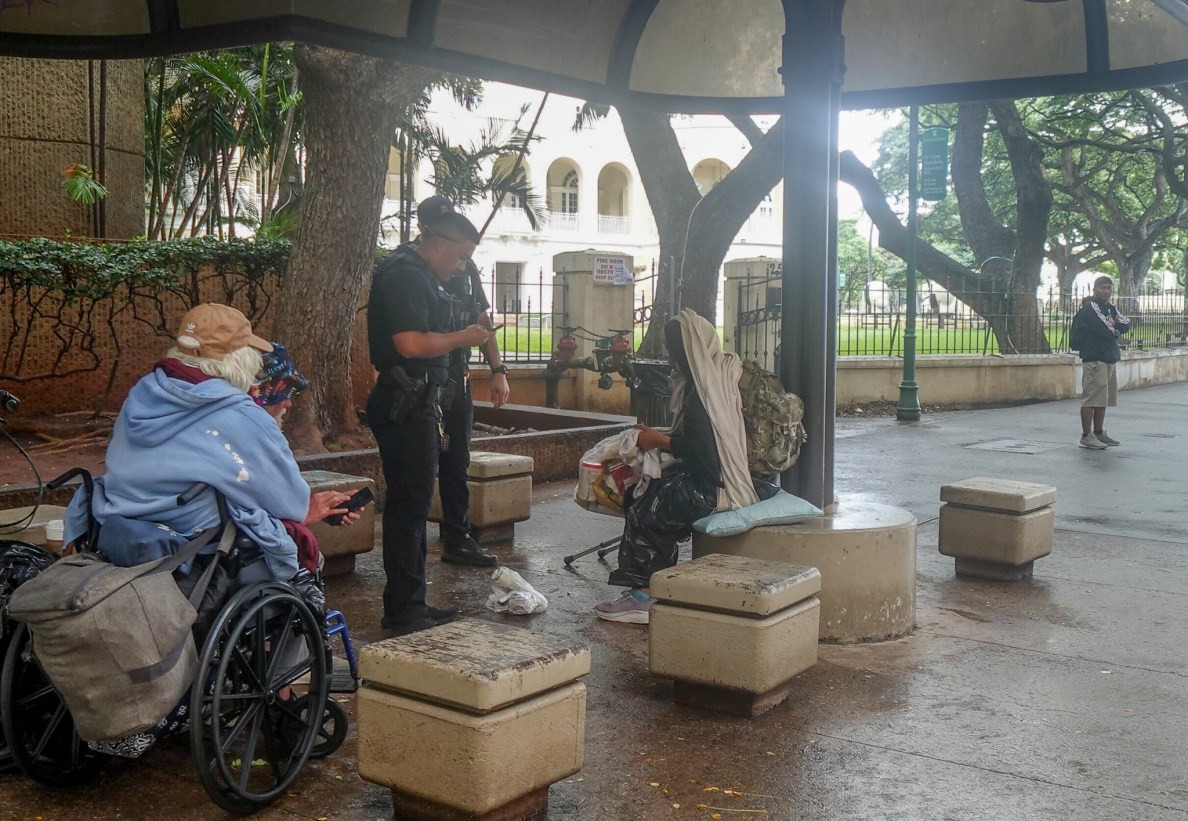
Two police officers pull up outside the courthouse where Mona Lisa Hickman has been sitting for hours under a bus stop awning. A bottle of Tylenol is next to her now.
The officers – Dominic Muscato and Makana Perkins – say they are responding to a call about a woman passed out there. It happens a lot, they say, and they are just here to check on her – and make sure she’s alive.
They ask for her name a few times.
(Caitlin Thompson/Civil Beat/2026)
“I told you my name,” Hickman says, thrusting her yellow patient worksheet from the City and County of Honolulu Emergency Medical Services at them. Her name is written on the paper in faded pencil under the printed line that reads “not a legal document.”
Within two minutes, they are back in their patrol car. Then they drive away.
Fed up with the officers’ attention, Hickman picks up her things, her blanket wrapped around her shoulders and a black trash bag wrapped around her waist.
She shuffles off to another bus stop around the corner.
12:51 p.m.
Anderina and Marianeina Part 6
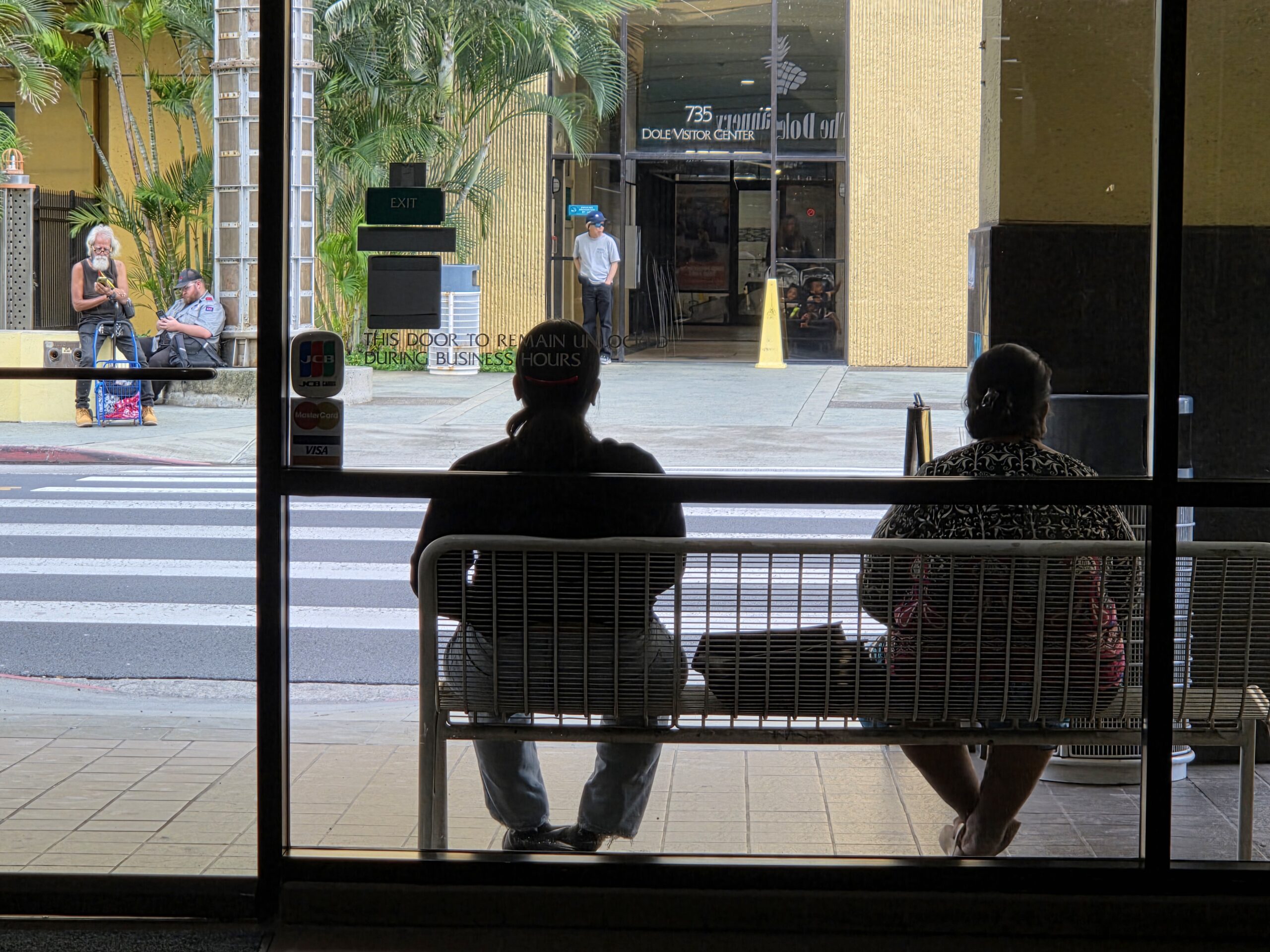
In the lobby of the Dole Office Building on Iwilei Road, Marianeina pumps some hand sanitizer from a dispenser stationed near the elevators. She and her mother ride to the 7th floor.

WorkHawaiʻi’s offices are quiet, with comfortable chairs and a large screen television showing the program’s smiling clients. Marianeina, who has been through this before when the women went through the process of qualifying for the program, checks them in at the front desk. They sit in the lobby for a while. Then they move to a carpeted corridor, its walls decorated with off-pink wallpaper and lined with decorative columns and glass sconces.
After some minutes, they are ushered into a small room to sit across from a caseworker with the stack of papers they carried from Waiʻanae.
1:15 p.m.
Iwilei
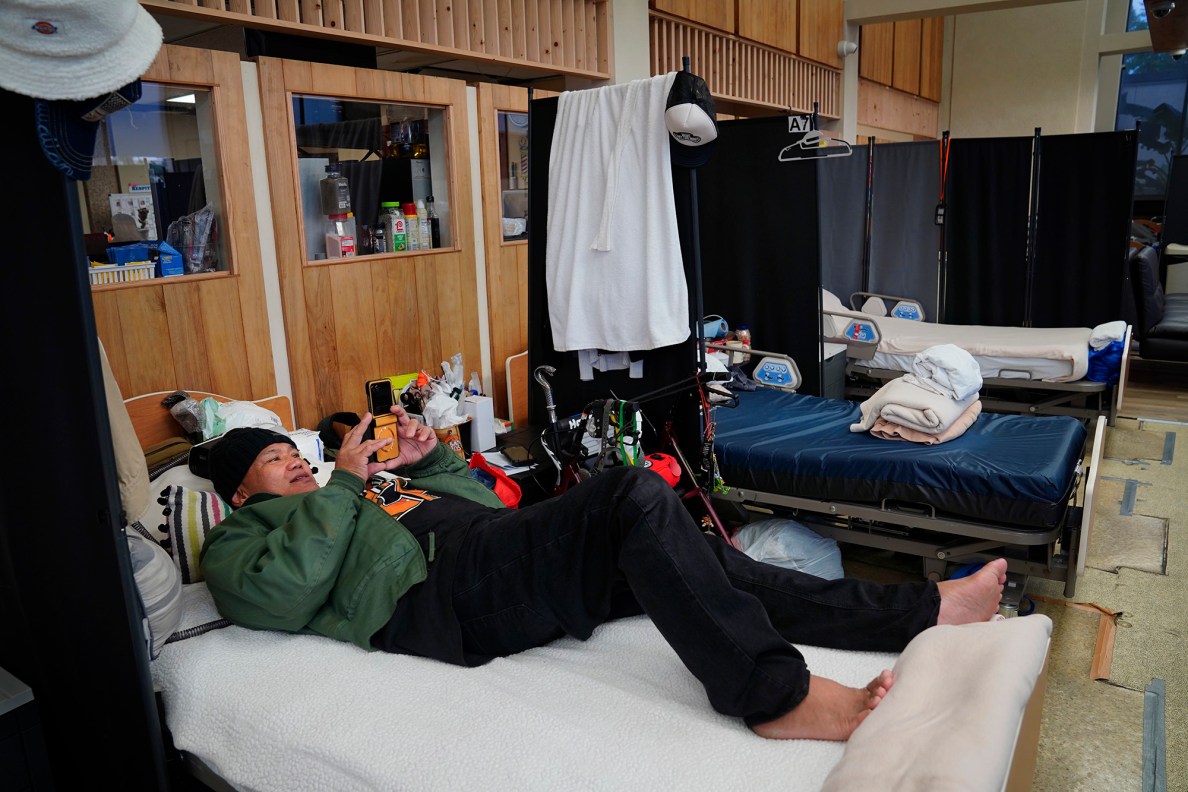
Tracey Mulleitner puts away a painting she was working on before lunch is delivered to patients at the ʻAʻala Respite Center, where the city sends medically vulnerable homeless people who might need frequent hospital visits.
It’s loud on the lānai where Mulleitner sits. Buses rumble by. Cars honk. She feels at peace, though. Before this, she’d spent four years living in an encampment among the mangroves around Pearl Harbor.
A recovering meth addict, she was introduced to the drug by a sister, who suggested it as a way to counter her extreme exhaustion. She didn’t know at the time why she was so tired: an undiagnosed case of severe sleep apnea.

Scott Miscovich, the doctor who runs ‘A‘ala, estimates that 60% to 70% of residents at the facility have only a few years of life left.
Many have health issues that have gone untreated for years, Miscovich says, standing in a staff-only room filled with wall-mounted jigsaw puzzles.
A friend of Mulleitner’s who lived at ʻAʻala died just a few weeks ago.

1:30 p.m.
Ala Moana
Harry Armitage is sitting with two friends at a picnic table in Pāwaʻa In-Ha Park between King and Young streets in Honolulu. The bench is missing on one side of the table, leaving two stubby stools. But it’s in the shade of the park’s largest tree.
That’s important to Armitage, 53, because he smokes methamphetamine every day – and meth can make you hot.
“The drug I do, I don’t like to stay in the sun and sweat,” he said. “I like to be in the shade, so I come out at night, I do my thing at night.”

Armitage, in dark glasses adorned with skulls, is holding his black mountain bike with one hand, jiggling it back and forth, as he recalls a friend who was found dead in the park almost a year ago.
The body of Shaun Nihipali, 46, was discovered by another homeless man. Some bikes had fallen on top of Nihipali, and when the other man went over to check on him, he discovered Nihipali was dead. An autopsy would show he had overdosed on fentanyl and methamphetamine.
Armitage prefers to blame the fentanyl, not his own drug of choice, meth.
He compares fentanyl to rat poison: “If that little bit can kill you, it’s just straight poison.”
167
At least 167 homeless people died on O‘ahu in the first 11 months of 2025. Meth use contributed to 43% of those deaths.
1:31 p.m.
Anderina and Marianeina Part 7
Anderina and Marianeina emerge expressionless from the meeting — but the news is good.
They had been looking at having to pay at least $2,200 a month toward an apartment, according to Anderina, if they’d been eligible for a subsidy at all. But it appears they are eligible for a subsidy — one that could last up to two years and would bring their monthly contribution down closer to $1,900 a month. They work, meet the income guidelines, are homeless and have passed background checks.
On Friday, they will collect their paychecks. After those are banked, they’ll be able to prove they have adequate savings for a security deposit, Anderina says. Their Rent to Work case manager will then be able to help them start looking for an apartment. They’ll also get help arranging the required financial planning training.
They are silent in the elevator headed downstairs. Outside, Anderina finds an open bench where she can wait for the Handi-Van one more time today. She sits down with a sigh.
She isn’t relieved, she says, nor excited about the news. Not yet, at least.
“I am just ready for sleep,” she says.
1:49 p.m.
Downtown
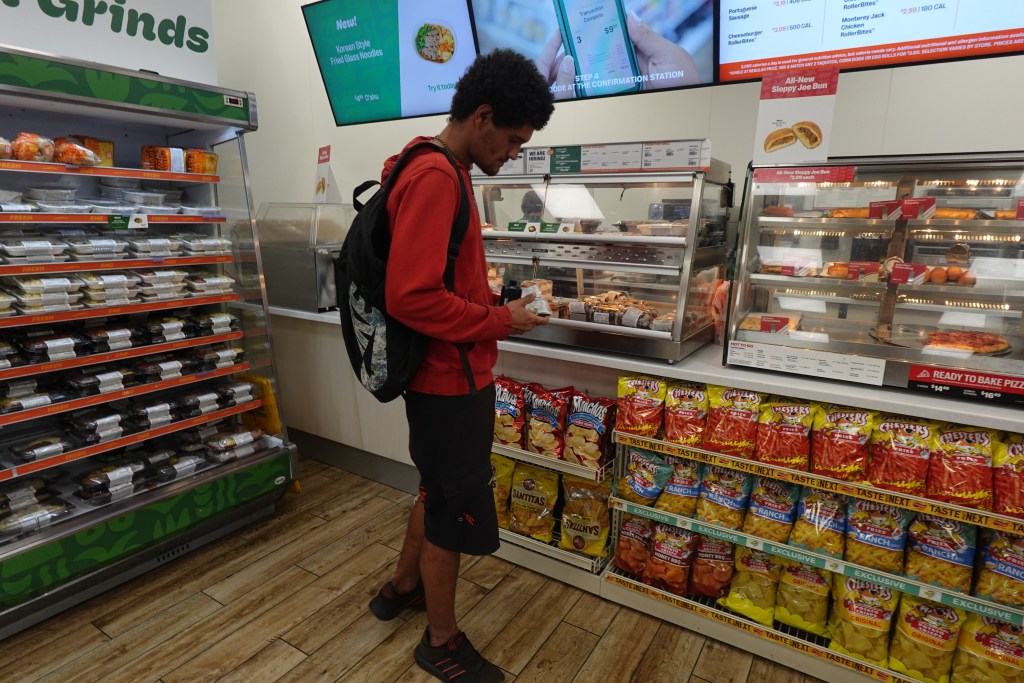
It’s a lucky moment for Lauren Allen Lutao: He finds 50 cents on a windowsill as he heads to a 7-11 near the Alakea Street courthouse. He pockets the coins for bus fare.
The 40-year-old homeless man got out of jail a few hours ago after getting picked up over the weekend for harassment. Now he and his friend, Tony Mersberg, are waiting for their girlfriends, who were arrested on different charges.
Hawaiʻi doesn’t give people a bus ticket to get home when they’re released from jail, so Mersberg has spent part of the morning panhandling. He collected $11.
At the 7-11, Lutao stays outside because he has no shoes. Mersberg, 25, pays about $4 for two musubi. The remainder of his cash will go toward bus fare for himself and his girlfriend.

Mersberg is lying on a wall outside the courthouse an hour later, when Gerene Cariaga, 18, comes running out.
Mersberg jumps up and darts toward her. She jumps into his arms and embraces him, wrapping her legs around his waist.
They sit on the wall and Cariaga rips open the plastic bag holding her belongings. They compare the antibiotic pills they were given by jail medical staff. Cariaga has big red pills and Mersberg has small red ones.
“To help us clear out all the whatever …” she says.
“… in our system,” he says.
Cariaga grabs Mersberg and kisses him. “I know, baby,” he says. “I love you.

In a few minutes, they leave Lutao waiting on the wall for his girlfriend so they can catch the bus home. Home is Waiʻanae – wherever they can find a place to sleep. Tonight, they hope to stay at Cariaga’s mother’s house.
2:47 p.m.
Downtown
Librarian Baron Baroza stands on the front steps of the Hawaiʻi State Library and surveys a group of homeless men smoking cigarettes and rearranging their bags a few feet away. Baroza considers asking the group to move so library patrons can access the nearby bicycle rack, but decides against it when a few of the men leave on their own.
There have been fewer problems with people loitering outside the library and intimidating patrons in the past few years, Baroza says, since the state pushed out a large encampment by ʻIolani Palace.
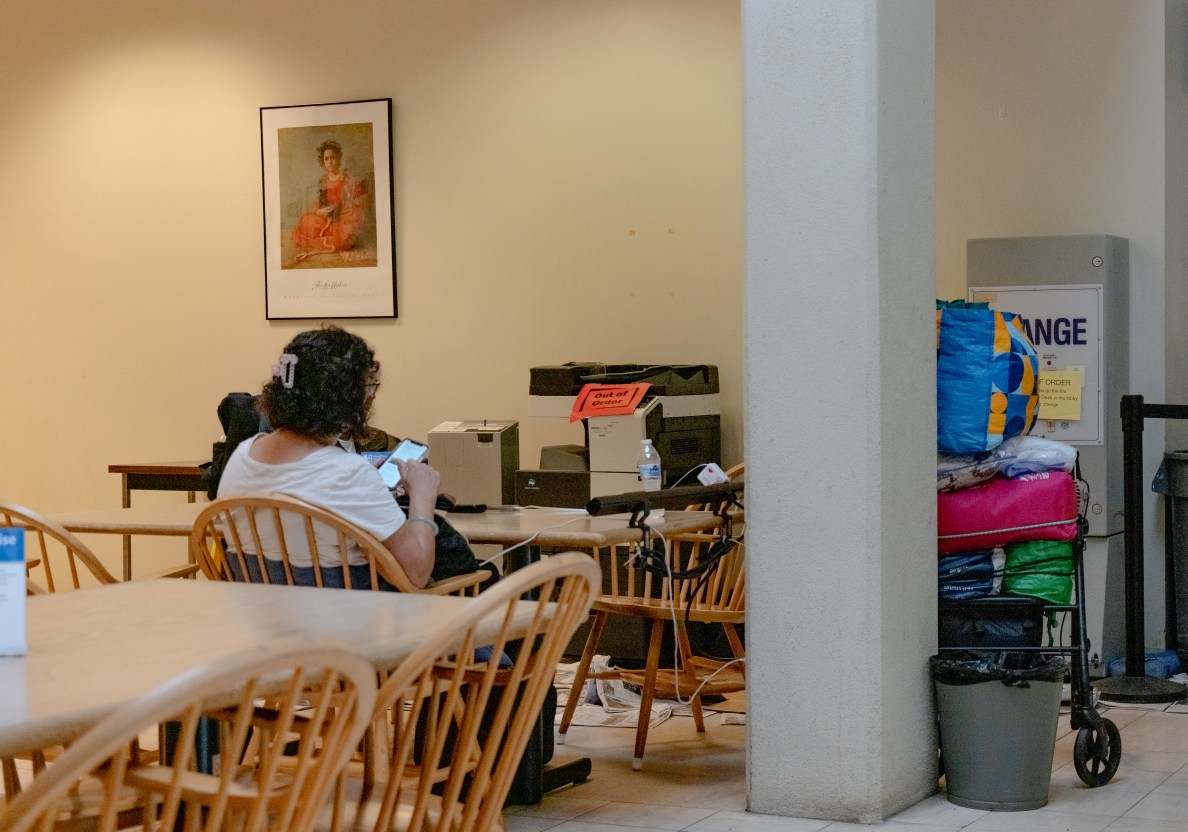
Baroza says he used to approach people who appeared homeless to give them information about resources, but they often didn’t want to talk. Instead, staff now leave about 25 copies of printed resources on the circulation desk. They’re usually all gone by the end of the week.
He mainly lets people be, Baroza says, unless they’re being disruptive – talking to themselves, for example, or flushing the toilet a dozen times – or if they smell really bad.


2:30 p.m.
Family Promise Shelter, Wahiawā
Erty Searnus is stressing out about what her family will do when their 90-day stay ends at the emergency shelter in Wahiawā. They are supposed to move right around when her third baby is born.
“It plays in my head over and over,” she says.
She sits on the floor, leaning against one of two air mattresses that serve as the main furnishings in the small studio the family shares at the shelter. Her two older children, who just got home from school, sit nearby.
She cried with joy the first night they were able to sleep at the shelter, which is run by Family Promise, a nonprofit social services agency. They even have their own bathroom.

Before that they’d been sleeping in Wahiawā District park for five months, even though her husband, JD, works an under-the-table construction job in Pearl City. Now, he’s looking for a job that comes with a paycheck — proof of income that landlords will accept in a housing application.
Her 7-year-old daughter, Ella, touches Searnus’ stomach.
“You just have to have faith sometimes,” Searnus says.
But Searnus struggles with high blood pressure because of the stress she’s under. Her doctor told her to try not to think so much because it’s bad for her pregnancy.
“How can you not?” she says. “For a mother, it’s nonstop.”
3:30 p.m.
Punchbowl Street, Near The Queen’s Medical Center
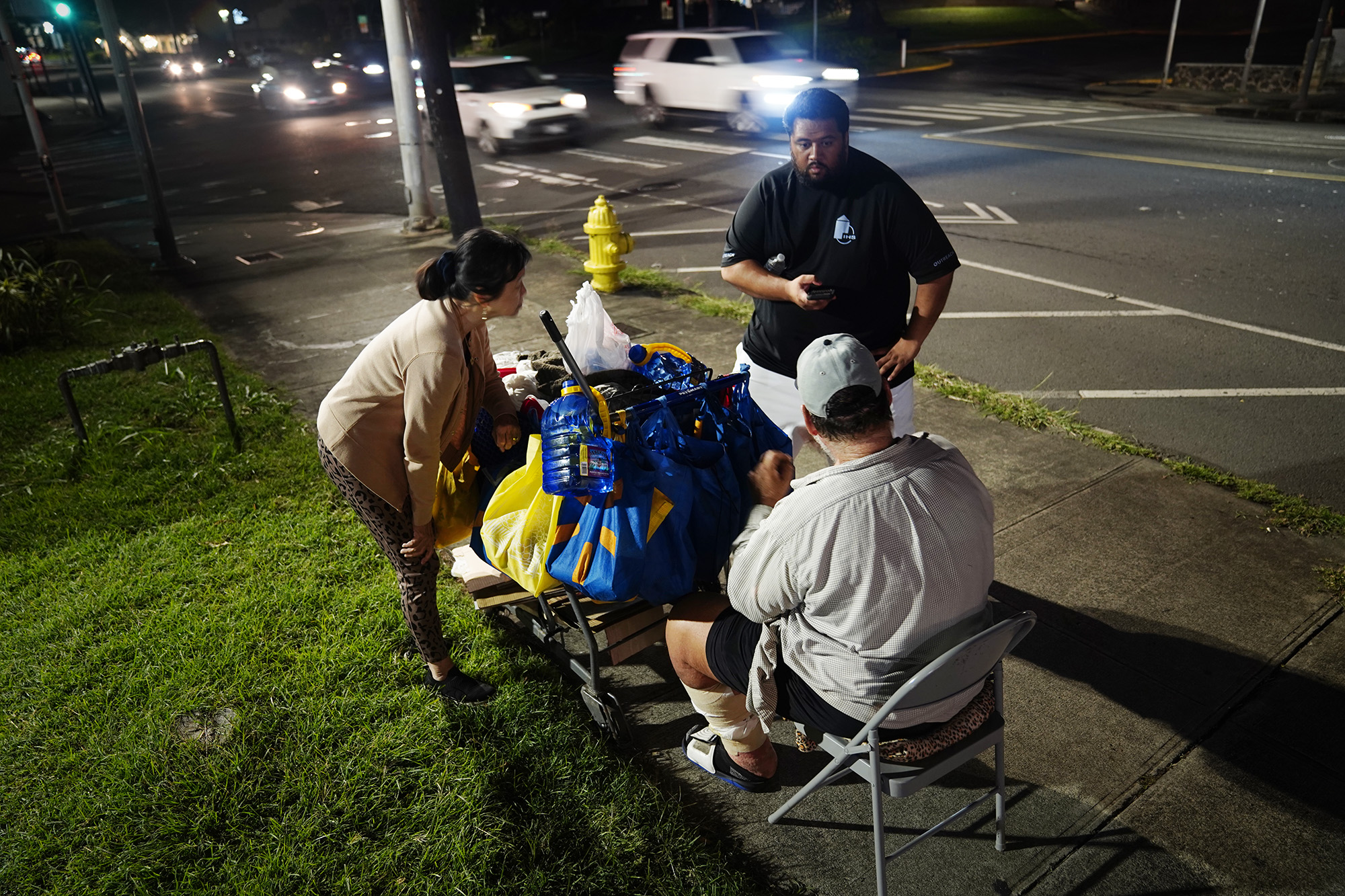
An old man wearing only one slipper shuffles down the block, his belongings packed into a duffel bag and canvas tote loaded onto a wheelchair.
He stops to talk to two men in blue scrubs as they smoke cigarettes across the street from The Queen’s Medical Center Emergency Room. He says he is actually a millionaire — or will be once he wins the fight with his sister over their inheritance. He’ll have to take her to court, but first he has to take care of his health.
Over the course of the day, The Queen’s Medical Center will treat around 50 patients who identified themselves as homeless, according to Dr. Daniel Cheng, medical director of the Queen’s Care Coalition, a program to improve health care for the homeless.
Both of Cheng’s first homeless patients of the day had underlying chronic behavioral health and substance abuse issues, along with other chronic medical conditions.
Over the years, he has found that homeless people are more resourceful than they are often credited for.
“I always chuckle about how they can holo holo around Oʻahu on the bus and get from point A to point B with fairly decent speed and accuracy,” he says. “One thing I always tell people is never underestimate our homeless population, and give them the benefit of the doubt that they can try to meet the challenges that we try to help them solve.”
10,625
In 2025, The Queen’s Health Systems’ five emergency departments treated 10,625 cases in which patients identified themselves as homeless.
5:20 p.m.
Kim Mathias’s hair is still wet from the shower she took at the Ho‘okahi Leo kauhale on Middle Street. It’s one of 16 homeless housing facilities Gov. Josh Green’s administration has opened on Oʻahu, most consisting of tiny housing units.
Mathias visits the kauhale every day to eat, shower and collect water, but there isn’t a room available for her at the shelter. She’s been on the waitlist for about four months.

She retrieves a wagon parked by the kauhale’s front gate. The wagon holds four gallon jugs of water and a large purse, and she drags it down the bike path parallel to H-1. She waves to a few passersby.
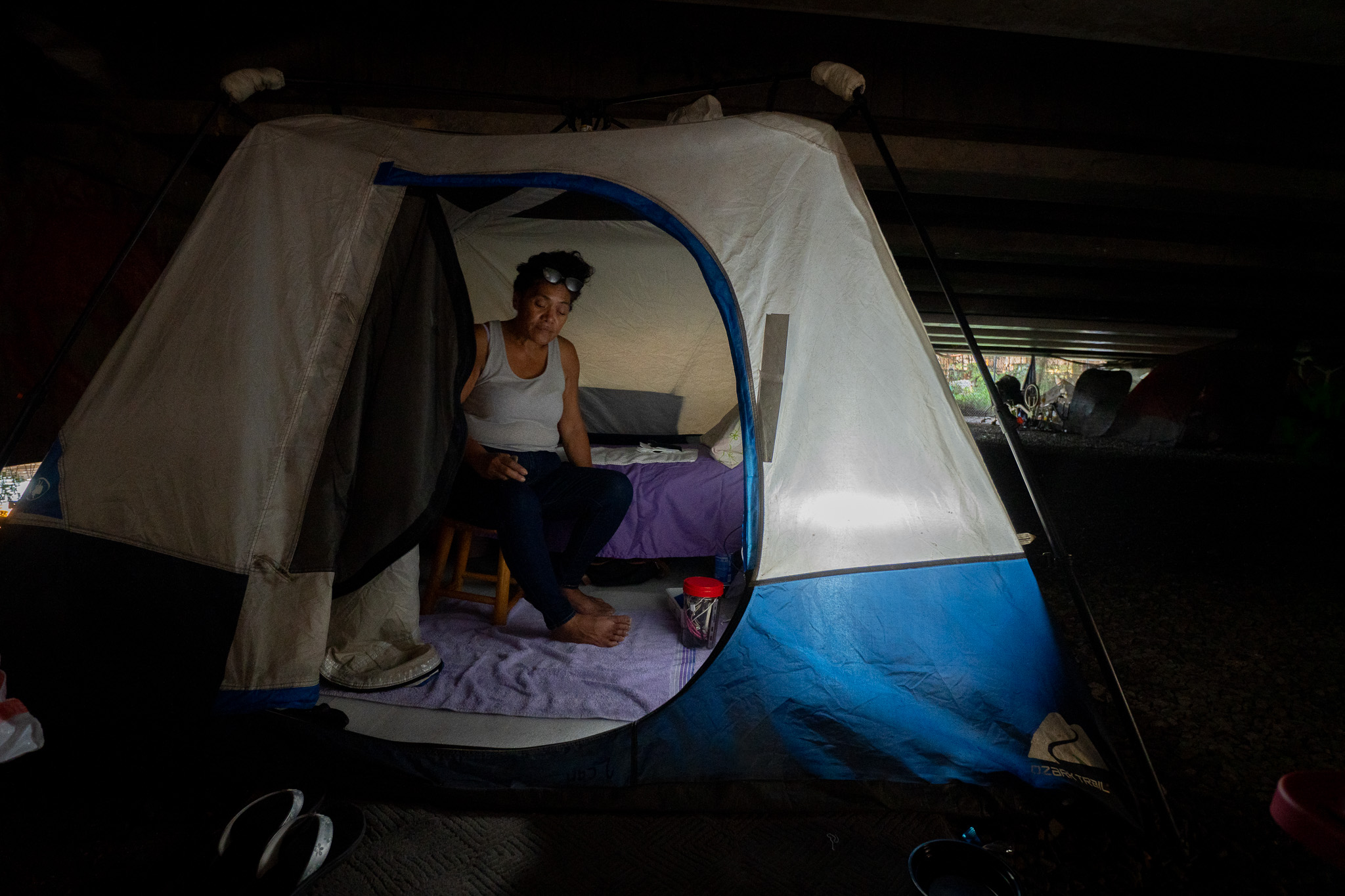
After about a five-minute walk, the 55-year-old arrives at an area beneath a freeway overpass. A skinny young man covered in tattoos runs up to a cardboard ramp that leads down below and helps her hoist the wagon.
The help is welcome: Mathias is in need of a knee replacement, though she says doctors won’t operate on her while she’s living outside because she needs a secure place to recover.
The need for medical care is what drove her into a tent in the first place. Matthias had a full-time job and stable housing before a stroke rendered her unable to work. She lived with a sister on the Big Island for a while, but there weren’t enough specialty doctors there for her to get the care she needed. So she came back to Oʻahu and has been living under the H-1 for about a year.
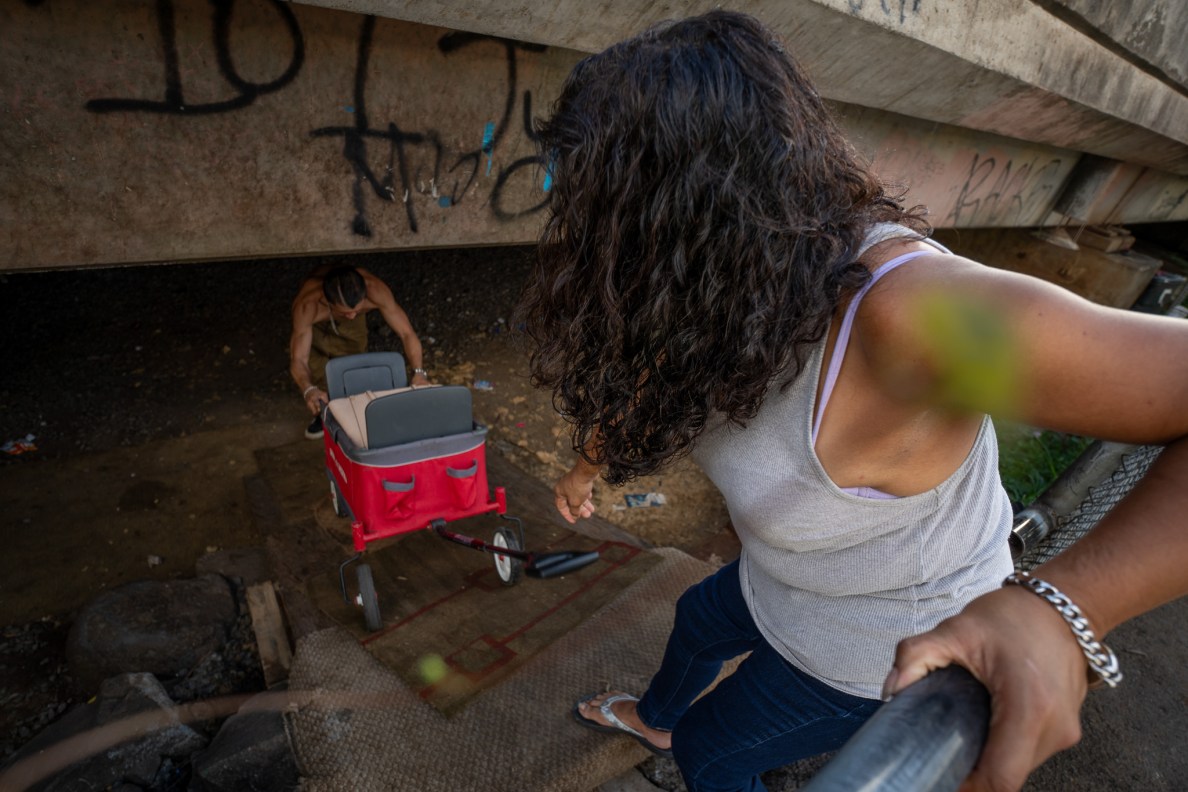
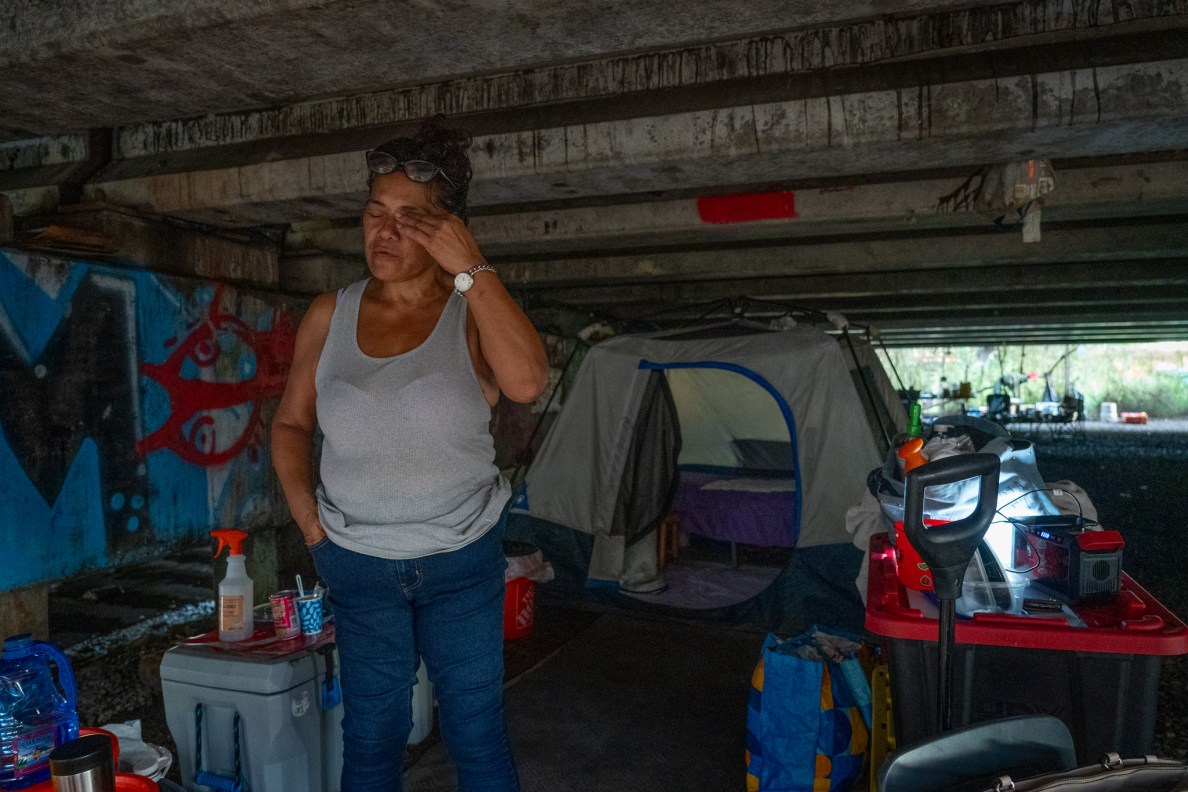
It’s dark, damp and cool under the overpass. Traffic rumbles overhead.
Mathias’s camp is next to a concrete foundation. A small tent is pitched there with a carpet in front of the entrance. Coffee grounds are sprinkled around the carpet to help deter bugs. She can’t afford store-bought bug repellent, Mathias says, so she improvises.
She prides herself on keeping the nearby stream clean, working to clear out trash, leaves and dead vegetation. She points to the water and says she saw an eagle ray swimming there a few months ago. It wouldn’t have been possible before, she said, because the stream was so dirty and congested.
5:20 p.m.
Honolulu International Airport
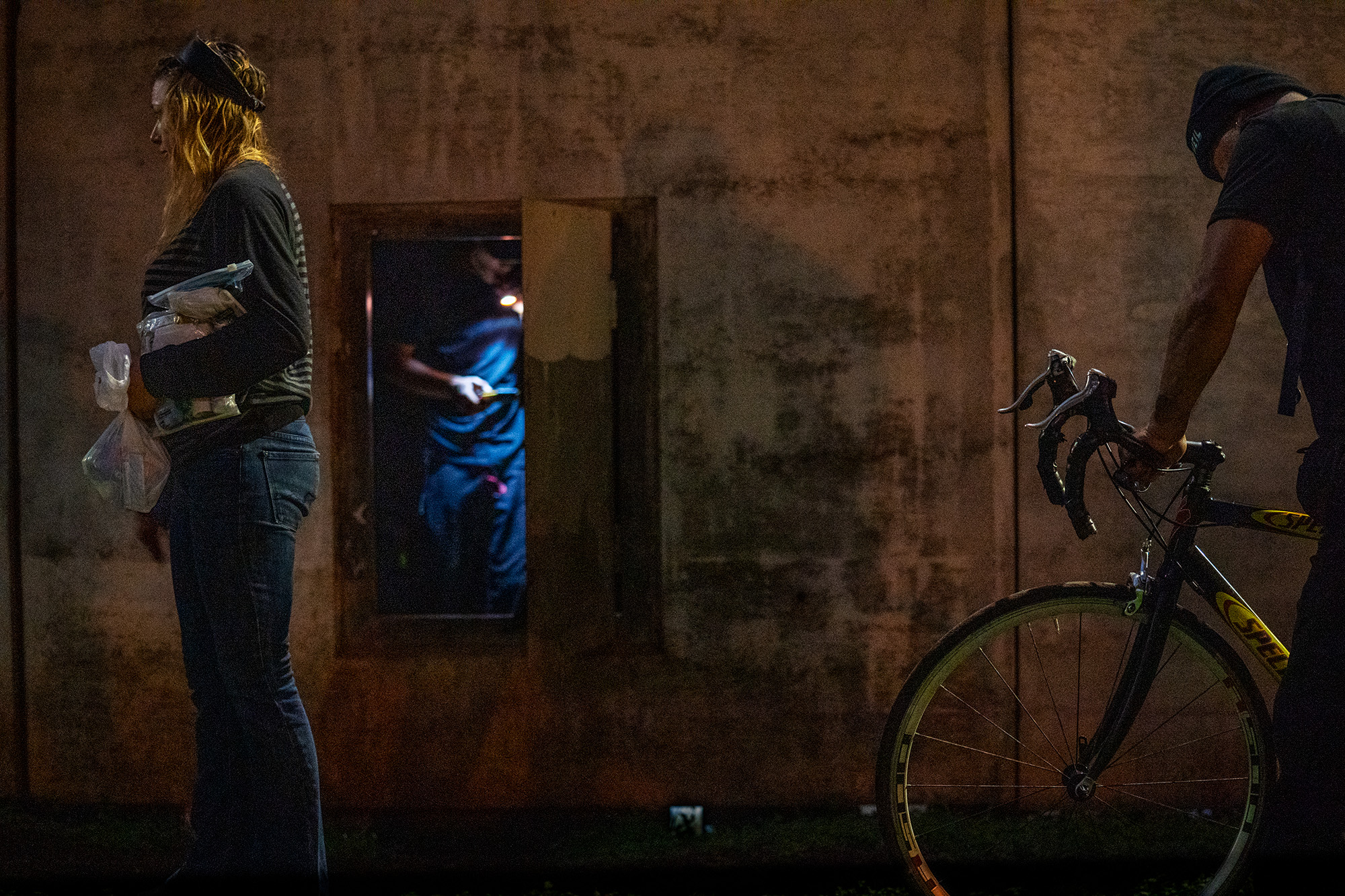
On this day of the annual census, Institute for Human Services Executive Director Connie Mitchell leads a team of four who have been asked to count the hardest-to-find homeless.
The team — and hundreds of volunteers — started their day before dawn. Workers had stopped by the airport in the morning and didn’t find anyone. As evening approaches, they’re giving it another try.
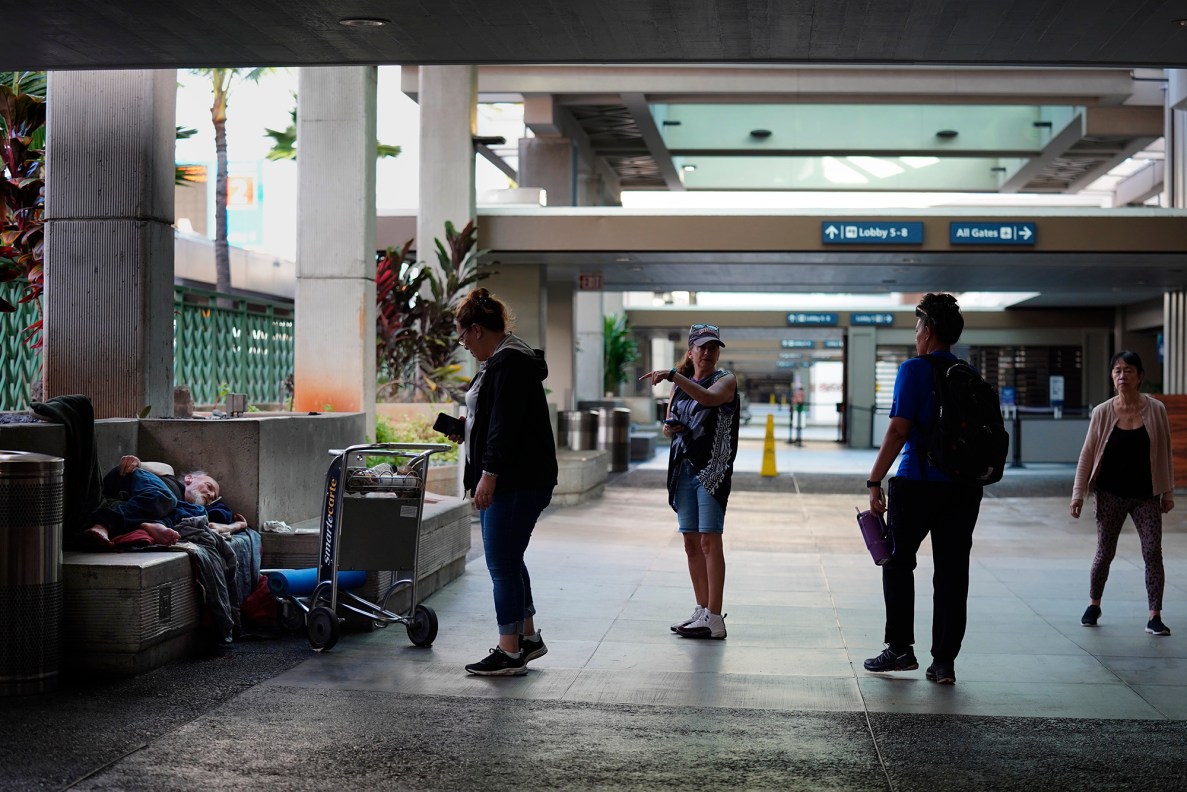
This time, they find three people, two of them asleep on benches. A team member using a proprietary IHS facial recognition app called Cupcake identifies a man with a gray beard after aiming her cellphone at him. The app includes information about people IHS staff have previously spoken to and entered into the nonprofit’s database.
The app shows the man regularly stays at the airport, is from Washington State and has indicated he’d be willing to return to the mainland.
In the Terminal 2 baggage claim, they spot a middle-aged man sitting alone, his belongings gathered on a baggage cart. He’s squeezing a plastic water bottle. The screen by the carousel reads Delta 465, arriving 5:59. Another screen flashes advertisements for a lūʻau and the Royal Hawaiian Center.
Sarah Rodrigues and another worker approach the man, and the bottle-squeezing intensifies. It’s clear he’s agitated by their approach, and Rodrigues sees a pocket knife at his side.
“He could be using it for food,” she said. Still, it’s clear he “doesn’t want to be engaged.”
The team walks away. Their next stop: Moanalua Community Park, where several people are living in a hidden opening along the side of a freeway onramp.


7:45 p.m.
Ala Moana Beach Park
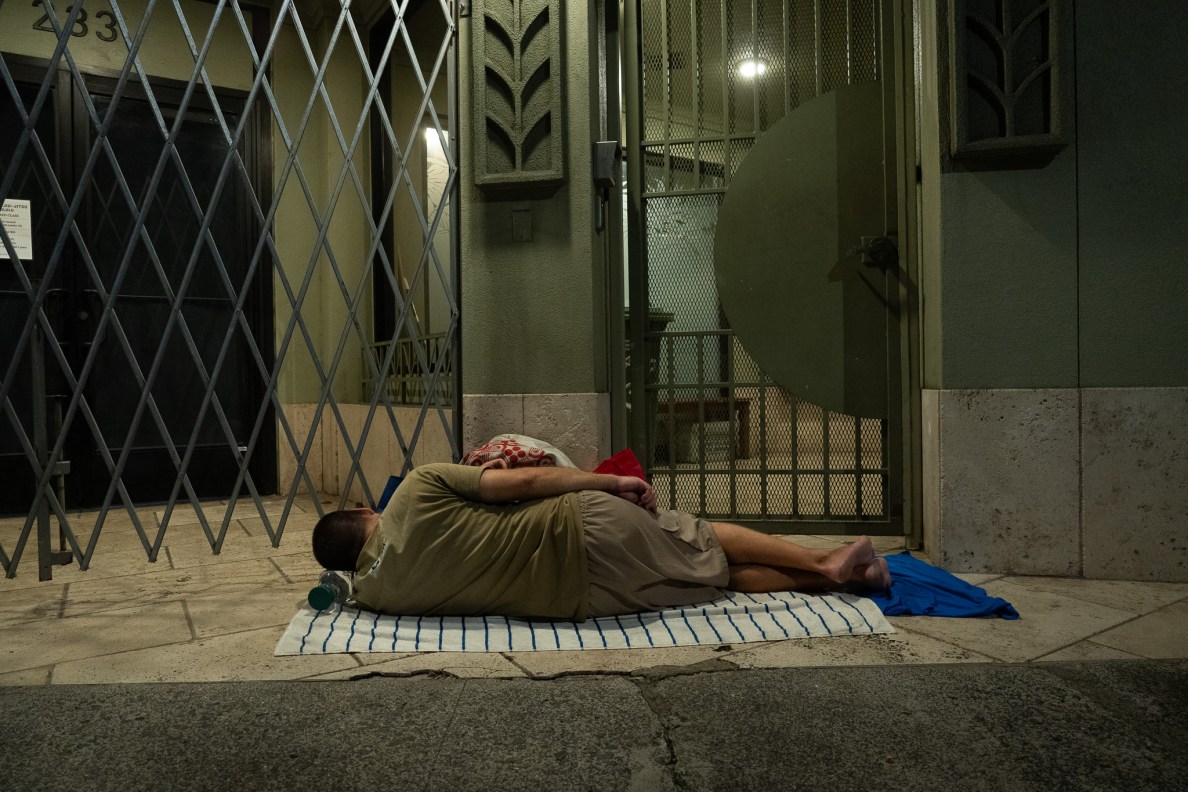
David John Tom, 55, is lying on his back on a striped blanket. It’s dark, but the lights from the mall parking garage across the street illuminate his face.

Tom is with a half a dozen people under an awning on the beach park side of Ala Moana Boulevard, all sprawled out between the benches. He takes a hit of something out of a small blue pipe and hands it to the person next to him. His legs are covered with fresh bandages that he got that afternoon at the Punawai rest stop.
In a few hours, he can be cited for being in the park after hours, which starts at 10 p.m. That’s happened about six times in the last year or so. But he doesn’t bother to go to court unless he gets picked up by the police.
Tom says he was evicted from public housing for not paying his electric bill. He should have been getting assistance with the bill, he says, because he qualified for a federal program that would pay it. But somehow that never came through.
He can deal with being homeless, but it’s a struggle sleeping outside, where his wake-up call frequently is by a cop.
“They’ll come at the oddest hour,” he says.
He typically moves around a few times in the night, then goes to sleep around 3 a.m., probably back where he is now.

10 p.m.
Sixteen hours after volunteers set out across the island looking for anyone who might be unsheltered, the annual homeless census comes to an end. The final tally: 4,539 people — a slight increase from the last count. There was one bit of good news: More of them were in shelters than two years before.
In Waiʻanae, at the hour that usually marks the start of their overnight shift, Anderina and Marianeina are getting a much-needed reprieve from work.
Tomorrow they will line up to wait for a Handi-Van around 8 p.m. — two full hours before their shift starts. They often end up hanging out in the restaurant for an hour before work, but it’s better than risking being late.
That dedication could give them the advantage they need to find — and keep — long-term housing, the ultimate and elusive purpose of every one of the millions of dollars spent on homeless outreach on Oʻahu. It’s the promise of every politician, the objective of every worker, the dream of every volunteer.
It is unlikely to be easy. Honolulu has one of the tightest rental markets in the country. The median rent for a one-bedroom is more than $2,000. It would take someone making minimum wage almost three full-time jobs to comfortably afford that.
Lead writer: Jeremy Hay
Reporters: Caitlin Thompson, Madeleine Valera, Stewart Yerton, Megan Tagami, John Hill, Leilani Combs, Marcel Honoré, Ben Angarone, Matthew Leonard
Photo and video: Kevin Fujii, Craig Fujii, Ronen Zilberman
Design: April Estrellon
Project editor: Jessica Terrell