6 In 10 Lost Power During Lala. It May Take A State Inquiry To Learn Why
HECO has spent millions of dollars to strengthen its electric grid in recent years. Lala still wiped out power for most of the state.
In the days after Hurricane Lala swirled near the islands leaving 6 in 10 Hawaiʻi households in the dark, one question loomed large: Why did the state’s electrical grid fail so badly?
Many residents who went days without power also had no electricity during the Kona lows that flooded parts of the state just a few months earlier. This time around, some are looking at several more weeks in the dark, particularly in hard-hit areas in rural Kaʻū on the Big Island.
With climate change increasing the frequency and potency of extreme weather, getting more detailed information on what went wrong and what can be done to prevent future outages is ever more urgent.
Hawaiian Electric Co. has known for years about the grid’s vulnerabilities in the face of extreme weather events such as a hurricane or tropical storm – and the challenges with restoring power after skies clear.
To address that, the company put forward a $190 million plan to strengthen infrastructure — funded in part by federal taxpayers — in 2021. Then the fires on Maui in 2023 forced HECO to shift focus from hurricanes to wildfires.
The utility has made significant strides in increasing surveillance and monitoring in areas at high risk for wildfires. But that’s come at a cost: less money than originally planned for projects such as removing trees that threaten power lines.
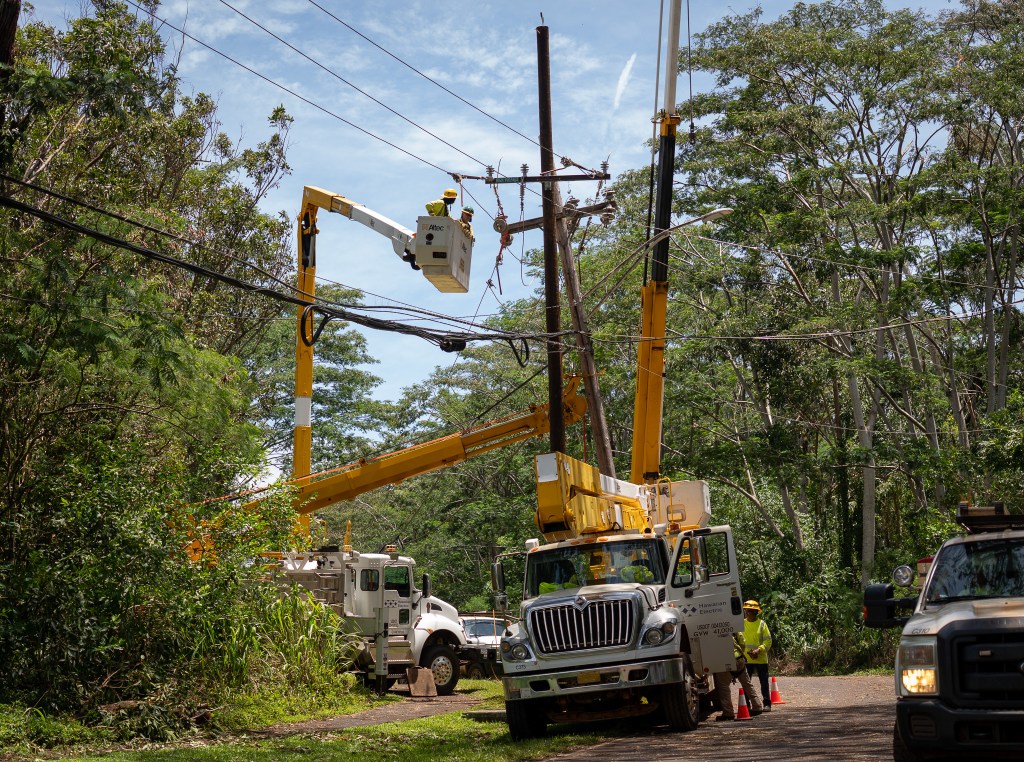
More than any other single issue, HECO now blames the Lala outages on invasive trees falling on transmission and distribution lines.
When the company’s equipment was put in decades ago, the brittle, fast-growing albizia trees weren’t as dense as they are today, notes Jim Kelly, HECO’s vice president of government and community relations and corporate communications.
“All the albizia that you see,” Kelly said, “That’s the No. 1 culprit. All it takes is an errant branch.”
“If this had been a Category 5 direct hit, how bad would it have been?”
Michael Colón, Ulupono Initiative
Beyond falling trees, why and where the grid is vulnerable to extreme weather – including what specific systems and equipment failed, why outages lasted for days in some places and what mitigation measures have worked best – isn’t clear without data from HECO that’s not publicly available.
Without a significant postmortem of Lala, the public and policymakers can’t determine how well HECO’s climate adaptation and resiliency projects have strengthened the grid against extreme storms – and how well prepared we are for the next one.
“If this had been a Category 5 direct hit, how bad would it have been?” said Michael Colón, director of energy for the Ulupono Initiative.
HECO’s Kelly calls a direct hit by a Category-5 hurricane “a worst-case scenario you don’t want to find yourself in.”
In an extensive 2018 analysis of the vulnerability of Oʻahu’s infrastructure if a hurricane or tsunami struck the island, Civil Beat asked “Are We Ready?” Lala and March’s Kona low storms suggest we’re not, despite HECO’s investments in resiliency.
Henry Curtis, who closely follows utility issues as executive director of the environmental group Life of the Land, is asking the Public Utilities Commission to open an investigation into the systemic causes of the outages related to Lala and the Kona lows. But the information he’s seeking is not easily found.
While the PUC requires HECO to report granular data on the causes of outages in areas prone to wildfires, Curtis says, there’s no such reporting requirement when it comes to extreme weather events.
Transparency must accompany the large grid-hardening expenditures being made and planned, Curtis wrote in a formal request to the PUC last week.
Neighborhoods Had Pockets Of Prolonged Outages
Such an investigation could help solve mysteries that have baffled HECO ratepayers.
Among the 190,418 HECO customers who lost electricity on Oʻahu was Miyuki Bridgewater of Mānoa. Bridgewater was accustomed to storm-driven floods while growing up in Indonesia. Compared to those monsoon floods, Lala, which had been downgraded to a tropical storm by the time it passed Oʻahu, “was nothing,” she said.
The power outage was another story. The home Bridgewater shares with her husband, two children and in-laws lost power for three days, from Aug. 14 through Monday, causing problems familiar to many of HECO’s Oʻahu customers: no way to cook, charge phones or keep food refrigerated over the long weekend.
Just as puzzling as why she lost power for three days was why neighbors on the next block didn’t lose power for very long, if at all. Bridgewater’s friend five houses away reported that she and another neighbor were fine during the outage.
Janet Cho, who lives two houses away from the Bridgewaters, told Civil Beat that her home’s electricity never shut off thanks to a solar system with battery storage. But she could also see from the solar system’s app that she lost power from HECO’s grid for only about two hours during the time that Bridgewater and the neighbors on her block lacked power for days.
“I was really surprised,” Bridgewater said.
It’s a situation that played out across Oʻahu before and after the storm. Kelly said the main cause of these patchworks of outages is that clusters of homes within a neighborhood are on different HECO circuits. So if a problem happens on one circuit, it can shut down power for one cluster of homes while the power stays on for the neighbors.
System Upgrades Focus On Wildfires
High winds are the archenemy of power lines and Lala brought them in force as it barreled through the ocean south of the Main Hawaiian Islands, narrowly missing direct landfall on the Big Island by just about 30 miles. Winds reached 91 mph in Kohala, according to HECO. Even Oʻahu, about 75 miles from the center of the storm, experienced winds upward of 84 mph at higher elevations.
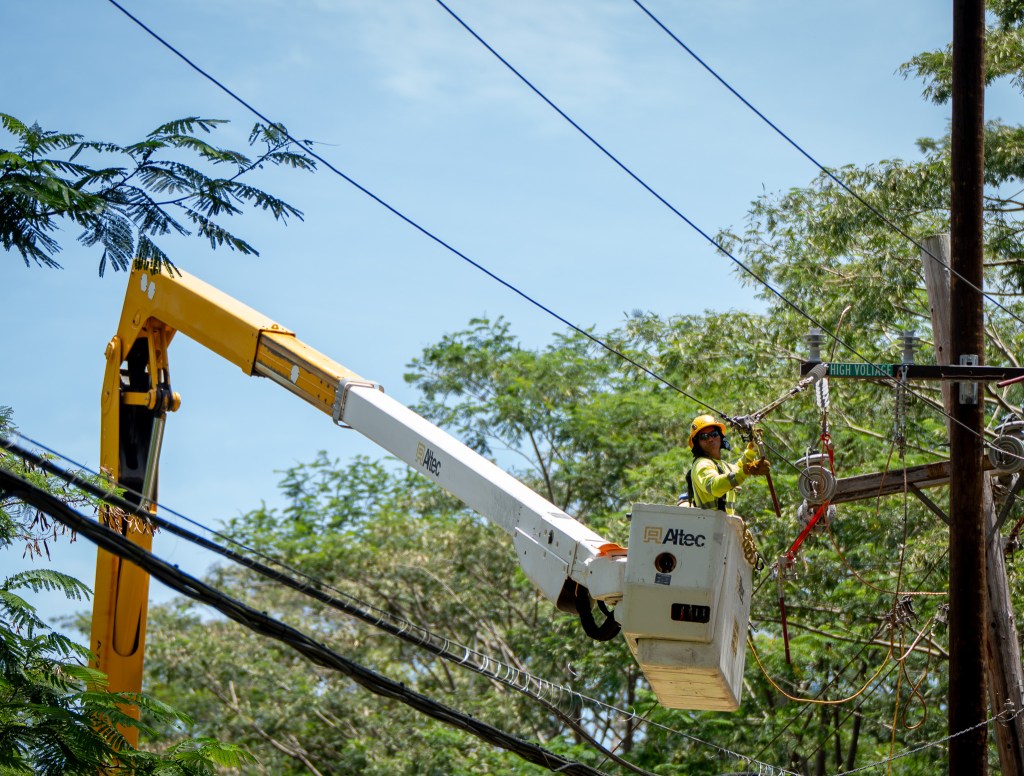
The damage was so extensive across the state that HECO had to fly in 100 linemen from California to help get the power back online. Most of them descended on the Big Island several days after the storm to find washed-out bridges and flooding and debris blocking roads, making it difficult to reach the dozens of broken electrical poles and downed lines.
It was against the backdrop of increasingly powerful storms that HECO in 2022 went to the Public Utilities Commission with a request to let the company charge customers just under $190 million over five years to fund what the company called its Climate Adaptation Transmission and Distribution Resilience Program.
“Ensuring that the Companies’ electric system can withstand and recover from severe disruptions and adapt to the changing climate is vital to the resilience of our entire community,” HECO said.
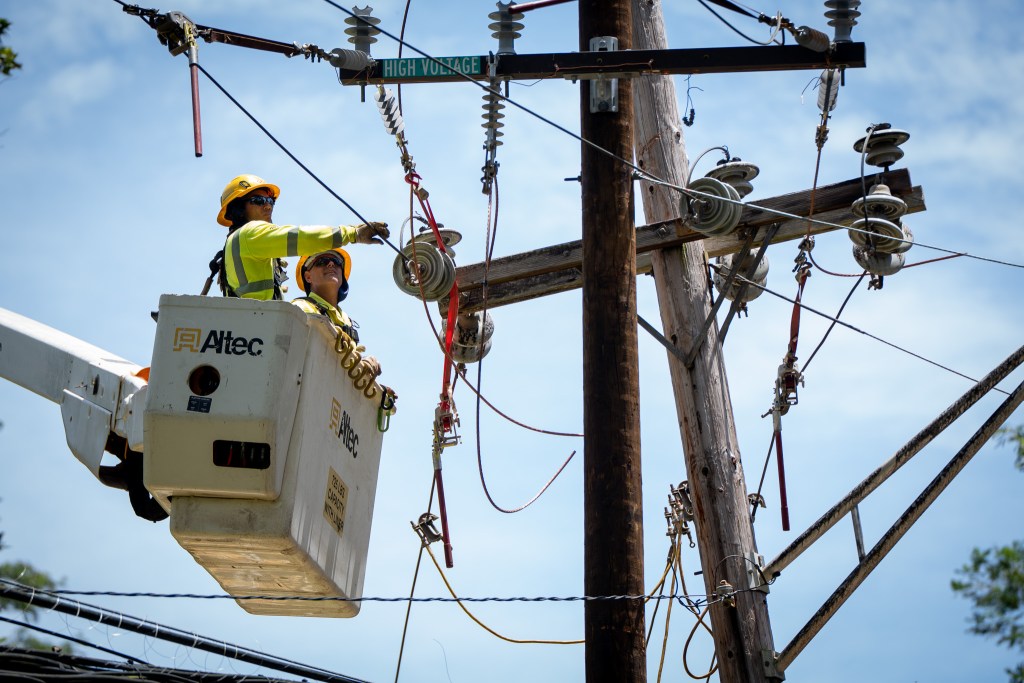
The application included $75 million for critical transmission hardening. Such work often entails crews repairing massive steel structures that carry the high-voltage lines, Kelly said. It also can include replacing older wooden structures with steel ones. Another $32.4 million was for “hazard tree removal” and $14.1 million for wildfire prevention and mitigation.
With the application pending, a fallen HECO power line sparked a fire that destroyed much of Lahaina and killed 102 people in August 2023. Wildfires suddenly rose to the top of the public’s mind, and HECO’s climate adaptation request playing out before the PUC morphed to focus on wildfire prevention.
As a result, fire prevention and mitigation funding approved by the PUC in 2024 more than doubled from HECO’s original request, critical transmission hardening was cut by almost half and hazard tree removal was cut by 65%, to $11.1 million.
In the years since, Kelly said the company has emphasized things that would be two-for-ones by both mitigating fire risks and making infrastructure more resilient during storms.
“Vegetation management, cutting back trees – that’s a definite twofer in high-risk areas,” he said.
Still, HECO has less money overall to remove trees, which it identifies as a main cause of outages.
“We’re still doing a lot of work,” Kelly said, “but if your budget gets cut, you’ll do less.”
Maybe most important for customers, by the time the PUC approved the plan, the federal government had agreed to pay $95 million of this, cutting costs to Hawaiʻi ratepayers by half.
HECO Has Made Progress On Some Upgrades
Given the federal money involved, HECO must file quarterly progress reports with the U.S. Department of Energy. The latest report, through the end of June, is a mixed bag.
HECO originally planned to move some distribution lines that bring power to consumers underground on Oʻahu but pivoted to focus that effort on Maui after the Lahaina fire.
The biggest strides have been in setting up monitoring systems in areas at high risk for wildfire, while efforts to strengthen the kind of high-voltage lines that went down during Lala have lagged.
Records show that improvements to prediction and monitoring systems in high fire risk areas are nearly complete. HECO finished installing 53 weather stations on the islands it serves and is nearly done putting up dozens of AI-enabled cameras that will eventually cover 99.5% of high-risk areas and 73% of medium-risk areas. The intent is to share access and alerts with fire departments and emergency responders so they can put out fires before they spread.
The company also spent more than $103 million between 2021 and 2025 to manage vegetation that threatened to cause outages across the state. So far this year, Kelly said HECO’s contractors have cut down 20,000 trees and pruned 25,000 others on Hawaiʻi island alone.
Efforts to strengthen infrastructure, meanwhile, are lagging. Projects to harden critical poles, transmission lines and distribution lines would decrease the likelihood of outages in high wind and storms or fires ignited by equipment, Kelly said. But delays in the scoping, design and approval have pushed back the work.
Improvements to the high-voltage transmission lines that carry power from substations have fallen significantly behind, too. These hefty lines were hit hard during Lala. Nine transmission lines were out on Oʻahu. Sixteen went out on Hawaiʻi island — the bulk of the island’s major lines. The transmission line that stretches from Hawaiʻi Volcanoes National Park to South Point Road and the one that feeds Upper Puna both have to be rebuilt, according to HECO. The project to strengthen those lines was supposed to move into the installation phase in June, but it’s still in the design phase.
Improvements to distribution lines – which bring power to consumers – are furthest along, about 70% completed. The company replaced nearly 8,000 fuses and more than 2,200 lightning arresters with fire-safe equivalents. But HECO is still in the process of replacing miles of devices that shut off electricity in case of problems. About 261 wooden electrical poles in communities across the state have been replaced with stronger or taller versions, with an unspecified number still to come.
Electrical poles played a major role in the outages following Lala. At least 60 were broken on the Big Island alone, with more than half concentrated in Kaʻū. At least 85 lines went down on the island, most of them in Puna.
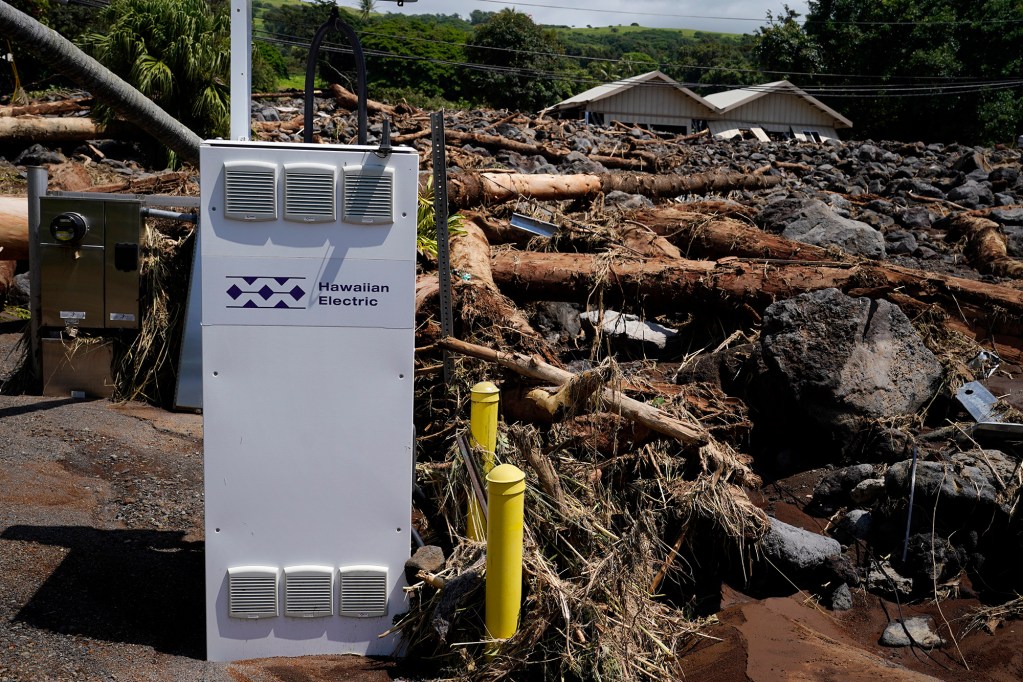
Most of the work to strengthen the infrastructure, Kelly said, has been in drier areas that are at risk of burning, such as the leeward side of the Big Island from Kona to Waikōloa – not the island’s southern regions that were devastated by Lala.
“We haven’t done anything but kind of the traditional resilience work done in Puna,” he said. “I’ll be straight up: The focus has been for the last almost three years on the highest risk wildfire areas.”
Energy Activist Calls For Transparent Investigation
Henry Curtis wants to know what all of this investment has meant for customers. HECO’s Kelly said the company will likely have to file a report on Lala with the PUC, although he didn’t expect it to include detailed information explaining why, for example, some circuits failed while others didn’t.
Curtis said that’s not enough. HECO could file such a report, he said, with heavy redactions, within an obscure ongoing PUC case, with no input from stakeholders.
“So much would be blacked out that it wouldn’t help us much even if we could find it,” Curtis said.

Instead he wants the PUC to use its statutory power to commence an investigatory proceeding, known as a docket, in which some parties could intervene, allowing them to submit formal information requests to HECO. Customers could submit public comments as part of the record. Everything would take place in a highly public forum.
His letter to the PUC asks the commission to look not only at Lala, but also March’s Kona low storms — the types of weather events that are becoming increasingly common in Hawaiʻi, with two in the past six months.
That some 60% of HECO’s roughly 450,000 customers statewide lost power during Lala, Curtis said, shows that the outages were a systemwide problem.
He wants the PUC to determine things such as which circuits and communities were interrupted, what proportion of those interruptions was attributable to the condition of equipment rather than wind and flooding alone, and how long each affected community waited for power to be restored.
HECO has ample data to answer these questions, Curtis said. It’s simply a matter of the PUC launching an inquiry.
Ulupono’s Colón said such an investigation is fairly common.
“Something like that is normal and to be expected after one of these events,” he said.
Ultimately, the PUC’s investigation could not only determine causes of outages but also help assess whether HECO’s resiliency projects are adequately addressing the risks posed by wildfires as well as extreme weather.
“We have a problem. We’re having all these disasters,” Curtis said. “What do we do so when the exact same thing happens in the future, we don’t get the same result?”
Customers already paying the nation’s highest costs for electricity, meanwhile, will have to decide how much more they’re willing to pay to keep the lights on during and after storms.
“We have solutions,” Kelly said. “The question is what choices do we want to make? How much do we want to pay? And are these solutions acceptable to communities?”