Lala’s Wrath: Homes Swept Away, Some Power Outages May Last Months
Widespread damage followed the tropical storm, including power outages, road closures and flash floods. Homes were damaged, and trees fell on cars and people.
Some 200,000 residents started their day without power on Oʻahu, Maui and Hawaiʻi island as Tropical Storm Lala traveled south of the islands on Sunday morning, with Hawaiian Electric warning power could remain out for weeks — or even months — in some of Hawaiʻi island’s hardest hit rural regions.
By mid-morning, the Kauaʻi Island Utility Cooperative reported that more than 4,700 Kauaʻi residents were affected as well. HECO reported more people lost power later that morning as crews worked to assess damage.
Although people awoke to learn Hurricane Lala had been downgraded to Tropical Storm Lala, the entire state remains under a tropical storm warning except for the Big Island, which was narrowly missed by the hurricane on Saturday but where weather conditions now are improving.
Gov. Josh Green estimates the storm caused hundreds of millions of dollars in damage statewide. Over 100 homes and eight bridges were damaged in the southern parts of Big Island, Green said. Some parts of the island received over 25 inches of rain, resulting in landslides, debris buildup and damage to local schools.

On Oʻahu, debris, palm fronds, downed trees, flooded roads and non-functioning traffic lights made travel difficult and city officials encouraged residents to hunker down at home. One large tree in Pualei Circle near Kapiʻolani Park on blocked the road entirely and crushed the bed of a Toyota Tacoma.
The Hawai‘i Emergency Management Agency is advising residents and visitors to avoid unnecessary road travel due to hazards and emergency workers needing to operate. Travelers should check with airlines before going to the airport, which are not equipped to provide shelter during the storm.
Get updates on Lala and more with Civil Beat’s free daily newsletter:
Randal Collins, director of Honolulu’s Department of Emergency Management, warned people to stay off the roads on Sunday and remain vigilant. Casualties often come after a disaster as people handle heavy machinery and begin repairs and clean-ups in their communities, he said.
As of Sunday morning, there were 215 individuals in Big Island shelters, Green said. On Oʻahu, the city’s eight refuge areas had 117 people.
Green said he plans on seeking a major disaster declaration for the state, just as he did following the Kona lows in the spring. The state has set aside $100 million that can help with storm recovery, he said.
All airports are open, Green said, but flights have been cancelled. Hawaiian Airlines alone cancelled 52 flights statewide today, he said. Around 190 total flights were cancelled or delayed yesterday.

Emergency Rescues On Big Island, Oʻahu
Hawaiʻi County Mayor Kimo Alameda said early Sunday that “several occupied homes may have been swept off their foundations.” Search and rescue operations, the mayor said, were complicated overnight by rushing water, boulders on the roads and low visibility.
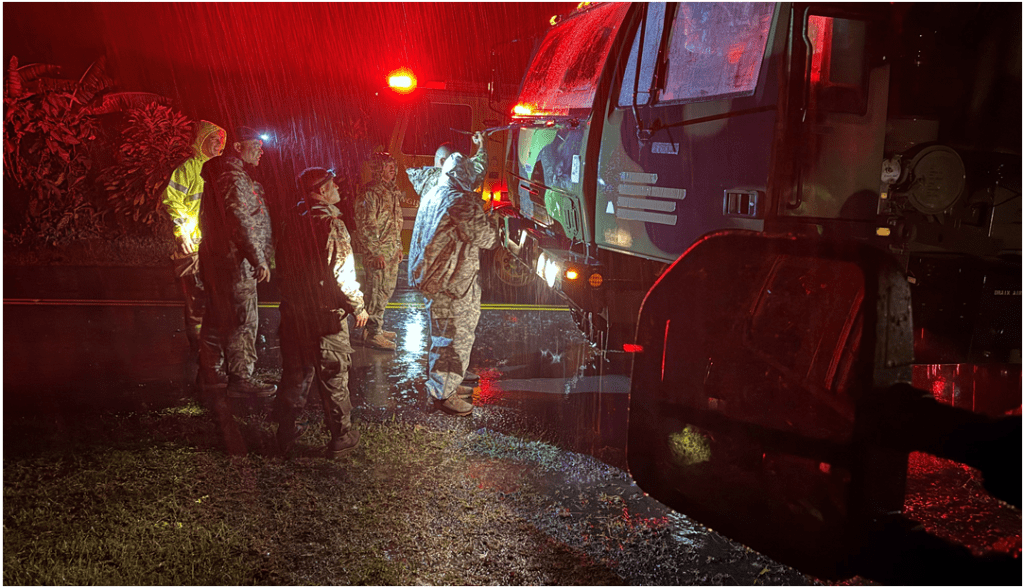
In coordination with the Hawaiʻi National Guard and the Coast Guard, Hawaiʻi County started search and rescue operations in Nāʻālehu and Waiʻōhinu in the early hours of the morning to reach people who had called 911 for help but weren’t reachable due to flooding.
Rising waters cut off road access to Kaʻū, and the county said homes in the area were flooded. The National Guard has high-water vehicles to reach people who called emergency services for help, and the Coast Guard’s helicopter is assisting. People rescued are being taken to the Robert N. Herkes Gym in Pāhala and the Department of Public Works base yard.
On Saturday, the mayor had confirmed there was one death after a vehicle collision at Hawaiian Ocean View Estates, and three people were seriously injured after a tree fell on them in Puna. Officials said on Sunday afternoon that the fatality was not necessarily storm-related. It occurred around 1:17 p.m. when a 45-year-old man from the Ocean View Estates subdivision collided head-on with a 21-year-old woman on Aloha Boulevard. The woman, also from the subdivision in the southern part of the island, remains in critical condition.
Another individual was found dead near Kalihi Stream on Oʻahu. The city is determining if the death was related to the storm, Honolulu Mayor Rick Blangiardi said.
As of Sunday late morning, the Honolulu Police Department was overseeing two rescue missions in the Waiāhole-Waikāne area, Police Chief David Lazar said. The rescue missions involve a total of 12 victims across four homes, including two elderly people who were trapped because of a flood, Lazar said.
Workers with a state task force had to rescue two paramedics whose county truck was tossed around by floodwaters in Nāʻālehu, according to Maj. Gen Stephen Logan, the state Department of Defense’s adjutant general.
Hawaiʻi Power Outages And Maps
Downed transmission lines – the high voltage lines that carry power from the power plant to the substation where it is connected to neighborhood power lines – have plunged thousands of people across the state into darkness, according to HECO. Sixteen transmission lines are out on Hawaiʻi island, the bulk of the island’s major lines. Nine are out on Oʻahu. This is the primary cause of power outages across the two islands, according to Jim Kelly, HECO’s vice president of government and community relations and corporate communications.
Check The Latest Power Outages In Your Area
Big Island power outage map from Hawaiian Electric Co.
Maui County power outage map from Hawaiian Electric Co.
Kauaʻi power outage map from Kauaʻi Island Utility Cooperative
“It doesn’t matter how many poles we fix in your neighborhood, they’re not going to be getting any power,” Kelly said on Sunday morning. “So we’ve got to focus on restoring those transmission lines first.”
As of Sunday at 7 a.m., Hawaiian Electric said the following areas were in the dark:
• Hawaiʻi Island: About 58,000 customers were without power including all of the east and southern sides of the island plus Waimea and Honoka‘a
• Maui County: Approximately 28,700 were without power in all of West Maui, parts of Upcountry, South and Central Maui, Ha‘ikū, and areas of Lāna‘i and Moloka‘i.
• Oʻahu: About 110,700 were without electricity, mostly in parts of Leeward O‘ahu and Honolulu as well as Windward O‘ahu.
Since the start of the storm, Hawaiian Electric has restored power to more than 63,000 customers. The company is bringing in 100 crew members from the mainland to help restore power later this week.
More than 36,000 customers on Kauaʻi, serviced by the Kauaʻi Island Utility Cooperative, were without electricity as of just before 10 a.m.
Customers can call HECO’s trouble lines to report downed power lines, which should be treated as energized and dangerous:
- Hawaiʻi Island: 1-855-304-9191
- Maui County: 1-855-304-8181
- Oʻahu: 1-855-304-1212

When Will Power Be Restored In Hawaiʻi?
The problem will take time to fix. Particularly on Hawaiʻi island, many of these transmission lines run through wooded areas where albizia trees can take out the line. HECO is working on inspecting the fallen lines via helicopter, Kelly said, but that is dependent on conditions. Kelly is reminded of Tropical Storm Iselle in 2014 where roads were impassable and albizia trees took down important lines, causing extended outages.
Restoring the electrical infrastructure will take weeks or even months, particularly in rural areas of Hawaiʻi island where transmission lines may be difficult to reach. In places like Puna, HECO has previously run into challenges reaching the equipment that needs to be fixed. The utility company doesn’t clear trees from roads, so it requires coordination with the state and the county.
“The topography, the geography, the vegetation, all of that combines in a situation like this to make it very challenging, and that’s why people just have to be patient,” Kelly said. “People who live in those areas – they’re tough. They’ve been through a lot. They’ve been through storms before.”
HECO had originally planned to send linemen based on Oʻahu to neighbor islands once the storm had passed to help get the system up and running, but with extensive damage on Oʻahu, it became clear that more crews would be needed.
“It doesn’t matter how many poles we fix in your neighborhood, they’re not going to be getting any power.”
HECO spokesman Jim Kelly, noting transmission lines are down.
HECO had to call in assistance from the mainland, and 100 linemen from California will be arriving in the state in the coming days, with most arriving on Tuesday, according to Kelly. HECO has mutual aid agreements with other utility companies, so crews can be called in from the wings if needed.
“When we do it, it’s because we really need it,” Kelly said.
While parts of Hawaiʻi island may be without power for much longer, Kelly anticipates customers on Oʻahu and Maui will see more places come online sooner. Maui’s electrical infrastructure came through the storm in better shape than Oʻahu and Hawaiʻi island, and the island was spared extensive damage to transmission lines. While more than 28,000 were in the dark as of 8 a.m. on Sunday morning, Kelly expects many will come online throughout the day.
In the meantime, the utility company is urging people who do have power to conserve electricity to avoid straining the operating transmission lines.
Flash Flooding, Flood Watches As Lala Passes Oʻahu
The National Weather Service issued a flash flood warning for Kaua‘i as gusts and rain picked up in Līhu‘e before noon. A flood watch was issued for Oʻahu through late Sunday.
On Oʻahu, Mayor Blangiardi said on Instagram that the Mānoa Stream was “extremely swollen” with raging waters.
Mānoa Stream jumped from just over 4 feet on Saturday afternoon to 14 feet early on Sunday morning, briefly putting it in the range of major flooding, according to the National Water Prediction Service. The stream levels have since dropped to under 8 feet, below flood levels. No evacuation notices were issued overnight.
As of Sunday morning, only one Oʻahu stream – South Fork Kaukonahua Stream in Wahiawā – was facing minor flooding, according to the National Water Prediction Service. The steam levels rose from just over 2 feet on Saturday afternoon to 8 feet on Sunday morning.
River and stream levels began receding on the Big Island Sunday morning. Wailuku River in Hilo dropped down to 15 feet sunday morning, from a peak of over 23 ft, a minor flood stage, at 6pm on Saturday, according to the U.S Geological Survey.
The usually dry Paʻauau Gulch in Pāhala, the worst hit southern portion of the island, peaked at over 6 feet, a minor flooding stage, at 7:20pm Saturday night. The water gauge malfunctioned an hour later.
Streams across the island swelled with flood waters on Saturday evening, pouring water over bridges and roads and into towns and residents’ homes and businesses, especially in the hardest hit southern region of Kaʻū and Puna.
By mid-Sunday morning, the rain had slowed to a light mist in South Maui. Flood waters in coastal neighborhoods along South Kihei Road— notorious for severe and frequent floods — began to recede, including on intersections that were underwater for many hours during Kona Low storms earlier this year.

Road Closures
Dozens of roads across Hawaiʻi were closed Sunday as Lala skirted below the island chain.
Downed power lines and trees forced the closure of many roadways across Hawaiʻi island, according to the county hazard map. Social media reports showed mudslides had strewn earth and rock across roadways, and flooding made many streets hazardous or impassible.
The County of Kaua‘i reported multiple road closures in Wailua Homesteads, ‘Ōma‘o and Kōloa due to downed trees or power lines. Kūhiō Highway near Hanalei Bridge is closed.
Storm Damage
The Honolulu Fire Department responded to over 120 storm-related calls as of 2 a.m. on Sunday, including 58 downed trees and 39 blown roofs, according to the mayor’s office. By early Sunday morning, 93 people were in the city’s eight refuge areas across the island.
TheBus resumed services at 8 a.m. after it had halted service Saturday evening amid concerns about unsafe road conditions.
One family in Kalihi completely lost the roof of their home, KHON reported.

Two Big Island Department of Education campuses – Nāʻālehu Elementary and Kaʻū High and Pāhala Elementary – are also facing closures after the storm. Nāʻālehu Elementary will be closed from Monday to Thursday because of road closures and storm damages to campuses, while Kaʻū High and Pāhala Elementary will be closed on Monday for officials to assess the campus and roads, the education department said in a press release.
At Nāʻālehu Elementary, brown water and mud covered some classroom floors and caked part of the campus’ grassy field. Debris and fallen traffic cones littered the driveway of the school.