

FBI Records Raise New Questions About Murder-For-Hire Plot
Search warrant affidavits, confidential until now, reveal new details about the investigation into a plot to assassinate a federal judge and prosecutor.
The first calls to the FBI came in just after Christmas Day 2023: Sheri Tanaka was looking for a hitman, an informant said.
At the time, Tanaka, an attorney, was a co-defendant in a high-profile bribery case alongside former Honolulu prosecutor Keith Kaneshiro and one of his top campaign contributors, Dennis Mitsunaga, founder of one of the state’s most politically connected engineering firms. The government alleged that Kaneshiro accepted campaign donations from Mitsunaga and his associates in exchange for prosecuting an employee Mitsunaga was having problems with. Tanaka worked for Mitsunaga.
Their trial was set to begin that February but, according to the informant, Tanaka and her uncle, Michael Irish — a prominent businessman known as the King of Kimchi because he owns several brands that produce the fermented food — wanted someone to “get rid of” U.S. District Court Judge Michael Seabright and Assistant U.S. Attorney Michael Wheat, who was spearheading the prosecution.
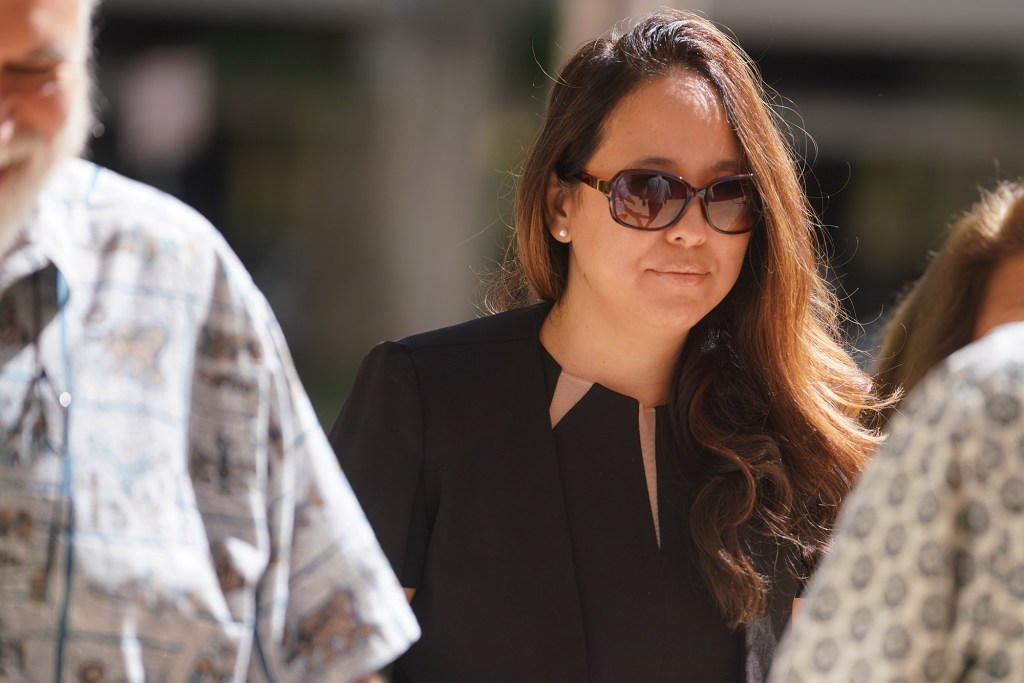
The informant told authorities that Tanaka and Irish also wanted their assassin to “take care of witnesses” and burglarize Tanaka’s offices to steal documents she didn’t want prosecutors to find. Some of those witnesses targeted for intimidation and coercion, according to the informant, included Tanaka’s own co-defendants.
No price was too high, the informant said he was told, and Tanaka and Irish ultimately offered to pay $100,000 to whoever took the job.
What happened next is detailed in newly unsealed court records that Civil Beat sought to make public with the help of the Public First Law Center.
The documents, which include more than a dozen search warrant applications and FBI affidavits supporting requests to raid suspects’ properties and collect cellphone data, show how Justice Department officials responded to the informant’s allegations and the push by authorities to corroborate what they were told about a plot to kill high-ranking federal officials just before one of the state’s most consequential public corruption cases.
The records also show that as investigators were closing in, Tanaka and Irish, in particular, had figured out that they were being watched. In Irish’s case, he even told an undercover agent posing as a hitman, “we have the FBI on us.”
What the records don’t explain is why the investigation fizzled and why no additional arrests were made, especially since the documents show the FBI was gathering what it described as credible evidence against Tanaka, Irish and their own informant, that included the exchange of money and recorded conversations in which their plan was detailed and discussed.
“When a judge is threatened and a U.S. attorney is threatened this isn’t something that should just disappear into a black hole.” — Alexander Silvert
Ken Sorenson, the U.S. Attorney for Hawaiʻi, did not respond to a Civil Beat request for comment about the investigation. Neither did the U.S. Attorney’s Office in Arizona, which was assigned to lead the investigation after local prosecutors were taken off the case.
Alexander Silvert, a former federal defender, said the public deserves more answers given the gravity of the allegations and the fact that no resolution has been announced.
“When a judge is threatened and a U.S. attorney is threatened this isn’t something that should just disappear into a black hole,” Silvert said. “It leads one to question whether in one way, shape or form the investigation was mismanaged.”

The murder-for-hire allegations, which first came to light in February 2024, delayed the DOJ’s bribery case. Seabright, the presiding judge, recused himself and so did every other federal judge in Hawaiʻi. A new judge was flown in from Alaska. Seabright and Wheat were given 24-hour security details.
Tanaka’s attorney, Mark Mermelstein, had argued in public court hearings that his client was the victim of an extortion scheme and that “she believed certain individuals sought to harm her and her family.” He said he had witnesses who could testify in support, but that doing so would “expose these individuals to harm from the extortionists.”
Tanaka, Mitsunaga, Kaneshiro and the other defendants were eventually found not guilty in the bribery case. The alleged assassination plot was never put before the jury.
Tanaka did not respond to a Civil Beat request for an interview and Irish declined to comment.
Irish’s attorney, Michael Proctor, said in an email that the federal government’s investigation was based on “false and misleading information from an informant” and repeated the assertion that Tanaka was the “victim of an extortion attempt by this informant.”
“Mike Irish came forward immediately and cooperated with the government and provided objective evidence that he committed no wrong and handled the matter appropriately,” Proctor said. He added that in 2025 the government sent him a letter stating that officials had closed the investigation into his client.
Proctor declined to provide a copy of that letter.
Two Banks, $50,000 Cash
As the defendants were preparing for a trial set to begin in late winter, Tanaka filed a motion to remove Wheat and his assistant federal prosecutors from the case for what she said was misconduct. On Dec. 8, 2023, just a few months before trial was to start, Seabright, who was still the judge on the case, said no.
Three weeks later, one of the FBI’s confidential informants came to the agency with a stunning allegation – that Tanaka and her uncle, Michael Irish, were seeking a person who could get rid of Seabright and Wheat which the informant “understood to mean that Tanaka and Irish wanted USDJ Seabright and AUSA Wheat murdered,” FBI agent Gregory Turner wrote in an affidavit.
The informant also reported that Tanaka and Irish wanted witnesses in the case, which included some of the other co-defendants “intimidated, coerced, obstructed with and/or threatened.”
In addition, the informant said Tanaka wanted someone to break into an office she’d used at Mitsunaga and Associates and steal evidence she believed would incriminate her.
The next day, the FBI opened an investigation into the hitman scheme. It relied heavily on the informant who, the FBI discovered, wasn’t always truthful with investigators. He lied about pocketing some of Tanaka’s money and he communicated with Tanaka and Irish when he wasn’t supposed to and without the FBI’s knowledge.

Still, Turner wrote that the FBI was able to corroborate much of what the informant was telling investigators through bank records and by recording some of the conversations he was having with Tanaka and Irish. “Consequently,” he said, “FBI personnel have found much of the information provided by (the informant) to be credible.”
The suspects all used WhatsApp to communicate and even came up with their own code names. Tanaka was “Sis,” the informant was “Braddah.”
Two days after Tanaka first talked to “Braddah,” she withdrew $50,000 from two Wells Fargo branches in Southern California, where she lived. The FBI interviewed a bank teller who remembered helping Tanaka. She had to go to a second branch because the first one didn’t have enough cash on hand.
Airline records showed Tanaka flew to Honolulu the next day. The flight got in late but the following day she told the informant she wanted to meet him to confirm he was “a real person.” They met in a parking lot near Ala Moana Center. The informant told her he’d found someone to take the job.
A short time later, Tanaka and Irish met up at Irish’s business, according to cellphone records that track locations. Security footage near the building also showed them meeting there.
Braddah tried calling Wheat, the assistant U.S. Attorney, but got no answer. He left a message and asked that Wheat call him back. Then the informant made his own trip to the bank, depositing the first of what would add up to $44,000 in he and his wife’s bank accounts.
The informant told the FBI he also had another three-way call with Tanaka and Irish and that they offered to pay $100,000 to take care of Wheat and Seabright and break into the law offices. Braddah said he’d give the hitman Irish’s cell number so they could speak directly.
But, according to Turner, by the time the hitman, who was really an undercover FBI agent, called Irish, Irish told him “things were changing” and he should call Braddah to find out what was going on.
On the day after New Year’s in 2024, the FBI recorded a call between Braddah and Irish.
Irish said he “was no longer interested in helping Tanaka with her plans and that he was only supposed to help with the exchange of money.” He told Braddah he wanted the money back that he’d already given him but later said he didn’t care, he just didn’t want to be involved any more.
“We have the FBI on us,” Irish told the undercover FBI agent in another recorded call, and “they’ve been tapping all our phones.”
Irish said he “found out this from my niece that this had happened.”
“All I only said was I don’t want any part of this,” Irish told the agent. “I said I don’t even know why she would give you guys fucking $50,000. I don’t even know why she’s talking to you guys.”

