Hawaiʻi Mormon Population Growing, Diversifying In U.S.
The history of Latter-day Saints in Hawaiʻi can be traced back to the 1850s.
The membership of the Church of Jesus Christ of Latter-day Saints, or more commonly known as the Mormon Church, has been getting more diverse over time, with the religion popular in the Pacific Islands and growing slightly in Hawaiʻi.
The Aloha State has the highest concentration of Latter-day Saints outside of the region around Utah, where members began settling in 1847 while fleeing persecution.
Latter-day Saints make up 1 to 2% of the adult population in the United States. But that proportion is more than double in Hawaiʻi – at around 4%, up from 3% in 2014.
Last month, the Pew Research Center released a report titled, “Tradition and Change Among Latter-day Saints in the U.S,” which found that the Church has grown more racially and ethnically diverse: The proportion of Latter-day Saints who are white fell from 85% in 2007 to 72% by 2024. In the same time period, the proportion of Hispanic adults doubled from 6% to 12% and Black membership grew from 2% to 6%.
Those who identified as “other/multiracial,” went from 3% in 2007 to 7% by 2024. Hannah Taber with the Pew Research Center said that 7% of people who identify as Native Hawaiian or other Pacific Islander throughout the U.S. also identified as Latter-day Saints.
A higher percentage of members also described themselves as immigrants, or children of immigrants: 13% in 2007 said either they or their parents were not born in the country, in comparison to 21% in 2024.
Historian W. Paul Reeve, a Mormon studies professor at the University of Utah who authored the book “Religion of a Different Color: Race and the Mormon Struggle for Whiteness,” said that for a long time, the church excluded people with Black African ancestry from priesthood ordination and admission to the religion.
“That sentiment continues to exist despite the fact that the church itself has made strides to overcome its racial past,” he said.
Latter-day Saints In The Pacific
According to the latest figures from the World Population Review, the U.S. has the largest population of those who identify as Latter-day Saints. But the top 10 countries with the highest percentage of Mormons are all located in the Pacific Islands, according to 2021 estimates by Church News, a Salt Lake City paper owned by the Latter-day Saints.
Tonga takes the lead at 63.5%, Samoa at 42.5%, followed by American Samoa, Kiribati, Marshall Islands, French Polynesia, Niue, Micronesia, Cook Islands and Vanuatu.
Hōkūlani Aikau, author of “A Chosen People, A Promised Land: Mormonism and Race in Hawaiʻi,” is Native Hawaiian and was raised in the faith but no longer practices. She said that the history of Latter-day Saints in Hawaiʻi can be traced back to the 1850s when George Q. Cannon, along with nine other Mormon missionaries, first came to Hawaiʻi and began proselytizing to haoles.
But at the time, there was “a high level of anti-Mormon discrimination happening both in the United States and in the dominant churches in the Pacific,” she said, so the missionaries had a difficult time.
The dominant narrative is that Cannon had a vision after a Hawaiian kūpuna took him in with kindness, that “Hawaiians are part of the lost tribe of Israel.” He took it as a sign that the missionaries should “shift their focus from haoles to bringing the gospel to Hawaiians.”
“Hawaiians hear their message and then think, ‘maybe this religion and its commitment to ancestors and land, and cultural continuity and preservation, is a legitimate alternative to the Catholics and the Protestants,” said Aikau, who is also the director of the School of Indigenous Governance at the University of Victoria. “The Church offered something material for them that allowed them to maintain their spiritual cultural practices, even in a limited kind of way, which is no small thing for Indigenous people.”
Hawaiian Latter-day Saints then started going to Tonga, Samoa, and other Polynesian islands for missionary work, she added, and the Church sponsored a lot of migration to the U.S. through its relationships and networks.
In her book, she also writes that “the LDS Church has been complicit in the colonization of Native Hawaiians while at times also providing a necessary refuge for its members,” emphasizing how both things can be true at once.
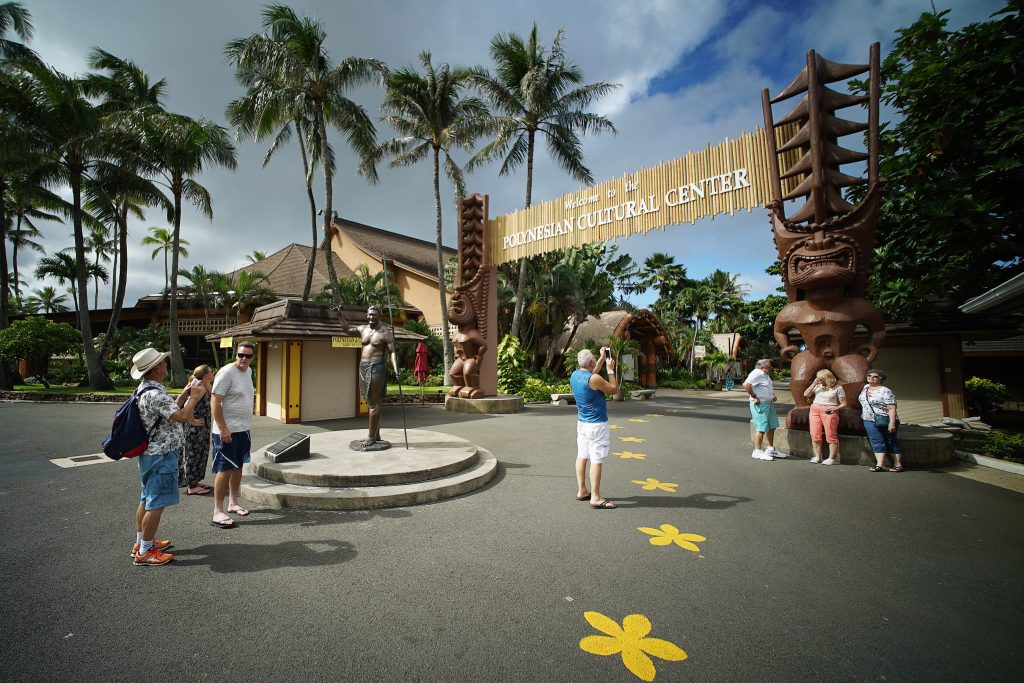
In 1865, the Church purchased 6,000 acres of land in Lāʻie, which allowed Native Hawaiian converts to move there and live. Between the Polynesian Cultural Center, Brigham Young University-Hawaiʻi, and the Lāʻie Temple that was built in 1919, the first Latter-day Saints Church to be built outside the contiguous U.S., “the area became the cultural center, spiritual center, and then an educational center of the Church in the Pacific,” Aikau said. Many BYU students work at the Polynesian Cultural Center through a work study program.
“The entire Lāʻie area is designed to center the temple on a hill,” Aikau said. “You drive down Kamehameha Highway and when you turn and look: All roads lead to the temple.”
“That is no accident, that is city planning,” she continued. “That is Mormon belief written on the land.”
Social Trends
The Pew Research Center report also found that young women who are born into the faith are more likely to leave the Church than their elders. About two-thirds of women over the age of 50 who were born into the faith still identify as Latter-day Saint, according to data as of 2024. But half of women in their 20s who were raised in the Church had left the religion, according to Pew’s survey.
Jana Riess, author of the forthcoming book “Leaving Mormonism: Who Is Exiting the Church of Jesus Christ of Latter-day Saints—and Why,” writes that it’s about the “three Ps”: “young women are reacting against politics, purity culture and powerlessness.” She writes that young women are more liberal, and those who are liberal are more likely to leave religion in general.
Latter-day Saints women are also getting ahead in education. In 2007, women’s graduation rates were 8% behind that of men. As of 2024, women were more likely than men to hold a bachelor’s degree, 40% to 34%, respectively.
Figures released by BYU-Hawaiʻi show that 57% of its students were women last year, while 43% were men.
Latter-day Saints are also overwhelmingly affiliated with the Republican Party and were among the country’s most politically conservative groups when asked about their ideology by researchers: 73% identified as Republican or Republican-leaning independents.
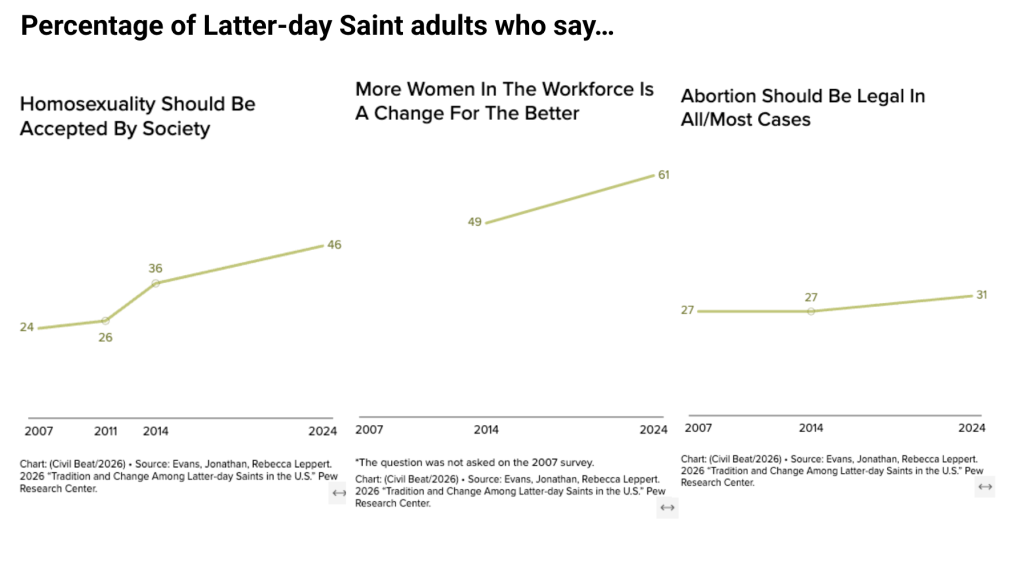
But the report showed many were more liberal on some social issues: 46% of those surveyed said that homosexuality should be accepted by society, compared to 24% of those who were asked the same question two decades ago. There was also an increase in those who believed that more women in the workforce is a “change for the better.”
Views on supporting legal abortion, however, have remained largely unchanged. The majority, roughly 70%, believe abortion should not be legal in all or most cases.
In response to requests to interview BYU-Hawaii faculty, Bryce Pendleton, the school’s director of communications, sent Civil Beat a statement from the church.
“Across the globe, The Church of Jesus Christ of Latter-day Saints is experiencing a season of spiritual vitality and growth,” the statement said, noting the church has 90,000 missionaries currently serving worldwide. “Official Church records show consistent worldwide increases in both membership and participation. We are encouraged by increased participation among our children, youth and young adults in the United States over the past decade.”
The church invited people curious about the faith to “come and see for themselves.”
“The truest measure of the Church’s growth,” the statement said, “is found in the increased joy and purpose reflected in the daily lives of its members.”