

Is OHA’s Board In For Another Shakeup?
Incumbent At-Large Trustee Keoni Souza trailed former City Councilmember Ikaika Anderson in the Primary Election.
The outcome of the race for three at-large seats on the Office of Hawaiian Affairs Board of Trustees has the potential to change the makeup of the board as it faces several crucial decisions.
Although trustees are aligned on most issues, the three incumbents running are part of a majority faction of the board led by Chair Kai Kahele in a dispute over how to handle a lawsuit from deposed CEO Stacy Ferreira. Her lawsuit claims the trustees retaliated against her for reporting Kahele to the state ethics commission.
The board plans to announce finalists to replace her on Monday.
The board has also found itself split over whether it should move forward in exploring the acquisition of the television stations KITV and KIKU.
Just one win by a newcomer could be enough to change the outcomes of those and other issues.

The incumbents are Brickwood Galuteria, Keoni Souza and John Waiheʻe IV; their challengers are Keali‘i Akina, a Kamehameha Schools principal; Ikaika Anderson, a former city councilman; and Kanekoa Crabbe, a tour operator.
Although OHA trustees represent geographic areas, they are elected statewide. And all voters in Hawaiʻi have been allowed to vote since the U.S. Supreme Court’s 2001 decision in Rice v. Cayetano struck down a state law limiting those races to voters of Native Hawaiian ancestry.
The next Board of Trustees will have many decisions to make, including what to do about lands OHA owns in Kakaʻakoa Makai.
All but one of the candidates want to see at least some development in Kakaʻako Makai, which has sat mostly unused as it has tried repeatedly to convince the Legislature to end a ban on residential development in the area.
The candidates said OHA should pursue low-rise commercial buildings and others on the board are also in support of trying to lift the residential ban at least one more time or partner with the state Department of Hawaiian Home Lands to build condominium units for Native Hawaiians. Crabbe, who has opposed such development in the past, said he believes OHA took on a bad land deal and should either sell its parcels or propose a land swap with the state.
Anderson came in third in the primary election and has so far outspent the field. Campaign spending reports show he plans to have television ads running soon; he’s the only candidate in the race who appears to have bought such advertisements. Incumbent trustee Souza placed fourth, but performed better than Anderson on neighbor islands.
Here are the candidates, listed in alphabetical order:
Adrian Kealiʻi Akina
A graduate of the University of Hawaiʻi Mānoa, Akina has been an educator and administrator at Kamehameha Schools for 20 years, including a stint as summer school principal for the last three.
The Hawaiian history and social studies teacher was motivated to seek public office to combat what he calls “negative narratives,” which he says are statements such as “priced out of paradise.”
In that example, he believes local families and youth need to have more ways to learn financial literacy and better economic opportunities to increase their chances of making it in Hawaiʻi instead of being forced to move out of state by the high cost of living.
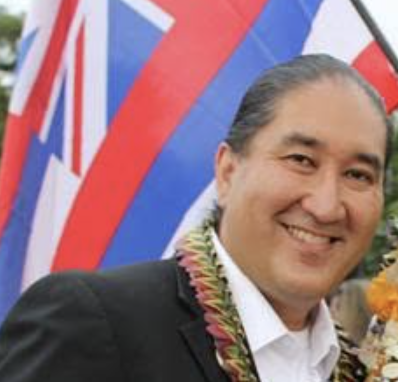
“It’s not that our people cannot do it, we’ve got to go back and understand how to do it,” he said. “If we don’t teach those things as a community, then we become priced out of paradise.”
He thinks OHA needs to place a greater emphasis on improving education in Hawaiʻi, acting as a bridge between the state Department of Education and the aliʻi trusts, specifically Kamehameha Schools, created to educate Native Hawaiian children, to fill gaps in the educational system.
But Akina also thinks OHA needs to do a better job of educating the public about its work. Most people don’t know how much OHA spends or where its money goes, and he suggested the office should widely publish financial statements in the same way KS is required to advertise such reports each year in the newspaper.
“If you want beneficiaries to be part of the system,” he said, “they need to have trust in what we’re doing.”
Regarding the military’s use of lands, Akina doesn’t see the federal government and the military withdrawing completely or giving lands it owns in fee simple back to Hawaiʻi. But, he said the state should negotiate for the federal government to fund college education in exchange for the use of those lands.
He also says OHA is entitled to significantly more state funds for the use of former Hawaiian Kingdom lands. Akina wants to see those additional funds set aside to respond to emergencies, as OHA did earlier this year with the Kona low storms and hurricanes.
Ikaika Anderson
Anderson says he is running for OHA this year because he sees a lack of real-world land use experience on the Board of Trustees.
He points to his experience on the City Council, including negotiations he had with developer DR Horton to include more affordable units in the Hoopili neighborhood as well as advancement of a mixed-use project in ʻAiea on the site of the old drive-in theatre. That project, anticipated to revitalize the area, ultimately stalled during the pandemic.
He said OHA’s lands are underutilized and should be made available to OHA’s Native Hawaiian beneficiaries to open businesses or for the office to generate more revenue. Those include Kakaʻako Makai, where the office has been stonewalled by the Legislature, and Iwilei, where OHA is headquartered and owns office space and buildings occupied by Ross Dress for Less and PetSmart.
Anderson said OHA should try to lift a ban on residential development on its Kakaʻako lands one more time at the Legislature. If that fails, it needs to consider building within the current zoning rules, selling the land or swapping it for other lands with the state.

In Iwilei, he believes OHA needs to begin discussions with developers and the community about what it can or should build there in anticipation of the rail line coming through the area. As for the 500 acres of agricultural land the office owns in Wahiawā near the Kūkaniloko Birthstones where high-ranking aliʻi were born, Anderson said beneficiaries should be allowed to determine what happens there, whether the land should be preserved or put to use for farming.
If he is elected, he wants to push for tuition waivers for Native Hawaiians in the University of Hawaiʻi system. That could come through OHA either funding tuition or advocating for waivers from UH in lieu of the annual payments state agencies must make to the office.
He would also like to see OHA partner with community health centers to offer discounts on prescription drugs.
Anderson termed out of the council office in 2020 and ran unsuccessfully for lieutenant governor in 2022. Gov. Josh Green picked him to lead the state Department of Hawaiian Home Lands in 2023 but he failed to get enough support from state senators to win that appointment.
That same year, he was charged with domestic abuse and kidnapping of his then-girlfriend. Prosecutors accused Anderson of refusing to drop her off at the airport causing her to miss her flight, and after parking somewhere, took her phone and elbowed her during a scuffle when she tried to get it back.
A state judge dismissed the case after the girlfriend failed to appear in court on the trial day. Anderson says he was innocent and wants voters to consider his entire record – not just his criminal case.
Kanekoa Crabbe
Crabbe is a single father and has held a huge array of jobs in his life, including as a teacher, electrical contractor, wastewater worker and contract laborer. He now does private tours aimed at wedding parties on Oʻahu.
Crabbe wants to make a major push to increase transparency at the office.
He doesn’t support OHA’s acquisition of KITV — some of the trustees believe it could give the office more exposure — and believes due diligence should be done in-house instead of contracted out to third parties, as the trustees have done.

In his first 100 days in office, he said he would call for a comprehensive audit of OHA to understand who exactly the office has benefited over the years. Crabbe also said he wants to end the use of executive session meetings, when government boards meet out of the public eye to confer with their attorneys. Those closed meetings used to be more frequent, but the board has often lacked the votes to move into executive session over contentious issues such as the CEO lawsuit and TV acquisition.
Crabbe is among candidates who believe OHA must do a better job of getting out in the community. Specifically, he said the office needs to learn the history of lands it owns or acquires from kūpuna who are from or have knowledge of those places.
Making those efforts, Crabbe said, could put the office in a better position when it comes to negotiating with the military over its use of land in Hawaiʻi. He believes the office should push for the return of those lands to the public. They could be used for housing Native Hawaiians or for farming, which he says OHA can support by restoring ancient waterways that have dried up over time or been cut off by development.
And Crabbe, a lifelong bodyboarder who was part of a protest movement decades ago to ban high-rise development in Kakaʻako Makai, thinks OHA should get out of that area.
He said the land deal, proposed under former Gov. Neil Abercrombie to compensate OHA for public land payments, should have never been accepted. Opponents of the development have raised environmental concerns with some of those lands, which OHA has been investigating under a grant from the Environmental Protection Agency.
Crabbe said the state should provide a land swap with OHA or at least $200 million in compensation, equal to the amount the land was supposed to be worth in 2012.
Brickwood Galuteria
Galuteria had a long career as an entertainer and radio personality before diving into politics. He was also a state senator representing Kakaʻako and much of urban Honolulu from 2008 to 2018, when he lost reelection.
But he says he’s kept many of the relationships he forged in the Legislature; he was once part of the faction of lawmakers that has dominated the Senate for more than a decade and held a plum spot as majority leader.
“If there’s anything I can bring to the fold, it’s friendships,” he said.

He put those friendships to use earlier this year to revive a bill that ultimately provided OHA with $55 million and cleared a path to renegotiate the annual disbursement from the state.
He leads an ad hoc group at OHA responsible for directing that $55 million to needy nonprofits that faced funding cuts from the Trump administration.
If he’s reelected, Galuteria wants to build more relationships for OHA with the business community, particularly financial institutions that could partner on homeownership programs.
He thinks OHA needs to be more visible, and sees the possible acquisition of KITV as a way to do that.
OHA could run educational and cultural programming on the station, he said, and reserve spots for shows produced in Hawaiʻi.
He also believes OHA must connect the aliʻi trusts. Those are Kamehameha Schools, which educates Native Hawaiian children; Queen’s Health Systems, the state’s largest healthcare system; Liliʻuokalani Trust, serving indigent children; and the Lunalilo Trust for the elderly. He considers OHA, the state’s 13th-largest landowner, the fifth aliʻi trust and the one that should bring the others together and work with other Native Hawaiian-serving and advocacy organizations to help uplift the Hawaiian people.
OHA wasn’t meant to exist forever, Galuteria said. It was created in 1978 to act as a repository of reparations and a placeholder for a Hawaiian nation. He sees uniting the Hawaiian organizations as an important step to that nation-building.
Keoni Souza

Souza is a real estate agent and member of the Hawaiian music trio Na Hoa. He was first elected to the board in 2022 and now serves as vice chairman. In his time as chair of a committee that guides the office’s investment and land decisions, the value of the office’s assets has grown to more than $900 million.
He is also one of the trustees taking the lead on the possible partnership with DHHL to develop condo units in Kakaʻako Makai, as well as a separate but related project to build a Native Hawaiian cultural center in the area.
Souza wasn’t available for an interview, but has said in responses to campaign questionnaires that he wants to focus on programs that expand options for Native Hawaiian homeownership and workforce development.
In land negotiations with the military, Souza wrote that OHA should advocate for cultural stewardship and environmental protection.
John Waiheʻe
The son of former Gov. John Waiheʻe III, the younger Waiheʻe is currently the longest-serving trustee at OHA, having been in office for the last 24 years. He’s seen a lot of proposals come before the board in that time and now offers his insights to make sure “we don’t do the same mistakes twice.”
He was motivated to first run for OHA after the U.S. Supreme Court’s decision in Rice v. Cayetano worried him that non-Hawaiians could take up seats on the board of the Native Hawaiian-serving agency.
Among his accomplishments are pushing for OHA’s acquisition of the culturally important Waimea Valley and proposing startup funding for programs still in place at UH’s Hawaiʻinuiakea School of Hawaiian Knowledge.

Some of his initiatives are less sexy but made the board more efficient, like creating a numbering system for the board’s action items to help staff and the public track documents and splitting one of the board’s committees into two so that trustees can put a greater focus on land and investments.
Waiheʻe is now back in charge of the board’s Budget and Finance Committee, as of late-2025, which puts him in a position to guide the agency’s spending priorities next year if he wins reelection and maintains that post.
He wants to continue work on initiatives he has already started, which includes determining how best to use a $55 million fund to shore up shortfalls for nonprofit agencies that had grants cut by the Trump administration.
Waiheʻe also wants to restart OHA’s community grants program, paused this year after key staff left their jobs. He said he’s found about $6 million available in the current budget that could go to nonprofits that advance some of OHA’s target areas of education, housing and economic stability.
In addition, he wants OHA to create a rainy day fund. The office was called on to respond to a record amount of disasters this year, and he envisions putting the office’s annual carryover savings – about $4 million last year – into an account that grows interest to reserve funds for emergency assistance.
If reelected, Waiheʻe plans to ask lawmakers for funding to repair the bulkhead under the old Fisherman’s Wharf site. It’s a landfill area OHA acquired from the state in 2012, but since then repair costs have ballooned from $10 million to more than $65 million.

