Kalaupapa Evacuated With No Return Date After Crucial Infrastructure Fails
Dozens of residents were temporarily removed from the Molokaʻi settlement on planes after a one-two punch of water and electricity failures.
UPDATE: This story has been updated with a statement from the property owner whose land surrounds a crucial power pole.
Two former leprosy patients housed at Kalaupapa on Molokaʻi now are being temporarily housed by the state in a Honolulu care facility after the settlement was evacuated earlier this month — and their return date remains unknown.
The saga began when the settlement’s drinking water system failed and it became unclear whether there would be enough water to go around after multiple repair attempts.
State officials on Sept. 11 took the unusual step of airlifting dozens of residents from the isolated peninsula, including National Park Service staff, healthcare workers and the last two former leprosy patients who choose to reside in the settlement with support from the Hawai‘i Department of Health. The patients are provided with furnished homes, nursing staff and stipends for food and clothing.
Although the water system was restored on Sept. 25, plans to bring residents back home were thwarted two days later by Hurricane Nolo, which knocked out a crucial power line, leaving the settlement without electricity.
This one-two punch of infrastructure failures means that Kalaupapa will remain eerily deserted — except for a few National Park Service law enforcement officers — until the power outage ends.
It could be a while. On Monday, Hawaiian Electric repair workers were blocked from accessing the damaged utility line by R.W. Meyer, the private owner of the land that surrounds the pole, as well as the Kalaupapa trailhead.
Hawaiian Electric and the National Park Service, which manages the settlement’s electrical system, are working with the property owner to attain a right of entry to the land around the utility line so that repairs can begin, state officials said.
On Thursday, a representative of the landowner said in an email that the company is working on “the required authorizations as quickly as possible so that repair work may proceed as soon as practicable.”
“We have been mindful of the hardship the outage has caused for Kalaupapa residents,” said R.W. Meyer Vice President & Treasurer Michelle Tancayo.
Meanwhile, with the peninsula largely unoccupied, trespassers are rumored to have entered the settlement. Police are investigating resident reports of home break-ins and theft.
“We remain focused on getting our patients home to Kalaupapa as soon as it is safe to do so,” said Diana Felton, chief of the state health department’s communicable disease and public health nursing division.
Molokaʻi Residents React
Mikiʻala Pescaia, a former interpretive park ranger for Kalaupapa National Historical Park who lives there and was evacuated, expressed her concerns about the settlement’s damaged infrastructure Tuesday in a widely shared social media video.
She fought back tears while describing a lack of supervision over the settlement during the evacuation order, which, she said, led to home break-ins.
“It’s been rough,” Pescaia said. “We were reluctant to leave but we had to, we had to make the call.”
Maui County Council member Keani Rawlins-Fernandez, who lives on Molokaʻi, said she was upset over news of the break ins.
“It breaks my heart to hear that there may have been breaking and entering into folks’ homes, stealing not only folks’ valuables but also their peace of mind,” she said.
Rawlins-Fernandez said she believes that some residents will be able to return even as the power outage persists through the use of generators, gas and a Starlink connection acquired by National Park Service workers.
“Their presence alone will again deter trespassers,” she said.
Relocation May Be A First
Jutting out from perilously steep sea cliffs, Kalaupapa Peninsula is a remote outpost with a difficult history as the place where thousands of people afflicted with Hansen’s disease were segregated from the rest of society.
The temporary relocation of Kalaupapa residents may be a first in the settlement’s sordid 160-year history, which began in 1866 when the royal Hawaiian government criminalized Hansen’s disease and banished patients to live in isolation at the foot of the world’s tallest sea cliffs.
After the discovery of a cure, the Hawaiʻi state government in 1969 lifted the quarantine that for over a century had separated the disease-stricken victims from their families. But many former patients chose to remain in Kalaupapa voluntarily as full-time residents.
Four people remain on the Kalaupapa Registry, the Hawai‘i Department of Health’s official record of thousands of people who were isolated at Kalaupapa before the government freed them from quarantine in 1969. The youngest is 85 and the oldest is 102.
Two of them reside full-time at Kalaupapa and two live on O‘ahu.
The names of other living former Hansen’s disease patients are absent from the registry at their request. It’s unclear how many people are in this group.
Settlement Tours Drew Protests
In June, former leprosy patient Meli Watanuki died at age 92. Her company Kalaupapa Saints Tours, working in partnership with Honolulu-based Seawind Tours, had been the only outfit permitted to offer commercial tours.
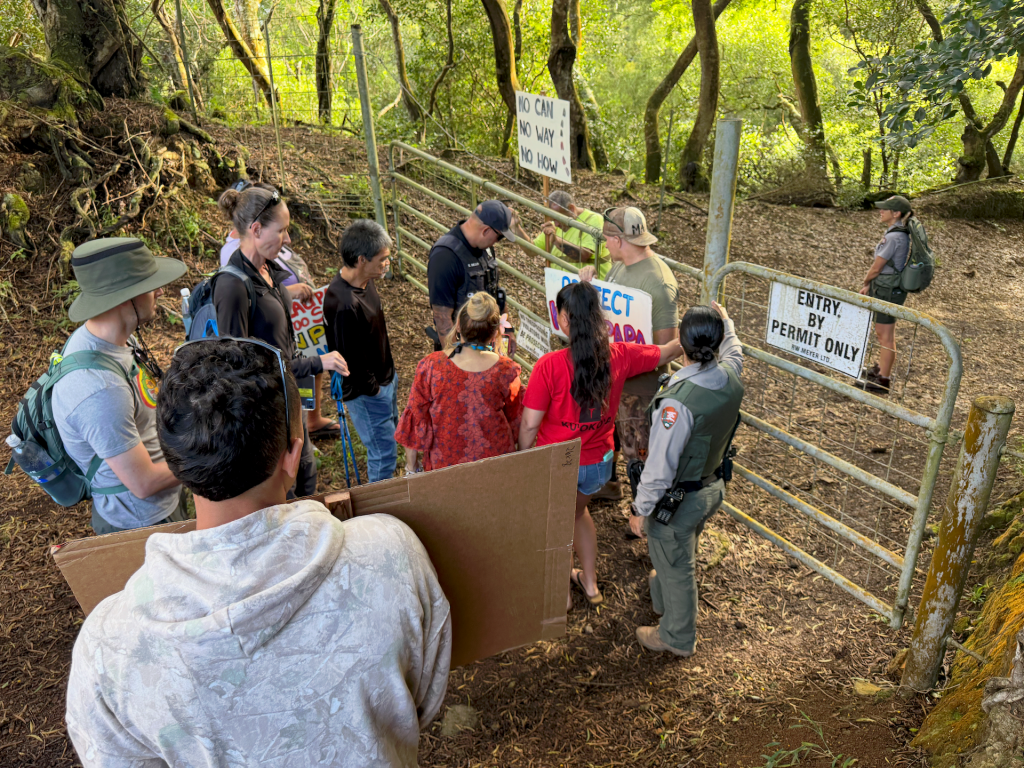
Tours were restarted a month later but became the focus of protests. About two dozen Moloka‘i residents, including a Maui County Council member and several longtime anti-development activists, gathered early in the morning at the trailhead in Pālāʻau State Park with homemade signs that read “No tours on Kalaupapa” and “Feds get out.”
Federal law and National Park Service policy require commercial tour companies on the peninsula to be owned by former leprosy patients who live there until no more are interested. The protesters said the community had not been consulted and the following day, the park service announced that it was “temporarily pausing future public tours while it reassesses the feasibility of visitor access. More information will be shared as it becomes available.”
The tours have never restarted.