

Three Finalists Announced For New Office of Hawaiian Affairs CEO
The list includes OHA’s current interim CEO, a former city councilman, and a former head of the Department of Hawaiian Home Lands.
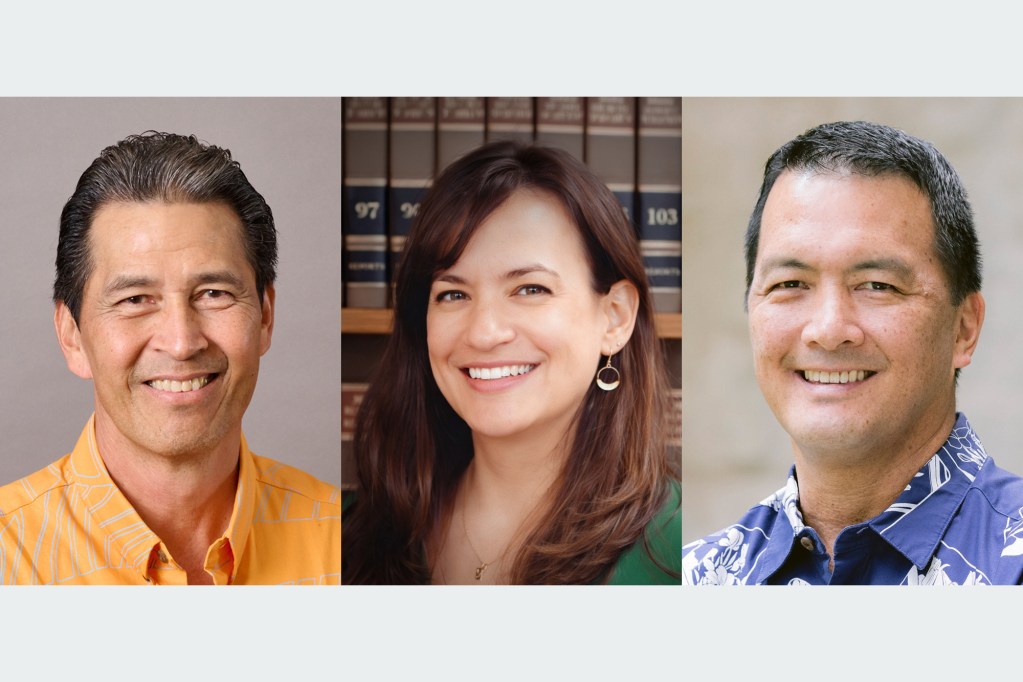
Trustees of the Office of Hawaiian Affairs have selected Todd Apo, Kaulana Park and Summer Sylva as finalists for the role of the office’s administrator in charge of advancing OHA’s mission of bettering the condition of Native Hawaiians.
Sylva, a former Biden administration official, has served as the office’s interim CEO for just over a year. Apo is a former Honolulu City councilman, and Park is a past director of the state Department of Hawaiian Home Lands and previously worked at OHA.
The search for the office’s next top executive comes as the organization continues to fight a lawsuit from deposed CEO Stacy Ferreira alleging she was improperly removed from her post in 2025. Her three-year contract is up at the end of October.
A total of six candidates had made it to a first-round of interviews conducted by the trustees in September. The board could also have picked from a handful of alternates recommended to them by Kumabe HR, the company contracted to perform the executive search. One candidate withdrew from the process earlier this month, and an alternate took their place.
Next, the finalists face the public during a comment period that runs through Oct. 16. The finalists are also scheduled to appear for a moderated discussion at OHA’s office on Oct. 15. The trustees will take that feedback and consider references, writing samples, leadership assessments and interview responses before finalizing their selection on or around Oct. 22.
Each Brings Experience To The Role
People who testified before the board last week spoke in support of Sylva, who has been the office’s interim administrator since Ferreira was put on leave.
Activist De Mont Manaole applauded her for taking a stand against Gov. Josh Green in advocating for Native Hawaiians to play a significantly larger role in negotiations over expiring military land leases. In December, she wrote a letter to Green urging him to do a better job of involving an advisory committee, comprised mostly of Native Hawaiians, in discussions with the Army and federal officials.
“She has shown she can do the job; she is excellent at the job,” Waiʻanae resident Kapua Kamai said. “Her history speaks for itself.”
Sylva was previously executive director of the Native Hawaiian Legal Corporation during a time when the nonprofit took the state to court over ownership of the Mauna Kea access road as mass protests sought to halt construction of the Thirty Meter Telescope at the mountain’s summit.
She was later appointed senior advisor on Native Hawaiian affairs in the U.S. Department of the Interior under former President Joe Biden.
Apo served on the Honolulu City Council from 2005 to 2010. Most recently, he was CEO of the nonprofit ʻIole that cares for more than 2,400 acres of land in North Kohala. He has also worked in leadership positions at the Hawaiʻi Community Foundation, Howard Hughes Corp., Disney and The Resort Group at Ko Olina, according to an OHA press release.
Park had a brief professional football career with the New York Giants. He previously worked at OHA managing a revolving loan fund and helped establish a research division in the office, according to the press release. Park led efforts to combat homelessness under former Gov. Linda Lingle. He also held leadership positions at DHHL during her administration and is currently the vice president of Laulima, a new 500-acre development in Kapolei.
Search Takes Place Amid Lawsuit
The next CEO will take over against the backdrop of an oingoing legal battle with Ferreira, who sued the trustees and the office in November 2025 alleging they retaliated against her for reporting Board Chair Kai Kahele to the ethics commission and Attorney General’s Office.
OHA’s lawyers have said that was a tactical decision done to head off a potentially bad job review. Ferreira and Kahele had butted heads over the handling of the office’s budget in 2025; she alleges that Kahele used the budget process to improperly benefit a Native Hawaiian organization and micromanaged staff.
Two inquiries were launched in 2025 – one into Ferreira for issues that predate the allegations in her lawsuit, according to OHA’s lawyers; the other, into Ferreira’s allegations that Kahele created a toxic work environment and abused his authority.
Both inquiries were completed, with reports submitted to the board. Their findings would help shed light on the dispute between OHA’s leaders — except the office has declined to release them to the public citing attorney-client privilege.
Earlier this year, four of the board’s nine trustees took the unusual step of siding with Ferreira in the lawsuit. They filed an answer to her complaint that supported many of her allegations against Kahele and the board while also arguing that she should receive compensation for her removal. OHA lawyers have said that the legal document filed by the dissenting trustees has kneecapped the office’s ability to defend itself.
In August, a state judge dismissed claims against the trustees and Sylva, allowing Ferreira’s case to proceed against only the office itself. The judge also ordered the dissenting trustee’s answer to be tossed.
A trial in the case currently is set for October 2027.
The outcome of the elections could shape how the board handles the lawsuit going forward, with five incumbent trustees up for reelection this year, two of whom among those who have supported Ferreira.

