

Maui Housing Policy Divides Top Candidates For Mayor This Election
Maui County Council member Yuki Lei Sugimura is trying to unseat Mayor Richard Bissen in a closely watched race this election.
Maui is at a critical juncture.
As the recovery continues following the deadly wildfires in August 2023, residents have been forced to reckon with complicated and often uncomfortable questions related to Maui’s tourism-dependent economy, the growing threat of climate change-induced natural disasters, a dire housing shortage and competing visions of a rebuilt Lahaina.
The mayoral election on Nov. 3 will give voters their first opportunity since the fires to decide who should steer the county for the next four years as it grapples with those issues. With four months before the candidate filing deadline, Maui County Council member Yuki Lei Sugimura has emerged as Maui Mayor Richard Bissen’s top challenger.

“I don’t think this election is about one issue. I think this election is about leadership,” Bissen, 63, told Civil Beat. “Our community has been through a rough time. We need steady leadership to help us get through this period and the next.”
Sugimura, who has held the council’s Upcountry seat since 2016, offers a starkly different position on the anticipated phase-out of thousands of Maui’s short-term vacation rentals through Bill 9, illustrating just how deeply the issue divides voters.
“This is a next step that’s kind of been on my horizon,” Sugimura, 72, said of her decision to run for mayor. “I was born and raised here, I’ve seen how our community has grown and has taken a whole different perspective, and that’s why the division that I’ve seen happen over Bill 9 is really concerning and heartbreaking from the aloha that I think we all grew up with.”
With more than nine months still remaining before Election Day, the Maui mayoral race is already shaping up to be one of the most closely watched elections in the state, according to political analysts, and its results are likely to be regarded as both a referendum on the Bissen administration’s disaster response and an indicator of how willing the public — in Maui County and across the state — is to embrace progressive housing reform.
“This is probably the most significant election in Hawai‘i of the 2026 cycle,” said Colin Moore, a University of Hawai‘i political scientist. “I expect it to be kind of a hot race — and not just hot in terms of contention — but emotionally as well.”
West Maui real estate broker P. Denise La Costa and local community organizer Justin Herrmann have also announced their mayoral campaigns. The filing deadline to run is June 2.
High-Profile Test Of Housing Policy
While Bissen and Sugimura disagree on the decision to ultimately phase out between 1,500 and 6,000 vacation rentals, they both recognize it as an issue that will be top of mind for many voters.
Bissen introduced Bill 9 in May 2024, responding to the 2023 fires that displaced more than 12,000 people and exacerbated a longstanding housing crisis.
For more than a year and a half, Bill 9 was the center of countywide debate, political advertising campaigns and economic impact studies. Supporters said the legislation would free up much-needed housing for locals and offer an opportunity to diversify Maui’s tourism-dependent economy, while opponents argued that such a drastic change in housing policy would wreak widespread financial havoc and infringe on individuals’ property rights.
When the Maui County Council eventually passed the bill on Dec. 15, Sugimura — who had been among the council’s most vocal critics of Bill 9 — was one of three dissenting votes.
“What really, I’d say, sent me over the edge, is just seeing how Bill 9 was processed and handled, and how it’s divided the community,” she said about her motivation to run for mayor. “I’m consistent with my belief that that’s not the way you get housing.”
As passed, the exemptions — which have long allowed between 6,000 and 7,000 apartment-zoned units to operate as short-term rentals — will expire on Jan. 1, 2029 in West Maui and on Jan. 1, 2031 in the rest of the county. The council is expected to take up a separate bill, based on the recommendations of a Temporary Investigative Group for Bill 9, that would rezone more than 4,500 affected units to allow hotel and residential uses.
Sugimura said Bissen should have called for an investigation of the law’s potential economic and social impacts and drafted a plan to counteract the expected loss of millions of dollars in tax revenue before introducing it and rushing the legislative process.

“If I were to introduce a policy, I would surround myself with good minds and good policy people who would understand how to move government and create a space for communication and do the research before,” Sugimura said. “I believe that the community deserves to have more information than just have this bill be enacted the way that it is.”
Bissen took a bold and controversial step when he introduced Bill 9, he acknowledged.
“Our goal was to help as many as we could and to hurt the least amount,” he said. “There’s no issue that we’ve had to decide on that doesn’t come with that trade-off.”
His actions following the disaster were not influenced by politics, Bissen said, but his past experience making controversial decisions as a judge after listening to all sides.
“You’ve got to be decisive, and sometimes you have to make a call that’s going to be unpopular,” he said. “That was all designed to keep our local population home. Where else can you get 1,500 to 2,000 units built without swinging a single hammer?”
Many individuals and groups like Lahaina Strong and the Maui chapter of the International Longshore and Warehouse Union celebrated Bill 9’s passage, hailing the legislation as a glimmer of hope for locals who have long struggled with the cost of living. Bissen noted that condominium prices had already dropped significantly.
The median price of condos declined by 25.6% between December 2024 and December 2025, according to the Realtors Association of Maui.
Others felt alarmed. Some business and property owners called for swift action to mitigate Bill 9’s potential negative ramifications, and lawsuits have been filed saying the law violates individual property rights.
La Costa, a former Maui Planning Commission chair and long-time West Maui resident, cited her opposition to Bill 9 as one of the key pillars of her campaign. She said it would force local businesses to shutter.
Bill 9 is an exceptionally far-reaching shift in housing policy, but debates about short-term rental restrictions and how to balance locals’ and visitors’ interests are not unique to Maui, Moore said. Stricter regulations on vacation rentals have been proposed in other parts of Hawaiʻi and across the country.
“This is a really high-profile test of where voters ultimately fall on this. Will they support — in some ways — pushing back on the tourism-oriented economy to provide more housing? Or are they more worried about potential loss of tax revenue or job opportunities?” Moore said. “It really will narrow the focus of the campaign.”

Bissen and Sugimura supported the temporary investigative group’s recommendation to create two new hotel zoning districts to create a path for most affected units to continue operating as vacation rentals.
“We need to do that, and I believe that’s going to be a heavy lift, but I’m going to be there to be sure that and other things that we need to do move forward,” Sugimura said. “Those primarily are units that look like a hotel, walk like a hotel and talk like a hotel.”
The Pace Of Progress
Bissen counted the county’s response since the fires among the achievements he is most proud of since taking office. The Maui Fire Department and the Maui Emergency Management Agency have filled a combined total of more than 50 new positions, the county launched a new emergency alert system, and local officials carried out wildfire mitigation projects in Ukumehame and other parts of the island.
About two-thirds of Maui residents who responded to a Civil Beat survey in 2024 were dissatisfied with both Bissen and the County Council’s response to the disaster.
While officials have announced that post-wildfire reconstruction has recently gained new momentum, rebuilding efforts have been criticized for being too slow and disorganized.
As of Monday, 116 homes had been rebuilt in Lahaina and another 300 were under construction. Some businesses that were destroyed have been able to reopen in new locations, but the county has only recently begun to shift its focus to rebuilding Front Street and the rest of the town’s iconic commercial district.
The rate of permitting on Maui has been faster than some places that have experienced megafires, but numerous obstacles have continued to prevent property owners from rebuilding. Tariffs implemented by President Donald Trump’s administration have been blamed for increased costs of labor and construction materials, insurance payouts often have not covered the full cost of rebuilding, eligibility for grant-funded recovery programs remains limited and the wait for lawsuit settlement money has dragged on.
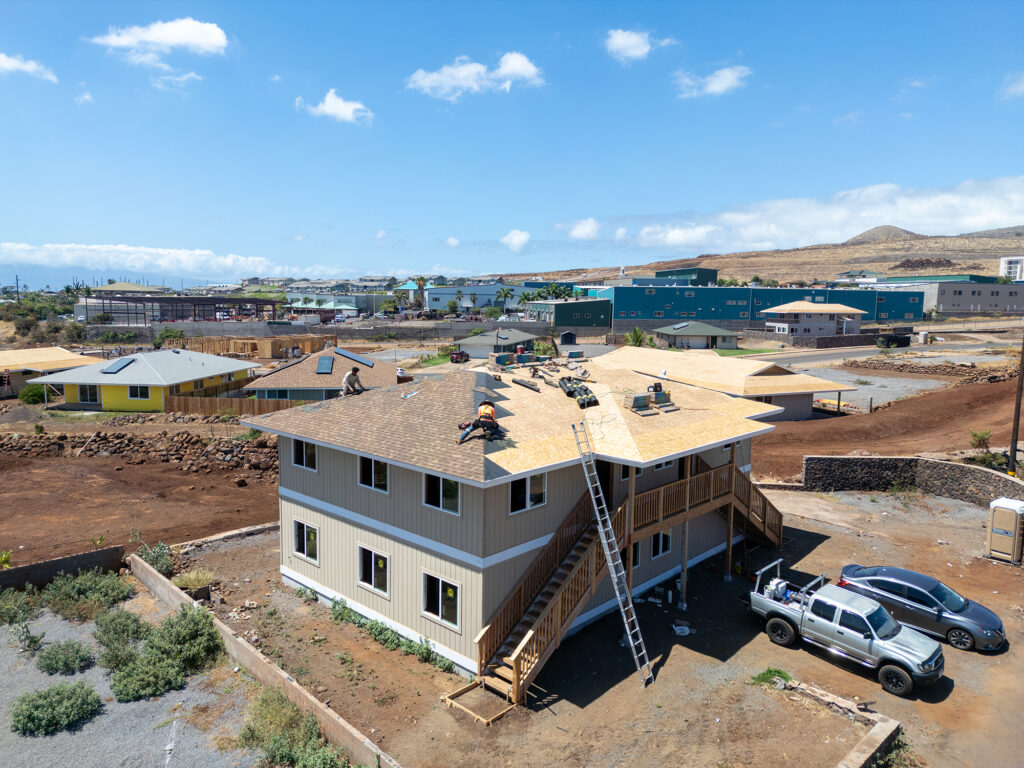
There was a widespread housing shortage even before the fires, and Sugimura and Bissen agreed that in addition to advancing rebuilding efforts, Maui’s next mayor will need to encourage new residential development.
Bissen emphasized that Bill 9 and other potential policy changes could be tools to lower housing costs in the meantime.
“The ones who agree with me and the ones who disagree with me should all be allowed to stay here if that’s their choice, and the government should try as much as we can to make that possible,” Bissen said. “It shouldn’t be a foregone conclusion the minute your child is born to say, ‘Yeah, you won’t be able to live here.’”
Thousands of units had been built over the last three years, he said, and officials estimated that about 3,000 new affordable and workforce housing units were expected to be completed across the county by 2030.
Still, Bissen’s administration has declined to take other actions that would drive down housing costs, Sugimura said.
As mayor, Sugimura said she would push to quickly build new infrastructure on county property, paving the way for her administration to seek out developers to construct new housing.
“That’s how I would want to see housing being built, not by taking somebody else’s property and converting it for a long-term rental,” Sugimura said.
There were some hurdles to overcome before housing could be built in some areas, she said, particularly where officials say there is insufficient water supply to support more units.
“Water is a huge problem countywide,” she said, adding that she looks forward to meeting with people about their ideas to address the issue. “What’s happening with West Maui is stopping housing.”
Pulelehua, a proposed 1,000-unit affordable housing project north of Lahaina, is perhaps the most notable example of what some county officials see as a necessary residential development project that has been delayed because the county Department of Water Supply has said there isn’t enough water.
Early Indicators
With no recent public polling results to reference, it’s not clear which candidates currently have the most voter support, according to Moore, but endorsements and fundraising numbers can offer early indications.
Sugimura, who launched her campaign in January, raised $6,220 in contributions and spent $11,125 during the second half of 2025, according to the most recent campaign finance disclosures. She had $77,783 on hand at the end of the reporting period.
Bissen hauled in $21,577 from donors and loaned his campaign $20,000 during the same period. He spent $19,651 on his campaign during the last half of the year and had $27,333 on hand as of Dec. 31.
Two major unions — the Hawaii Government Employees Association and the Maui chapter of the International Longshore and Warehouse Union — endorsed Bissen in December, before other candidates announced their intentions to run. Political analysts viewed it at the time as a way to keep other would-be challengers at bay.
For both Sugimura and Bissen, the decision to run for mayor was preceded by long conversations with loved ones and a lot of consideration regarding whether they believed they were prepared to address the myriad issues facing Maui.
“There’s unfinished business for us to do,” Bissen said about why he was compelled to seek reelection. “I’m really, really proud of the team that we’ve assembled and the work that they’ve put in, and I’d like to see that through to completion.”

By familiarizing themselves with various issues and forming relationships with federal and state officials, nonprofits and private organizations, Bissen said his administration has built momentum and positioned itself for success as the county works to build a more resilient Maui.
“There’s so much that I’ve learned along the way, and there’s so much more to learn, a lot more to give,” he said.
Bissen has also faced controversy. Some people expressed concern when the county Salary Commission approved significant pay bumps for county officials including Bissen — who is now Hawaiʻi’s highest-earning mayor after his annual income rose to $245,000 from $159,578 — and there have been questions about turnover in his administration.
During his first three years as mayor, Bissen has had to replace people in key roles, including planning director, economic development director and chief of staff among others.
“I think it’s normal to have turnover,” he said, explaining that some people left for personal reasons, some were transitioned into new positions and others were asked to leave. “There have been a variety of different reasons for different people leaving.”
For Sugimura, becoming mayor has been a lifelong goal, and she knew it was time to pursue her dream when she realized the significance of the current moment.
Campaign season is still ramping up, and there is plenty of time for new candidates to garner voter support. Whoever voters choose, they will likely need to address numerous highly contentious issues — the local government’s relationship with federal immigration officials, the management of East Maui’s water supply, who should be prioritized as the county approves new commercial and residential development — during an era when long-simmering tensions have begun bubbling to the surface.
Civil Beat’s coverage of Maui County is supported in part by a grant from the Nuestro Futuro Foundation.

