While Honolulu Waits For Permits, These Cities Are Already Building
Permit delays are linked to increased housing costs and higher rents, as new national research confirms.
While developers put the finishing touches on a new 20-unit apartment building in Reno or Indianapolis, developers of a similar project in Honolulu are still waiting for their permits.
And the owners of a new single-family home in Spokane or Colorado Springs can turn the key to their front door while those in Honolulu still have another year to wait.
Those stark differences are highlighted in a new study of permit and construction timelines across 60 U.S. cities over the last two decades. Overall the research shows Honolulu still has a way to go to compete with the permitting and building timelines of other cities.
The researchers found permit delays are directly linked to increases in the cost of new buildings and the rents tenants will end up paying. And that has a direct impact on residents’ lives. Housing costs in Hawaiʻi are a major driver of poverty in the Aloha State, according to another recent study on the housing shortage.
The bad news doesn’t stop there.
Permit delays across America have, on average, doubled since the early 2000s, while the levels of building activity have fluctuated widely over the same period, the data shows.
The typical single-family home permit in the U.S. took an average of two months to be approved in 2002, but now takes four, according to Evan Soltas, Assistant Professor of Economics and Public Affairs at Princeton University.
And while it once took an average of six months to get a permit for a 20-unit apartment building, it now takes a year, Soltas said.

“This represents a massive slowdown in the average regulatory performance across the United States,” he said.
The increase in the average wait time in Honolulu blows the national benchmark out of the water. In 2000, a permit for a 2,800-square-foot single-family home in Honolulu involved an average wait time of more than two months, but by 2024, it was over 14 months.
In Sunbelt cities such as Raleigh, Orlando and Phoenix, the same home goes from permit submission to completion in one year, the research shows.
And in the cities where permits took longer, it also took longer to complete construction once the permits were issued.
All told, those wait times have major consequences for the housing markets of those cities, Soltas said.
“If it takes two years to permit, and five years to build, that’s an imposition on every developer,” he said. “They’re tying up capital, construction and labor for a lot longer than other cities.”
In a city like Honolulu, it takes roughly a year longer to build a 20-unit building than in Columbus or Indianapolis, he said. Slower permitting, the study found, is associated with less construction, more demand and higher rents.
The figures suggest that the additional year of delay is connected to rents costing a third higher in Honolulu, compared to the other two cities.
“While not necessarily cause and effect, the numbers suggest that regulatory differences have really large consequences,” Soltas said.
In a statement, Honolulu Department of Planning and Permitting spokesman Davis Pitner said the department agrees with the study’s premise regarding the significance of permitting times and said it validates DPP efforts to speed up the process.
The bulk of permitting data for Honolulu covers the period from 2004 to 2025, and represents the period before DPP began implementing improvements, he said.
In Cities Where Permits Lag, So Does Building
Permit delay times have been the bane of Honolulu homeowners, builders and developers for years and a thorny challenge for the Honolulu permitting department.
Since at least 2015, Honolulu has been sitting in the top 25% of cities with the longest delay times for permitting and building standard single-family and multi-family homes, rubbing shoulders with Seattle, Boston and Providence, but performing better than Los Angeles or New York.
Comparing a sample of building projects in U.S. cities between 2015 and 2019, Honolulu had the 10th-longest wait times with a total project time of just over two years for an archetypal single-family home.
Permit wait times were the worst in Miami, where they take between 18 months and two years. San Francisco takes the longest to build overall – between four and five years – and 14 months of that is waiting on the permit.
While there are significant differences between the cities in the study, the samples were standardized for population density and household income and accounted for other differences, Soltas said. Comparisons between New York and Reno, for example, were made using data for neighborhoods with similar characteristics.
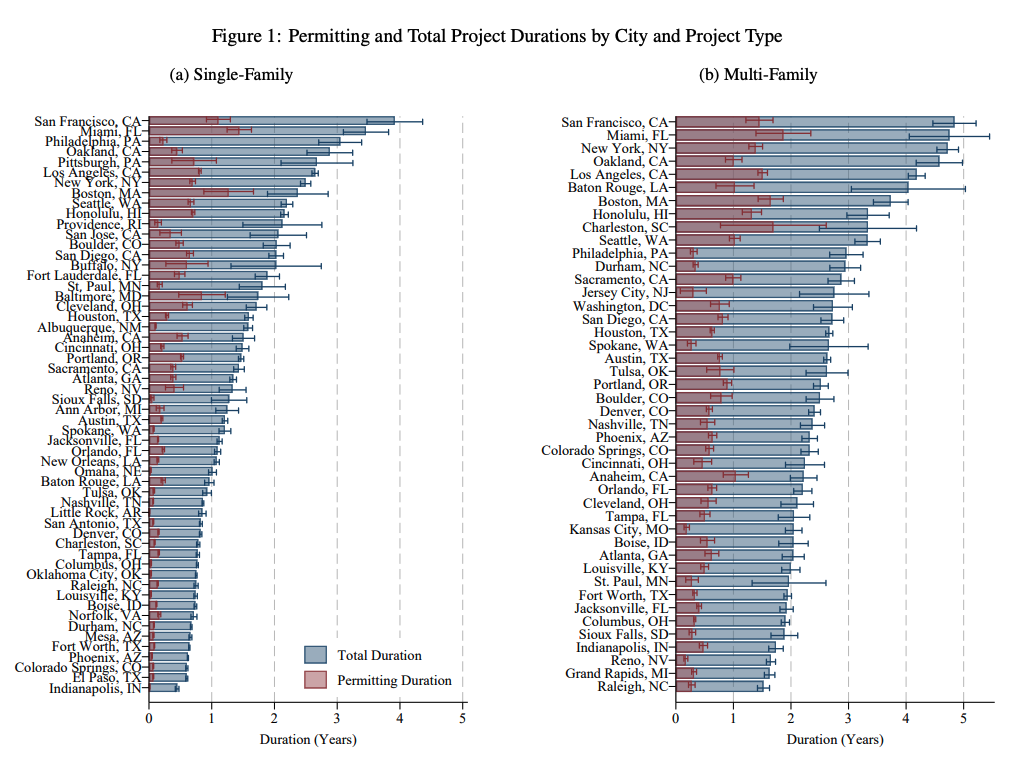
The researchers found that between 30% and 43% of the difference between the slowest and fastest U.S. cities were the result of permit delays, rather than construction time.
More recent data from 2021 through 2025 for 19 cities in the western U.S., analyzed by the same team, shows Hawaiʻi’s ranking has not changed significantly, with single-family homes taking an average of six months to permit and more than two years to build.
A 20-unit multi-family apartment building in Honolulu would have taken 14 months to get final approval and three years and change to build, according to the data from 2015 through 2019. Soltas said the sample size for new multi-family apartments in Honolulu is too small to conclude whether that measure has changed significantly over time.
The researchers suggest establishing processing time limits, one-stop-shop approaches and concurrent agency review among the possible reforms.
“Those approaches align with several of the changes DPP has been implementing,” Pitner said.
Since the primary comparison of the cities was made, he said DPP has undertaken substantial changes to its permitting system including electronic plan review, the new platform HNL Build, standardized workflows and stricter adherence to review timelines.
DPP has also seen encouraging results following the introduction of its AI-assisted screening tool, CivCheck which became mandatory on Sept. 1., Pitner said. Applications submitted using CivCheck had a permit decision an average of 40 days sooner than comparable applications made without CivCheck.
Empowering Cities With A Meaningful Indicator
While new housing remains high on public policy agendas in many U.S cities, Soltas said there is no central repository tracking how long it takes to approve and build new housing throughout the country.
“The reality is there’s no permitting office in America that has all the data at their fingertips to be able to say, ‘Are we doing better or worse than our peers?’” he said.
He and fellow researchers Leonardo D’Amico, assistant professor of economics and finance at the University of Chicago Booth School of Business, and Audrey Wang, senior research specialist at Princeton, drew on public data including the U.S. Census and agency records requests to pull the numbers for the study.
Even so, gaps remain.
The city of Chicago, for example, is not included among the 60 cities compared because the city lost 25 years of completion dates for permits and buildings when it moved its database to another system several years ago, Soltas said.
“What we’re trying to do is empower cities with a fair key performance indicator that’s reasonably well measured,” he said. “There’s a lot that cities could be doing.”