Kidney Nonprofit’s Taxpayer-Funded Bus Is Collecting Dust
The Kidney Foundation of Hawaiʻi’s mobile care clinic was never put into service for kidney patients, according to the nonprofit’s CEO.
Kidney patients in Hawaiʻi get sicker and die earlier because of late diagnoses, and in 2019, the National Kidney Foundation of Hawaiʻi had an idea to help.
The nonprofit went to the City and County of Honolulu with a request — a grant for a mobile clinic that could be used for health screenings and outreach in underserved areas of Oʻahu. The traveling program would help detect kidney disease earlier and, hopefully, prevent it entirely in thousands of island residents, the foundation said.
Honolulu City Council members at the time supported the idea and approved a grant request. The foundation ultimately got more than $73,000 in city funds.
Today, six years later, the 26-foot bus is collecting dust at a car lot in ʻEwa Beach.
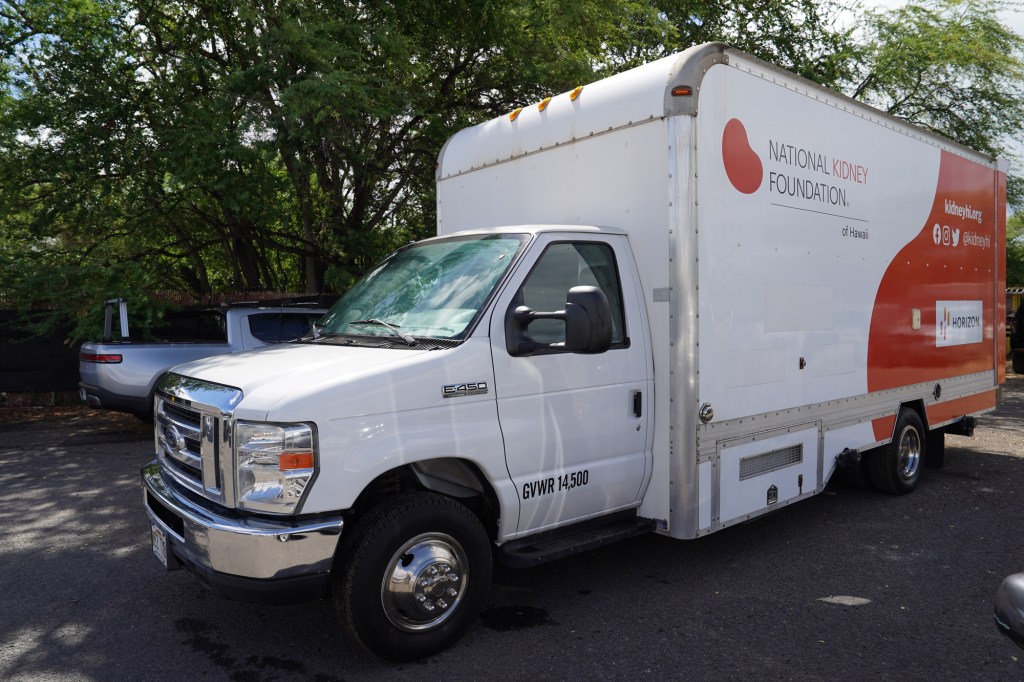
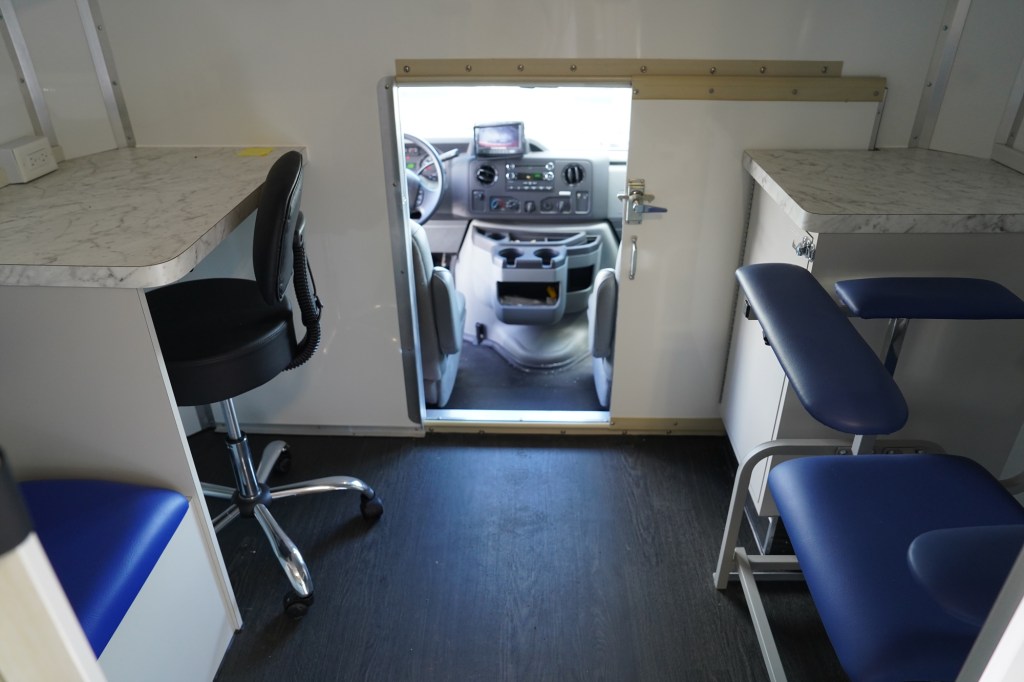
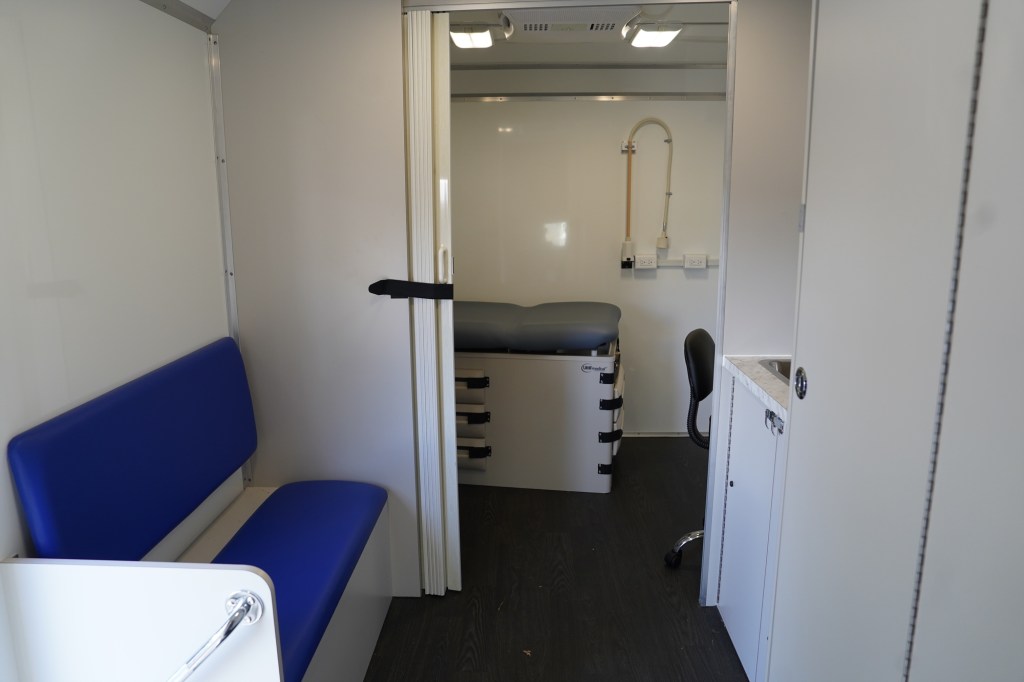
Its interior, which contains a blood draw room, a bathroom and two exam rooms, shows no signs of use. Cobwebs have formed in crevices near the floor. The odometer reads just over 1,200 miles — the roundtrip distance of going from one end of the island to the other just 15 times.
Maile Kawamura, who became CEO of the Kidney Foundation of Hawaiʻi last year, said she was concerned to learn the mobile clinic had never been used as intended. It was displayed once at a walk for kidney health, and may have been used for for Covid screening during the pandemic, but it’s never served kidney patients as far as she knows.
“I’ve been really disappointed to learn that it hasn’t been used,” she said. “I’m really determined to find out what happened.”
The foundation’s actions in 2020 and 2021 have come under scrutiny because of the nonprofit’s ties to a state bribery case involving Lt. Gov. Sylvia Luke and other state officials. Tobi Solidum, a consultant for the foundation at the time, was indicted last month for allegedly bribing state officials to help direct federal Covid-19 relief money to prop up the foundation’s testing program. Civil Beat revealed the foundation, which used millions in public funds to run the testing program, charged residents more than twice the median price for Covid tests.
The Kidney Foundation purchased the mobile clinic from Jim Ireland, who is now director of the Honolulu Emergency Services Department but at the time was working as a physician out of his practice in ʻEwa Beach.
Ireland said he purchased the mobile clinic in the spring of 2020 with his own money thinking it could be used by a nonprofit or medical professional to respond to the Covid pandemic, which was starting to cause panic across the country. He ultimately sold it to the Kidney Foundation for $148,222, almost exactly what he said he paid for it. He said the foundation used it multiple times in the summer of 2020 to screen homeless people for Covid, but he lost track of the clinic’s activities in 2021 when he became EMS director.
Kawamura said the Kidney Foundation is in the middle of a third-party audit of its activities during the pandemic, including the purchase of the mobile health clinic. She said she wants to be transparent with the community as well as the foundation’s donors and funders. She hopes to find a way to put the mobile clinic to good use.
“I’m really confident that after this review, we’ll have a better idea of what we need to do to move forward,” she said. “And ultimately, my goal is to serve the kidney patients and their caregivers across the entire state of Hawaiʻi.”
Unmet Goals
In a 2019 grant application to the City and County of Honolulu, then-CEO Glen Hayashida outlined how he hoped the mobile clinic would work.
It would travel to 30 locations around Oʻahu and serve more than 1,000 patients per year. By conducting health screenings, educational outreach and follow-ups, the mobile clinic’s staff would catch kidney disease earlier in at-risk patients and help prevent it from advancing to the point where dialysis would be necessary.
“Considering the fact that the average cost of dialysis is nearly $100,000 a year per person, preserving only one patient’s kidneys from failure for a year literally pays for the cost of this new mobile clinic,” Hayashida wrote in the application.
HMSA and Kaiser Permanente planned to provide nursing staff for the mobile clinic, and Dr. Eugene Wong, a Honolulu kidney specialist, volunteered to oversee the program, according to the grant application. Wong did not respond to voicemails left at his office. Lynn Shibuya, spokeswoman for HMSA said the company could not confirm whether it provided any nurses for the mobile clinic. Kaiser Permanente had no record of providing nursing staff for the effort, according to spokeswoman Tammy Brownfield.
The mobile clinic would provide services free for patients and bill insurance companies for those who had coverage, according to the application.
“We must protect our people in Hawaiʻi early to avoid the destruction of their kidneys and other organs, and preserve their lives,” Hayashida wrote. “For that to happen we need more accessible, affordable education and screening.”
Hayashida also wrote that the foundation would give data and research from the program to the state Department of Health and the University of Hawaiʻi medical school. Matthew Campbell, spokesman for the medical school, said the university never received any data from the foundation’s mobile van.
But as the Kidney Foundation began shopping for a mobile clinic, Covid began spreading across the U.S.
In Hawaiʻi, the first confirmed case was reported in March 2020.
Around that time, Ireland was talking with local philanthropists and medical professionals about bolstering the state’s preparedness for the virus which they feared would soon start to wreak havoc in the islands.
He decided to purchase a mobile clinic bus from the Phoenix-based company Magnum Mobile for $140,100. An invoice from Matson provided by Ireland shows he paid $8,223 for shipping with an estimated ship date of April 21, 2020.
Ireland said he learned from Hayashida that the foundation was seeking to purchase a mobile clinic and had been awarded grant funding from the city. He sold it to them for the purchase price plus shipping. City records show a check written from the foundation to Ireland on Dec. 1, 2020, for $148,222.53. Ireland said he did not know Solidum and never spoke to him.
Ireland said he delivered the bus to the foundation in July of that year so they could start using it for Covid screening. He said it was used on multiple occasions that summer, including in the area of Iwilei Road to help test homeless people as well as to the Oʻahu Community Correctional Facility to screen inmates being released, Ireland said. At the time, they were testing up to 90 people per day and finding 10% to 15% positive rates for Covid, he said.
But some time in the fall of 2020, the catalytic converter was stolen from the bus, he said. That grounded the clinic, at least temporarily.
Honolulu Mayor Rick Blangiardi nominated Ireland to serve as EMS director in March 2021, and after that, Ireland said he lost track of what was happening with the mobile clinic.
Kawamura, the foundation’s CEO, said the nonprofit doesn’t have records of the mobile clinic’s Covid testing usage or a catalytic converter theft. She said the bus currently has a catalytic converter.
Documents submitted to the city in 2021 show the foundation sought to amend the terms of its original contract with the city due to the pandemic.
“The COVID-19 pandemic emergency that is currently underway has substantially impacted the (foundation’s) ability to meet the deliverables and timeframes as originally proposed,” says a contract amendment dated Aug. 5, 2021.
By that time, the foundation had set up its Covid testing program and was receiving millions in government contracts.
Ex-state Rep. Ryan Yamane, who is charged with taking around $4,500 in bribes from Solidum, sponsored a bill in 2022 to appropriate $170 million to the health department for Covid mitigation. The state Department of Health directed at least $95 million to the kidney foundation for Covid-related work between 2020 and 2022. The foundation was charging people up to $166 per Covid test, more than twice the national median price of $62 for insured patients at the time.
Hayashida did not respond to multiple calls seeking comment. A reporter gave a letter with questions to a family member who answered the door at his Mililani home Monday afternoon, but Hayashida did not respond.
Kidney Foundation Board members Roberta Lovely and Leighton Hasegawa, who were also on the board in 2020, declined to comment for this story. Board chair Aileen Utterdyke and vice chair Linda Katagiri, who were also in those roles in 2020, did not respond to multiple calls seeking comment.
‘Waste of Taxpayer Funds’
Kym Pine, a former City Council member who served on the City Council from 2013 to 2021, said it’s unfortunate when grantees don’t use taxpayer money effectively. The city, she said, should investigate and ensure no future grants are given to organizations that don’t spend the money properly.
“It’s a very sad waste of taxpayer funds when there’s so many things that people need help with,” she said.
Avelino Halagao, who was then chair of the Grants in Aid Advisory Commission, a group responsible for reviewing grant proposals and making recommendations to the City Council, said the commission reviews more than 100 applications per year and recommends fewer than half of them for approval. He couldn’t remember the Kidney Foundation’s application for the mobile clinic specifically but said the process to get approved for a grant is rigorous.
If a nonprofit is found to have spent grant money irresponsibly or could not show it met the goals laid out in its proposal, that would factor in to the commission’s recommendations on future proposals, he said.
“That would be concerning,” he said. “That’s why we actually had a process where, if we’re going to give a grant, a second grant in subsequent years, we have to see how they perform.”
The mobile clinic wasn’t the only time the Kidney Foundation let public funds languish.
The nonprofit collected at least $3 million in state dollars over the last 10 years to support a $20 million construction project for a new building in Kapolei. The building, for which a groundbreaking ceremony was held in 2016, was meant to serve as a kidney health resource center for tens of thousands of Oʻahu residents.
A decade later, the lot still sits vacant, covered in weeds.

Kawamura said that will all be part of the third-party review, which she hopes will be finished soon.
“I think that’s going to help us really understand the whole situation and ensure that we are doing what we committed to for the community,” she said. “My focus, taking on this role just less than a year ago, is being open, honest, transparent, and serving our community as our mission dictates.”
For the mobile clinic, a city accounts payable document dated March 24, 2023, shows only $73,696 of a $98,000 city grant was paid out. The grant was paid out in installments as reimbursements. It’s common practice for the city to pay out grants this way, and the grantee is required to submit receipts in order to get reimbursements, Halagao said.
The remaining $24,304 “will not be required and should accordingly be lapsed,” the document says.
“That means $98,000 could have went to feed people, to house people,” Pine said.
“It’s a very sad waste of taxpayer funds when there’s so many things that people need help with.”
Former Honolulu City Council member Kym Pine
Ireland said he was disappointed to learn the bus hadn’t been used in recent years.
“It’s a beautiful clinic, and it has so much potential,” he said. “They can help a lot of people in any capacity, whether it’s global health, kidney screening.”
Ireland said if the foundation can’t find a use for the mobile clinic, they should consider donating it to the University of Hawaiʻi medical school’s Houseless Outreach and Medical Education program, which delivers free medical care to homeless people around Oʻahu.
“That would be a great use of it,” he said. “Or any other community health clinic that serves either the rural populations or underserved populations on Oʻahu.”