South Maui Growth Plan: More Delays Expected
The county is years overdue in updating its vision for the resource-stretched area.
For the first time in more than a quarter of a century, Maui County lawmakers earlier this month appeared to be on the cusp of finalizing a new legal blueprint for the long-term growth and development of South Maui.
But after nearly a month of public meetings dedicated to the latest draft of the South Maui Community Plan, it’s become clear that the final plan is unlikely to be approved by the current Maui County Council, according to council member Tamara Paltin, who chairs the committee responsible for reviewing it.
Residents from Kīhei, Wailea, Mākena and Māʻalaea — several dozens of whom have submitted testimony or raised concerns at a series of public meetings — have recently argued that the current draft is too developer-friendly and encourages rapid population growth without addressing concerns about chronic flooding, water availability, affordability and insufficient emergency evacuation routes.
Many are calling for changes that would require developers to build affordable housing and limit construction until new evacuation routes are established and existing infrastructure is upgraded to support long-range growth.
“We’ve had a lot of development in these past 28 years, but we have very, very little infrastructure, particularly transportation infrastructure, and I think the majority in the community believes that,” said longtime Kīhei resident Mike Moran, former president of the Kīhei Community Association.
Others, including attorneys for developers, argue that such restrictions would create legal problems for the county and hinder the construction of new residential units on an island grappling with a yearslong housing crisis.

Given the significant amount of work the document still requires, Paltin said she plans to avoid scheduling votes on controversial amendments and have her subcommittee focus on finalizing other parts of the plan.
“The review is much slower than I had anticipated,” said Paltin, who represents West Maui. “If we make controversial votes right now, I would anticipate that depending on how the election goes, it just becomes undone later on. That’s not a good use of our time.”
Updates to the community plans are supposed to occur once a decade, but the county has never actually managed to get through the lengthy, legally mandated process within the 10-year window. It has been particularly drawn out in South Maui, where the process began during the height of the COVID-19 pandemic and has been affected by frequent changes within the planning department and multiple catastrophic weather events, according to Paltin.
Kelly King — who represented the community on the council for six years, until she left to run for mayor in 2022 — is hoping to reclaim her former seat on the council in November’s election and is urging voters to consider who they want to represent South Maui when the council finalizes the community plan.
“All the other communities should care about what’s happening in South Maui too because this is going to happen to you next,” she said, pointing out council members are elected by voters all over the county, not just in the communities that they are running to represent. “We have to look 30 years down the road at how we can set ourselves up so that our communities are whole and taken care of, and we have the infrastructure and the water we need everywhere before we start overdeveloping.”
The election will be the second time that King faces off against her more moderate-conservative successor Tom Cook, a contractor by trade who is largely seen as more friendly to developers. Cook just barely defeated King in 2024, winning by less than 100 votes. Cook said he was unavailable for interviews when contacted this week.
‘We Can’t Accommodate What We Have’
South Maui has transformed significantly since the community plan — formerly known as the Kihei-Makena Community Plan — was last updated in 1998.
Condos, hotels, restaurants and gift shops have cropped up all along South Kīhei Road and in Wailea, and the local tourism economy has exploded. The population nearly doubled between 1990 and 2020, when census takers counted nearly 29,000 full-time residents living in 19,320 units, just under half of which were believed to be unoccupied or used primarily as short-term rental or vacation homes. The area was expected to gain an additional 3,700 to 6,100 residents by 2045, according to a 2021 report.
However, some community members such as Stephanie Musbach have argued that these estimates are outdated and likely extreme undercounts. Hundreds of units have been added in the last few years, and controversial major developments such as the already-approved Honua‘ula project, also known as Wailea 670, and the proposed 652-unit Makena Mauka project would add thousands more.
“You’re talking about building more stuff. Why don’t you finish what you started? Where’s the money for the infrastructure that we so desperately need right now?” Musbach said during a Sept. 14 public hearing in Kīhei. “You’re talking about adding more population, more houses, more cars, and we can’t accommodate what we have.”
Traffic in Kīhei has been a common complaint among residents for years, particularly on Piʻilani Highway and South Kīhei Road, which are the only two routes that connect South Maui to the rest of the island. During meetings in September, some testifiers mentioned sitting in hours of standstill traffic while attempting to evacuate for wildfires or tsunami warnings.
The county has been working to advance a decades-old plan to build a 3-mile bypass road that runs east of Piʻilani Highway, intended to ease traffic congestion and offer an alternative route out of South Maui during emergencies. But that project, called the North-South Collector Road, could take years.
Community members such as Kīhei Community Association President John Laney have expressed anxiety about the prospect of approving new residential developments that could introduce thousands of new residents and cars to a community that already struggles to safely evacuate its existing residents.
During a public meeting held in an overgrown former sugar cane field near Kulanihakoʻi High School in North Kīhei that has been proposed for large-scale residential growth, project representatives — surrounded by hundreds of acres of dry, crispy invasive grasses — informed council members and residents about some of the ways they planned to address concerns like wildfire and flooding. It wasn’t enough, residents told them.
“To build this without having another point of egress for all of the residents of South Maui would be a big miss,” Laney said, the late morning sun beating down on him. “When this is getting started, we want it concurrent with a plan for connecting us to Maui Veterans Highway.”
Later that morning, council members also held a public meeting at the site of a proposed section of the North-South Collector Road near the intersection of East Waipuilani Road and Liloa Drive, which is identified as a priority project in the proposed community plan.
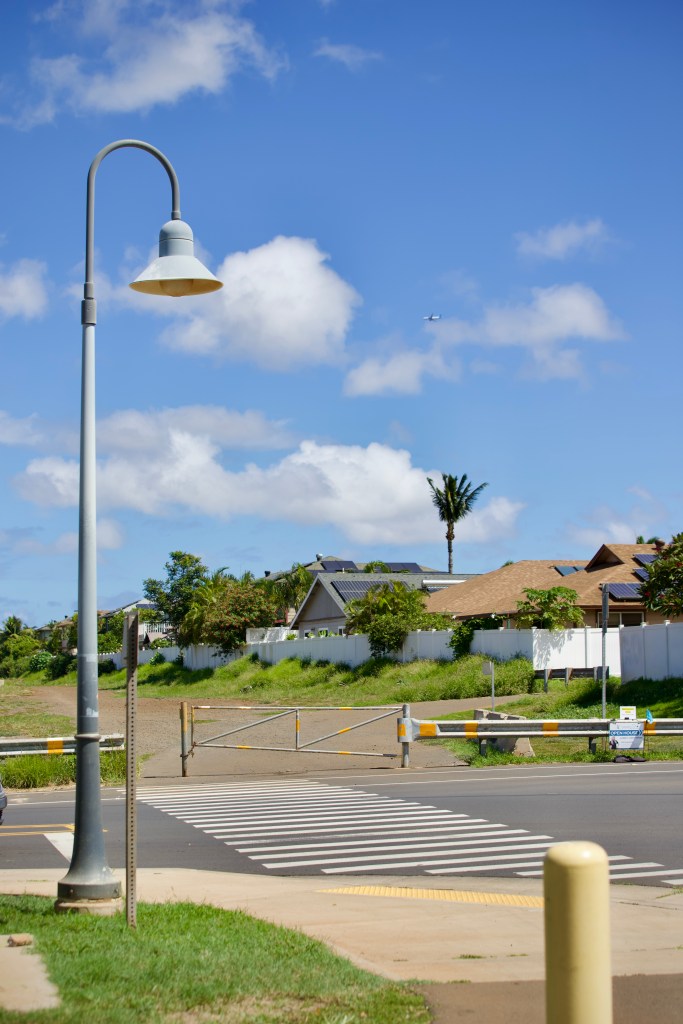
The road leading to the site offered a glimpse of what is envisioned for the future — streetlights, plumeria trees and pathways for pedestrians and cyclists. The passageway ends abruptly at a metal gate, on the other side of which is a dusty, uneven trail.
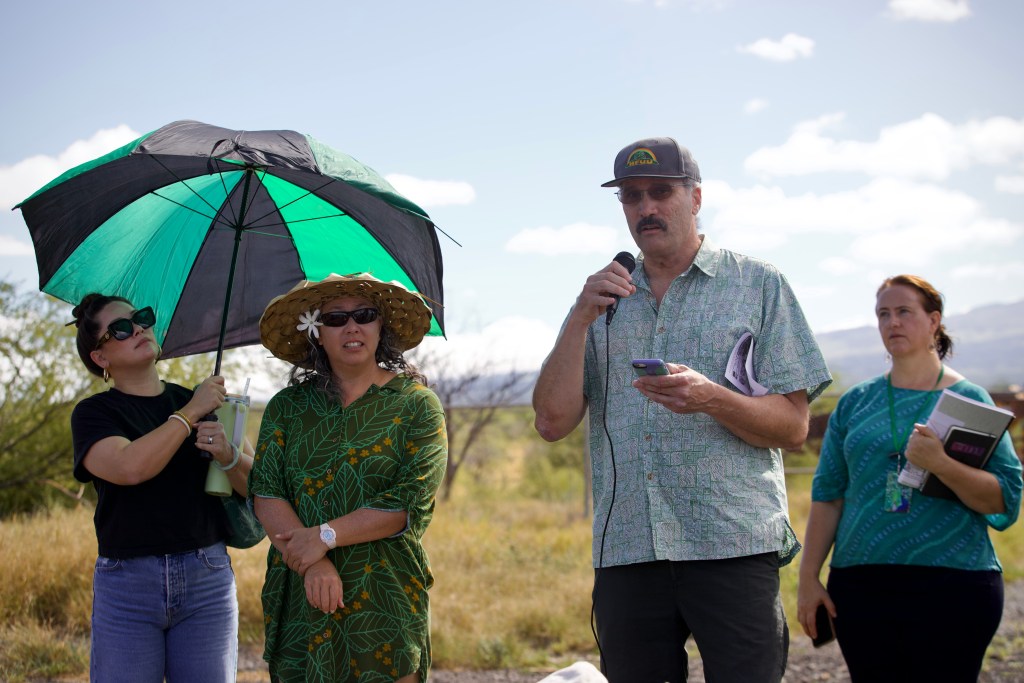
“As a layman, I have looked at this for years and years and said, ‘It’s all flat and open. How difficult is it to extend this over there?’” Moran told council members. “I just hope you can get this part going and then what? In my lifetime it would allow some escape routes, but it would reduce the traffic volume that we have.”
Not everyone who has testified in recent weeks has been in favor of increased restrictions on new growth. Representatives of various development projects argued that while the community plan could encourage developers to build more affordable housing and take certain measures to reduce the threat of flooding or wildfire, mandating such actions could entangle the county in legal battles on projects that have already been approved or proposed.
Keola R. Whittaker, a lawyer who represents developers overseeing the Honuaʻula project and others in Wailea, said in written testimony that including strict requirements for developers, such as dictating where and how many affordable units a developer must build, could end up having the opposite of the intended effect.
“Community plan requirements aimed at those projects are largely unenforceable and mostly add friction. And the more restrictive the terms, the fewer units get built.”
Similarly, Erin Mukai, a representative of a company planning a development in Kīhei, argued that language in the current draft that prohibits construction in or near gulches or drainageways is too restrictive and may prevent builders from pursuing the ideal flood mitigation measures for a specific site.
A Lengthy Process
Council review is one of the final steps in the update process, which already included approval by the Maui Planning Commission. Before forwarding the plan to the council, planning commissioners reviewed recommendations from a resident-led advisory committee, which wanted changes aimed at promoting responsible growth, planning for natural disasters and prioritizing affordable housing.
However, since the 13-member advisory committee shared its recommendations in November 2023, the Maui County Planning Department also suggested several critical amendments to the 171-page plan, such as softening language that would require developers to include workforce housing and infrastructure improvements in future projects. Planning commissioners are now facing criticism for accepting many of those changes over the recommendations of the citizen advisory committee.
“The group as a whole kept saying over and over again, ‘you need to have strong language because suggestions don’t work,’” said Moran, who was on the committee. “You don’t have laws that say, ‘You might consider not robbing a bank.’”
Moran said he was disappointed with how the commission handled the recommendations.
“We live in this community,” Moran said the advisory group kept telling the planning department. “This is what we want.”
Once the committee completes its intensive line-by-line review, it must submit any changes to the Planning Commission for another review before the committee can vote to send it to the full council for final approval.