10 Races To Watch In Hawaiʻi’s Nov. 3 Election
Contests could upset the status quo in Maui, Kauaʻi and Hawaiʻi island. Constitutional amendments and charter changes are also on the ballot.
On the surface, the 2026 election in Hawaiʻi would seem to be a snoozer: Little competition in statewide contests and most legislative races. But on Tuesday night, there will be good reason to track the returns in several Hawaiʻi races, including these 10.
1. Maui Mayor
Incumbent Richard Bissen is in a tight race with council member Yuki Lei Sugimura to retain his seat as Maui mayor, amid explosive allegations. Three weeks ago, Maui Police Chief John Pelletier claimed the mayor was the subject of two criminal investigations. Bissen has denied that, claiming that Pelletier’s accusations are politically motivated and designed to influence the election outcome.
Sugimura has raised and spent more campaign money than Bissen, and has also benefited from $1.7 million in support from the super PAC affiliated with Pacific Resource Partnership. Why the carpenters are backing Sugimura over Bissen isn’t entirely clear, but she is seen as more pro-development than the incumbent mayor – the public face of West Maui’s uneven track record in recovering and rebuilding after the 2023 fires.
2. ConAm No. 2

Speaking of the carpenters, they and their allies have put big money into a campaign to pass statewide ballot Question No. 2, a constitutional amendment aimed at infrastructure to support new housing development. If voters approve it, the measure would allow counties to set up special tax districts and then sell bonds to be repaid with revenue generated from projects within that tax district.
There are some detractors, but no organized opposition. Even so, the measure could be a test of the carpenter’s clout, since some voters may be exhausted by all the pro-2 mailers they’ve received. And there’s always the issue of voters ignoring that part of the ballot. When a voter doesn’t mark “yes” or “no” on a state constitutional amendment, it counts as a “no” vote. That is not the case for county amendments.
3. House District 14
In West Maui, Pāʻele Kiakona, a leader of Lahaina Strong, is vying to become the first Green Party candidate to be elected to the Legislature. It’s a three-way race, with Kiakona facing Democrat Sne Patel and Republican Rep. Elle Cochran, who won the seat twice as a Democrat before switching to the GOP. Kiakona rose to prominence after Lahaina Strong successfully pushed for legislation regulating short-term rentals, a major issue on Maui following the 2023 fires that displaced 12,000 residents.
He has support from major unions, as columnist Beth Fukumoto detailed on Friday, but the vote-splitting in District 14 is hard to predict, given Cochran’s name recognition, the electorate’s traditional support for Democrats and the state’s biggest public worker union backing Kiakona.

Hawaiʻi’s 2026 elections are right around the corner and Civil Beat’s elections guide is here to help with essential information, candidate positions, news stories and more.
4. Council Shifts
The county council elections on Kauaʻi, Maui and Hawai‘i island all have the potential to bring big changes to leadership and controlling factions. With an exceptionally high number of members either terming out or seeking higher office, voters could tilt these bodies toward more progressive or more conservative approaches to policymaking, tax rates and the overall spending plans. All the seats are up every two years.

5. Kauaʻi Mayor
On Kauaʻi, County Council member Bernard Carvalho Jr. is a known quantity, having previously served as mayor for a decade. But in this year’s mayoral race to succeed Derek Kawakami, Carvalho faces a major challenge from his friend, County Council Chair Mel Rapozo, who is running for the office a third time.
In a crowded primary, Rapozo won 40.6%, compared to 30.6% for Carvalho. Rapozo has also outraised and outspent Carvalho during this election season, including the most recent period for reporting campaign funds. The two candidates have similar stances on major issues, but different operating styles.
6. OHA Board
Facing internal divisions and major development decisions on the horizon, the Office of Hawaiian Affairs Board of Trustees is at a pivotal moment. Of the five seats in play, the race for the Oʻahu seat is arguably the most competitive race this year for the OHA board. Here, incumbent trustee Kalei Akaka, granddaughter of a late U.S. senator, is vying to hold her seat against Hinaleimoana Wong, a prominent cultural adviser known as Kumu Hina.
Whoever wins will play a key role in Oʻahu development decisions, including the downsizing of U.S. Army training grounds and projects in Kakaʻako. The victor may also have to help mend fences on the board amid divisions over selecting a new CEO. Both candidates are trying to woo potential voters across the islands. That’s because each of the OHA trustees are elected statewide, even though they represent specific geographical areas in Hawaiʻi.
7. Tokuda-Awa
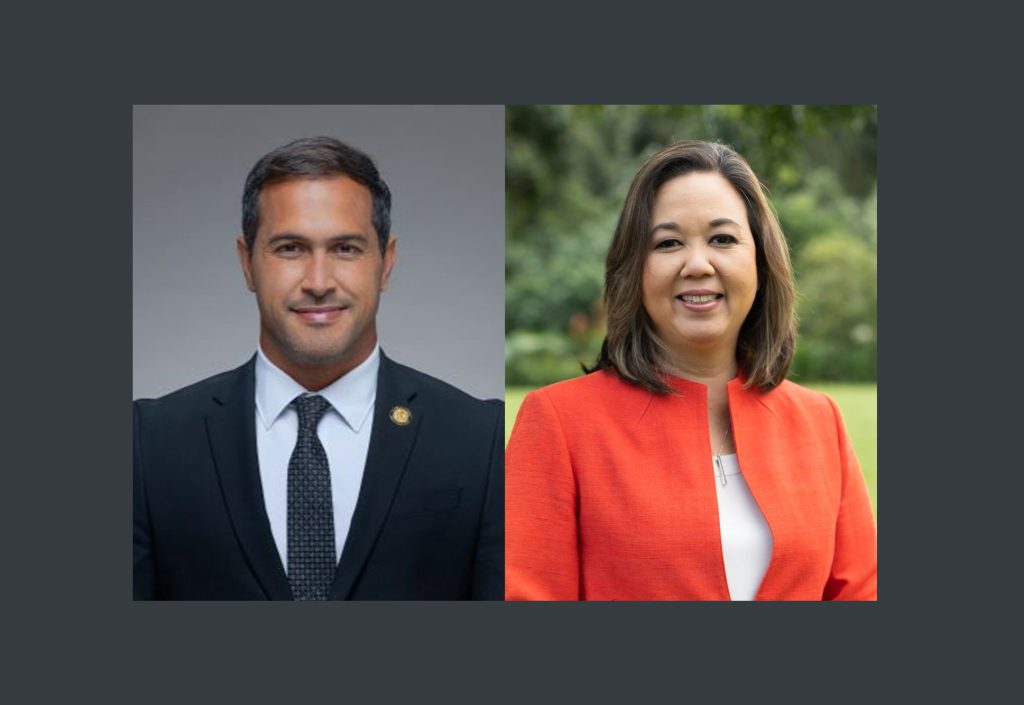
No Republican has ever represented Hawaiʻi’s 2nd Congressional District. That would suggest that Republican state Sen. Brenton Awa stands zero chance of defeating incumbent Jill Tokuda, a Democrat seeking her third term for the seat.
While the odds are against Awa, the vote split in this contest will be worth watching. Awa, a former TV news anchor, has campaigned on his Native Hawaiian heritage and his independent streak as a politician, and he has a formidable social media presence.
Even if he’s not favored to win, a strong showing could help grease his glide path to some other office, possibly as an independent.
8. House District 32

The rivalry between Micah Aiu and Garner Shimizu for this House seat could hinge on gift giveaways and how voters react to such efforts to court them. Three weeks ago, Aiu – who previously held the District 32 seat – held a campaign rally with an unusual promotion: A chance for attendees to win either a free 55-inch Samsung television or roundtrip airfare to Las Vegas.
Shimizu, the Republican incumbent, accused Aiu of ethical lapses. That prompted some to question a Shimizu campaign mailer that offered folks an ‘Ohana Card, granting them, among other things, a $16 admission to the Ice Palace in ʻAiea.
Will this tit-for-tat matter to District 32 voters in Fort Shafter, Moanalua, Āliamanu, Foster Village and portions of ‘Aiea and Hālawa come Tuesday? Maybe not, but the outcome of this House race and other close ones involving Republicans should be watched. If Republicans can secure just one additional House seat, the House rules will allow them to force roll call votes on the House floor, giving the GOP a bit more clout.
9. Food Security
Question No. 1 on Oʻahu ballots asks if the city should start a fund to help hungry residents obtain more locally produced foods. The proposal – which originated from the Hawaiʻi Foodbank – would use a slice of existing property tax revenues to direct $8 million a year to a food security fund.
The fund would support various local programs that get food to people in need, would focus on sourcing food from local producers, and is also intended to provide a bulwark in case of emergencies.
Supporters say it would relieve hunger and “very low food security,” in which people skip meals because they are unable to afford them. About 165,000 of Oʻahu’s 1 million people fall into this category, according to the food bank’s 2024-25 report.
Currently, about $24 million of Honolulu’s annual property tax revenue, or 1.5%, goes to three special funds – one for affordable housing, a clean water and natural lands fund and a climate resiliency fund voters approved in 2024. While some members of the Honolulu Charter Commission voiced concern about creating another city fund – noting it reduces the city’s budgeting flexibility – the commission ultimately agreed to let voters decide the issue.
10. Ranked Choice Voting
Question No. 5 on Oʻahu ballots asks if the city should switch to a ranked choice voting system for mayor, City Council and prosecuting attorney.
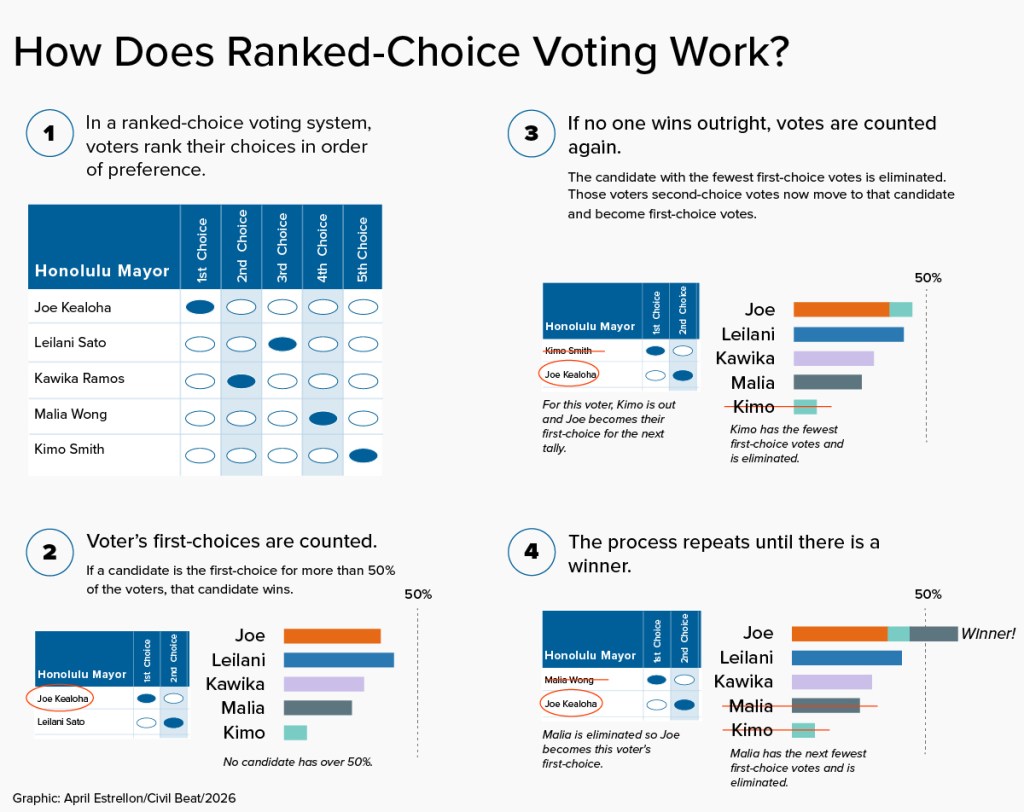
In a nutshell, RCV allows voters to rank candidates in order of preference: first, second, third and so on. If a voter’s first choice doesn’t prevail, their ballot counts for their next choice. Incumbents hate RCV, because it introduces more uncertainty into outcomes. But it also is a fast-growing election reform nationwide and Oʻahu voters may want to get in on the action.
There’s a catch, though. If voters approve No. 5, it would only go into effect if the Legislature approves it. Lawmakers may not like letting Oʻahu be the test case for this reform, possibly building support for spreading RCV to statewide races, similar to Alaska and Maine.
Ben Angarone, Chad Blair, Nathan Eagle, Patti Epler, Nick Grube, Jeremy Hay, Stuart Leavenworth, Blaze Lovell, Erin Nolan and Noelle Fujii-Oride contributed to this report.